Anti-Hindu hate speech: Bangladeshi Islamic preacher invokes Muslim mobilisation against India and Hindus
 Bangladesh
  9 May, 2026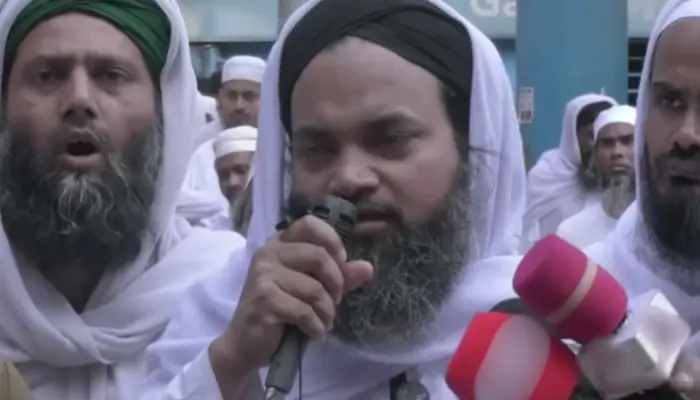
Case Summary
In Bangladesh, a video was circulated on social media in which inflammatory and threatening remarks against India and Hindus were issued by an Islamic preacher, including calls for an attack on India with the support of Pakistan and Muslims. The preacher, identified as the leader of the radical outfit ‘Insaf Kayemkari Chhatra Sramik Janata’, delivered a speech in which he openly invoked religious hostility and threatened large-scale violence against Hindus in India. In the video, he can be seen calling for an attack on India with the help of Pakistan and Indian Muslims. “India will be attacked, Inshallah. We will call upon Pakistan. It will not even take 3 hours for us to capture India. These 26 provinces of India will be crushed, Insha-Allah. And the Muslims of India are enough,” the preacher threatened. Referring to the Muslim population in India, he stated that “40 crore Muslims” were sufficient to overpower Hindus and warned that if Muslims became angry, Hindus in India would not be able to survive. The preacher specifically named political leaders, including Prime Minister Narendra Modi, Defence Minister Rajnath Singh, Assam Chief Minister Himanta Biswa Sarma, Uttar Pradesh Chief Minister Yogi Adityanath and West Bengal BJP leader Suvendu Adhikari, stating that they would be forced to apologise to Muslims. He also accused India of committing injustice and human rights violations against Muslims and demanded that Indian leaders seek forgiveness from the Muslim community and show them respect. The speech amounted to open hate-filled rhetoric directed against Hindus and India, invoking religious identity to threaten violence and intimidate the Hindu community.
Why it is Hate Crime ?
This case is added to the tracker under the primary category selected in this case is: Hate Speech against Hindus. Within this, the sub-category selected is: Violent Threats. Violent threats, explicit, implicit or implied, is the most dangerous form of hate speech since it goes beyond discriminatory and prejudicial language to express the intent of causing harm to an individual or a group of people based on their religious identity and faith. There could be several different kinds of threats that are issued to Hindus based on religious animosity. An explicit threat would mean the direct threat of violence towards an individual Hindu, a group of Hindus or Hindus at large. Physical violence, death threats, threats of destruction of property belonging to Hindus and threats of genocide would mean explicit threats against Hindus for their religious identity. Implicit threats may not be a direct threat but implied through the use of symbols of actions – for example – in the Nupur Sharma case, other than explicit threats, there were also implicit threats when Islamists took to the streets to burn and beat her effigies. It implies that they want to do the same to Nupur Sharma – thereby is considered an implicit threat. Violent threats can be delivered in person, through letters, phone calls, graffiti, or increasingly through social media and other online platforms. It would be important to understand that a threat – explicit or implicit, online or offline – to an individual who happens to be a Hindu does not qualify as a religiously motivated threat. Such a threat, while vile and dangerous, could be owing to non-religious reasons and/or personal animosity. To qualify as a religiously motivated threat, it would need to exhibit an indication that the individual is being targeted for religious reasons and/or owing to his/her religious identity as a Hindu. This case has been added to the tracker because the speech delivered by the Bangladeshi Islamic preacher contained explicit anti-Hindu rhetoric, communal incitement, and violent threats directed against Hindus and India. The statements went far beyond ordinary political criticism or commentary on India’s policies and instead invoked religious identity and collective Muslim mobilisation to threaten violence against the Hindu community and the Indian state. During the speech, the preacher openly called for an attack on India with the support of Pakistan and Indian Muslims, declared that India could be captured within “three hours”, and warned that if “40 crore Muslims” in India became angry, Hindus would not be able to survive. These remarks amounted to direct intimidation of Hindus through the invocation of religious identity, demographic strength, and the prospect of collective violence. It is pertinent to note that Muslim extremists harbour specific animosity towards Hindus and their faith and also view India as a Hindu collectivity. The very basis of the partition of India and the creation of Pakistan (including modern-day Bangladesh) was that the Muslims believed that Islam was a nation unto itself, which could not survive with a Hindu collectivity like India. Consequently, when Islamist figures invoke pan-Islamic solidarity and call for collective Muslim mobilisation against India, such rhetoric transcends political disagreement and enters the realm of communal hostility directed towards Hindus and India’s Hindu-majority identity. In this context, the preacher’s statements reflected more than hostility towards the Indian government; they framed Hindus and India itself as adversaries against whom Muslims should unite. The communal nature of the speech became particularly evident when the preacher framed the conflict in explicitly religious terms and portrayed Muslims standing in opposition to Hindus and India. Rather than criticising specific governmental actions alone, the remarks repeatedly invoked Muslims as a collective force that would overpower Hindus and challenge the territorial integrity of India. The repeated references to the numerical strength of Muslims carried an implicit message of religious intimidation directed towards Hindus, presenting demographic power as a weapon to instil fear and assert dominance over a Hindu-majority nation. By warning that Hindus would not survive if Muslims became “angry”, the preacher issued a communal threat rooted in religious hostility and the prospect of violence. The preacher also invoked cross-border Islamic solidarity by declaring that Pakistan would be called upon to assist in attacking India while simultaneously asserting that Indian Muslims themselves were sufficient to overpower Hindus. This invocation of transnational Muslim unity transformed the speech into a broader ideological call for religious mobilisation against India. The remarks reinforced the notion that religious identity should supersede national boundaries and that Muslims across nations should unite against India because of its Hindu-majority character. Such rhetoric intensified the communal nature of the speech and promoted hostility between religious communities. Furthermore, the preacher specifically named Indian political leaders, including Prime Minister Narendra Modi, Defence Minister Rajnath Singh, Assam Chief Minister Himanta Biswa Sarma, Uttar Pradesh Chief Minister Yogi Adityanath and BJP leader Suvendu Adhikari, stating that they would have to apologise to Muslims. While political criticism in itself does not constitute hate speech, the broader context of the speech demonstrated that these remarks were embedded within a communal framework where India and its leadership were portrayed as enemies of Muslims and where Hindus were threatened collectively through references to Muslim mobilisation and violence. The speech, therefore, fused political hostility with religious antagonism. The repeated invocation of Muslim unity, demographic strength, and violent confrontation against Hindus and India demonstrated clear elements of communal incitement and anti-Hindu hostility. By portraying Hindus as a vulnerable community that could be crushed through collective Muslim action and by advocating aggression against India with the assistance of Pakistan, the preacher promoted religiously charged hatred and intimidation. The remarks were not isolated political statements but reflected a broader ideological hostility towards Hindus, Hindu identity, and India’s Hindu-majority civilisational character. Therefore, this case qualifies for inclusion in the Hinduphobia Tracker under the category of hate speech and violent threats targeting Hindus and India. The speech constituted an instance where religious identity was weaponised to threaten violence, intimidate the Hindu community, and encourage communal hostility against India and its Hindu-majority population. Disclaimer: The Hinduphobia Tracker records incidents based on when an event occurred or when the victim's ordeal began. It is important to clarify that none of the media sources covering this case has specified the exact date when the Islamic preacher made those statements. Therefore, for documentation purposes, we have recorded the date based on when the incident was reported in the media, 10 May 2026.


Case Status
Unknown


Perpetrators Details
Perpetrators
Muslim Extremists
Perpetrators Range
One Person
Perpetrators Gender
male
 Sources




