Idol of revered Hindu goddess desecrated by miscreant in Ashoknagar, Madhya Pradesh
 Ashoknagar, Madhya Pradesh, India
  7 May, 2026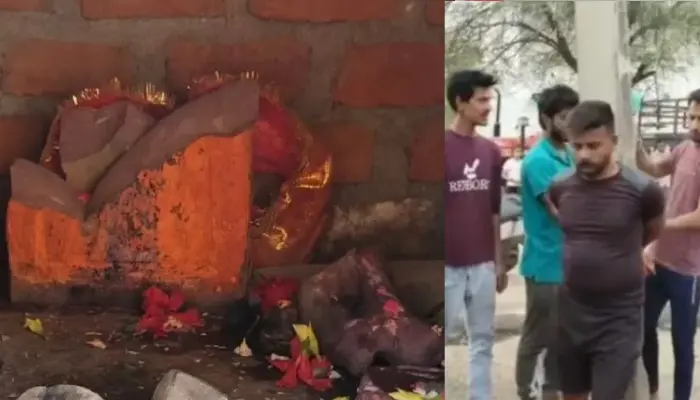
Case Summary
A Mahakali idol in Ghat Bamuria village in Bahadurpur tehsil of Ashoknagar, Madhya Pradesh, was desecrated by a miscreant named Bhimraj Ahirwar, son of Mansingh Ahirwar. The villagers apprehended the accused, tied him to a pole and handed him over to the police. This incident occurred on 8 May 2026. According to reports, the accused broke the idol of Mata Mahakali installed in the Mahamayi temple premises in the village by striking it with a stone and fled from the spot. According to the information received, the idol had been placed at a temporary location outside the temple because the goddess’s temple was under construction. The damaged idol was first noticed by an operator who was digging a pit with a JCB machine for the construction of the temple nearby. The operator informed the villagers about this, after which there was widespread anger among them. Upon learning of the incident, a large number of villagers gathered at the temple premises. Some villagers began searching for the accused youth. A short while later, the villagers caught the youth fleeing the village on the national highway. They brought him back to the village and tied him to an electric pole. The villagers demanded strict action against the culprit. Upon receiving information about the incident, the police arrived at the scene and brought the situation under control. Bahadurpur Police Station in-charge Neelam Yadav stated that a case had been registered against the accused Bhimraj under Sections 298, 302, and 351(3) of the Indian Penal Code and that he had been arrested. The police were investigating the matter. Given the tense atmosphere in the village following the incident, the police administration appealed to the public to maintain peace and restraint. Villagers said that the Mahamayi Temple was a major centre of faith in the village, where Hindu devotees visited daily for worship. The damage to the idol at such a sacred site deeply hurt people’s religious sentiments. Villagers demanded that the administration take concrete steps to ensure the safety of religious sites and prevent such incidents from recurring in the future.
Why it is Hate Crime ?
The primary category selected in this case is: Attack on Hindu religious representation. The subcategory selected is- Desecration of Hindu religious symbols. Icons and symbols or a religious representation of a spiritual ideal are widely revered in Hinduism. Iconography is of vital significance in the Hindu milieu. It helps connect people’s spiritual beliefs with the real world. Iconography within the Hindu faith takes several shapes and forms. Murtis are of most significance to Hindus, to which daily rituals, prayers and offerings are done. Besides the murtis, there are several other symbols which have deep significance in the Hindu faith – the Om and Swastika for example. Since these Hindu religious symbols hold paramount importance in Hinduism, any desecration of symbols, icons, murtis, religious representations and manifestations, is driven by animosity towards the faith itself which manifests itself through these murtis, icons and symbols. Therefore, any desecration of these Hindu religious symbols and representations is considered religiously motivated hate crimes under this category. This incident starkly exemplifies a religiously motivated hate crime, as the perpetrator deliberately desecrated the sacred idol of Goddess Mahakali, temporarily placed outside the temple during renovations. Such an act transcends mere vandalism; it constitutes a targeted assault on Hindu religious symbols, driven by animus against the faith. By desecrating a revered deity's idol, left vulnerable in plain sight, the offender inflicted profound spiritual injury on the Hindu community, signalling contempt for Hindu beliefs and practices. This calculated violation meets every criterion of a hate crime: bias motivation, selection of a religious victim, and intent to intimidate an entire community. Hindu temple idols hold immense spiritual significance, serving as more than mere statues; they are divine embodiments, or murti, consecrated through elaborate rituals like prana pratishtha, where the deity's life force is invoked. Devotees revere them as living presences of the divine, central to worship, festivals, and daily rituals that foster communal harmony and personal devotion. These idols symbolise the eternal dharma, linking generations to ancient traditions. Goddess Mahakali embodies fierce protection, time, and destruction of evil, revered as the ultimate mother-warrior in Hinduism. Depicted with multiple arms, wielding weapons, her form symbolises the triumph of righteousness over chaos. As a manifestation of the Divine Mother, she inspires awe and devotion, with temples hosting vibrant festivals like Kali Puja, where millions seek her blessings for courage and liberation. Targeting her idol strikes at the heart of Hindu feminine divine power, amplifying the hate crime's malice by undermining a symbol of empowerment central to millions of devotees' faith. Desecrating the idol of Goddess Mahakali constitutes blatant desecration of a core Hindu religious symbol, shattering its sanctity and mocking devotees' deepest convictions. This outrage wounds Hindu religious sentiments profoundly, evoking visceral grief and rage, as the murti, once pulsating with divine energy, lies profaned. It ignites communal tensions by portraying Hindus as vulnerable to repeated assaults, fostering division and mistrust. The psychological toll is immense, scarring the Hindu community's psyche with helplessness and betrayal. When Hindu idols and sacred symbols face such desecration, it instils pervasive fear and insecurity among Hindus, who perceive their temples and deities as perpetually at risk of violation anytime, anywhere. It unequivocally qualifies as a religiously motivated hate crime, as the intent to terrorise transcends property damage, mirroring hate crime patterns. The perpetrator's timing reveals premeditated malice: he struck precisely when the temple was under renovation, rendering the Mahakali idol unusually exposed and vulnerable outside its sanctum. This was no opportunistic act but a meticulously chosen moment, the idol unattended amidst construction, exposing the offender's well-calculated intent to maximise humiliation and harm. Such strategic precision cements this as a textbook hate crime. Given that this case meets the parameters of an anti-Hindu hate crime, it is added to the hate crime database of the tracker.


Case Status
Arrested


Perpetrators Details
Perpetrators
Others
Perpetrators Range
One Person
Perpetrators Gender
male
 Sources




