Tribal Hindu woman deceived into marriage, subjected to physical assault and coerced to consume beef and religious conversion by Muslim man posing as Hindu
 Garhwa, Jharkhand, India
  9 November, 2025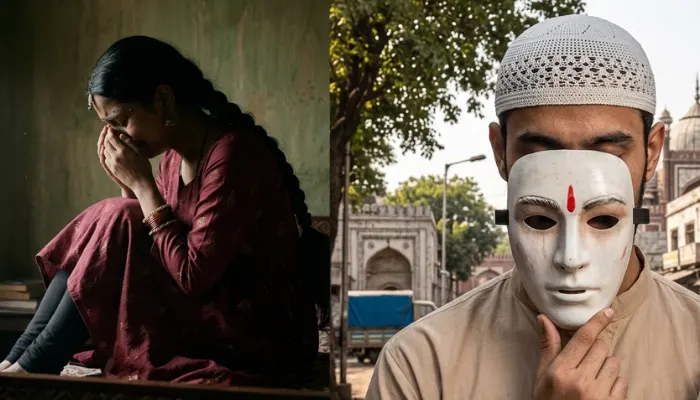
Case Summary
In Garhwa district, Jharkhand, a Hindu woman was deceived into a relationship and marriage, physically assaulted, forced to consume beef and pressured to change her religion by a Muslim man posing as a Hindu. The incident came to light when a Hindu woman, Kanti Uraon, submitted a written complaint at the Nagar Untari Women’s Police Station of Ranchi district against a Muslim man for concealing his religious identity. The accused was identified as Inayat Ansari, a resident of Kushdand village under the Nagar Untari police station area. The victim seeking justice. According to the victim’s written complaint, she had travelled to Hyderabad around six months ago in search of employment, where she came into contact with Inayat Ansari. The victim stated that the accused introduced himself as “Sonu Kumar” and presented himself as a Hindu man. She stated that he drew her into a romantic relationship under this false identity and established physical relations with her. Later, when she pressured him for marriage, the two underwent a court marriage. The victim further stated that when she reached the accused’s home, she discovered that his real name was not Sonu Kumar but Inayat Ansari. She also learned in January 2026 that he was already married and the father of two children, facts she stated had been concealed from her earlier. The victim stated that after she questioned him, she was subjected to physical assault and mental harassment. She further stated that pressure was exerted upon her to change her religion and alter her food habits, and that attempts were made to force her to consume beef. Kanti Uraon further accused the accused’s family members, including his father Zaheeruddin Ansari and mother Mairun Bibi, along with other relatives, of assaulting and harassing her. She stated that Inayat Ansari had refused to pay her maintenance expenses, after which she again approached the women’s police station to seek legal action. According to police officials, the matter had previously reached the women’s police station, where both parties had been called and counselled before being sent back after a mutual settlement. However, the victim later returned claiming that the harassment had continued. Nagar Untari Women’s Police Station in-charge Rukmini Kumari stated that the complaint had been received and that the matter was being investigated seriously. Sub-Divisional Police Officer Satyendra Narayan Singh stated that an inquiry was underway.
Why it is Hate Crime ?
The primary category selected in this case is- Crimes against women in relationships and other sexual crimes. The subcategory selected is "Man pretends to be Hindu". The tertiary category selected is- Name Changed. When a non-Hindu man pretends to be a Hindu to deceive a Hindu woman into a relationship, the act is seen as triggered by malicious intentions. In some cases, the woman eventually accepts the man’s original religious identity and converts after the man’s identity is revealed. These cases could be argued as cases of religious brainwashing and a result of the pressure a woman feels after getting into a relationship with a man. The woman, it can be argued, also changed her religious identity because of the stigma she believes she might face if she chooses to walk out of a deceptive relationship. However, for the purpose of documenting hate crimes, the cases in this subcategory are limited to those where there is explicit violence aimed at religious conversion against the wishes of the victim (force-feeding beef, blackmailing with intimate videos, rape on refusal to convert, etc), or if the woman herself complains of the man’s religious deception. In such cases, it is established that the deception of the non-Hindu man had a specific aim of religious conversion or targeting of the victim due to her Hindu religious identity, therefore, making it a religiously motivated hate crime. The other sub-category for this case is "Forced conversion after marriage". The tertiary categories here are "Forced to eat beef" and "Forced to wear hijab". In such cases, a non-Hindu man marries a Hindu woman, and the force/pressure to convert to any Abrahamic faith, like Islam, begins after marriage. In such cases, typically, two patterns emerge. First, when the relationship is consensual, and the religious identity of the perpetrator is known to the Hindu woman in the relationship. The marriage could be under the Special Marriages Act, where neither party is required to convert their religion for the marriage to be considered legitimate. While the victim in such cases enters matrimony assuming that religious identity is not a barrier, the non-Hindu man starts to pressure the woman to convert to his religion after marriage. The second is when the woman gets into a marriage with the man, pretending to share her faith. Later, when the truth is revealed, the man starts pressuring the woman to convert to his religion and give up her religious identity. In both situations, there is the application of force by the perpetrator, including the denial of the woman’s religious rights. Some of the means by which the woman is forced/pressured to convert include force-feeding beef, being forced to read the Kalma, being forced to wear a hijab, being forced to undergo Halala, etc. There are several instances where, after marriage, the woman voluntarily converts to Islam. Such cases are often argued to be a result of religious brainwashing; however, for the purpose of documenting religiously motivated hate crimes, in the absence of the victim complaining of forced conversion, such cases do not form a part of the database. Another sub-category for this case is "Assault or threat upon refusal to convert". When Hindu women are in a relationship with non-Hindu men, there are cases where the woman faces threats or assault after she refuses to convert and change her religious identity owing to pressure/force by the non-Hindu man. Such relationships may be consensual with the religious identity of the non-Hindu man known to the victim. Somewhere along the relationship, the non-Hindu man starts pressurising the Hindu woman to convert to Islam and upon her refusal, assaults or threatens the victim. Such cases are driven by specific religious motivations and against the religious identity of the victim and are therefore qualified as hate crimes. Cases where the Hindu woman converts to Islam and does not file a complaint about the force or threat are not considered a part of the hate tracker, even though it may be argued that the woman was brainwashed or threatened to convert to Islam. This case qualified as a religiously motivated hate crime because a tribal Hindu woman was deceived into a relationship and marriage by a Muslim man who concealed his religious identity and presented himself as a Hindu. The concealment of identity was not incidental but formed the basis on which the relationship was initiated and sustained. The deliberate use of a false Hindu identity showed a calculated intent to emotionally manipulate a Hindu woman by exploiting the trust and social comfort associated with shared religion. Such deception specifically targeted the victim because of her Hindu identity and therefore carried a clear religious dimension. By hiding his real identity and presenting himself as a Hindu man, he ensured that the victim entered the relationship under false religious assumptions. This was significant because religion often plays a central role in personal relationships, marriage decisions, and familial trust in Indian society. The deception was therefore not merely personal dishonesty but a targeted misuse of Hindu identity as a tool to gain emotional and physical access to the victim. Such acts reflected disregard for the victim’s religious beliefs and demonstrated manipulation rooted in religious identity. The second religious marker emerged through the pressure exerted upon the Hindu woman after marriage to abandon aspects of her Hindu faith and cultural practices. Attempts to force a Hindu woman to consume beef carried deep religious significance because the cow holds a sacred status in Hinduism. Such acts directly attacked her religious beliefs and personal dignity. Similarly, pressuring the victim to change her religion represented an attempt to erase her existing religious identity and replace it through coercion. These actions went beyond ordinary domestic abuse because the pressure specifically targeted practices and beliefs central to the victim’s Hindu faith. Another significant religious marker was the use of assault and intimidation after resistance to religious pressure emerged. Violence in such cases functions not only as physical abuse but also as a mechanism of religious domination designed to suppress the victim’s ability to retain her faith and identity. The victim faced hostility precisely because she resisted surrendering her religious and cultural practices. This transformed the abuse into a targeted attack on her Hindu identity rather than a simple interpersonal dispute. The concealment of crucial personal facts before marriage further demonstrated a pattern of calculated entrapment. By securing emotional attachment and marital commitment before the truth surfaced, the accused created circumstances where the victim’s social, emotional, and personal vulnerability could later be exploited. The subsequent pressure regarding religion and lifestyle changes, therefore, did not arise within an open and informed interfaith relationship. Instead, it emerged after the victim had already been drawn into the marriage through deception centred around religious identity. The involvement of family members in the harassment reinforced the coercive environment faced by the victim inside the marital household. The pressure was not isolated or momentary but formed part of a broader atmosphere where the Hindu woman’s identity, beliefs, and practices became the focus of sustained hostility. The cumulative effect of deception, coercion, intimidation, and religious pressure established that the victim was targeted specifically as a Hindu woman. This incident reflected a broader pattern where Hindu women were targeted through false religious identities, emotional manipulation, and post-marriage coercion aimed at weakening or erasing their religious identity. The religious concealment at the beginning of the relationship and the later pressure to abandon Hindu practices established a clear nexus between the abuse and the victim’s Hindu faith. Since the religious motive of the crime is evident from these facts, this case has been documented as a hate crime. Disclaimer: Media reported this incident on May 10, 2026. The exact date on which the accused first came into contact with the Hindu victim was not specified in the available sources. However, the report states that the victim came into contact with the perpetrator approximately 6 months before the article was published. Since no exact date was mentioned, only the approximate month and year of the beginning of the victim’s ordeal could be derived. As the Hinduphobia Tracker records incidents based on when the victim’s ordeal began, an indicative incident date was determined by aligning this six-month timeline with the publication date. Accordingly, 10th November 2025 has been selected for documentation purposes.
Victim Details
Total Victim
1
Deceased
0
Gender
- Male 0
- Female 0
- Third Gender 0
- Unknown 1
Caste
- SC/ST 1
- OBC 0
- General 0
- Unknown 0
Age Group
- Minor 0
- Adult 0
- Senior Citizen 0
- Unknown 1


Case Status
Complaint filed


Perpetrators Details
Perpetrators
Muslim Extremists
Perpetrators Range
From 2 To 5
Perpetrators Gender
both
 Sources




