Sacred Hindu temple land illegally encroached by unknown miscreants in Jaisalmer, Rajasthan
 Jaisalmer, Rajasthan, India
  11 May, 2026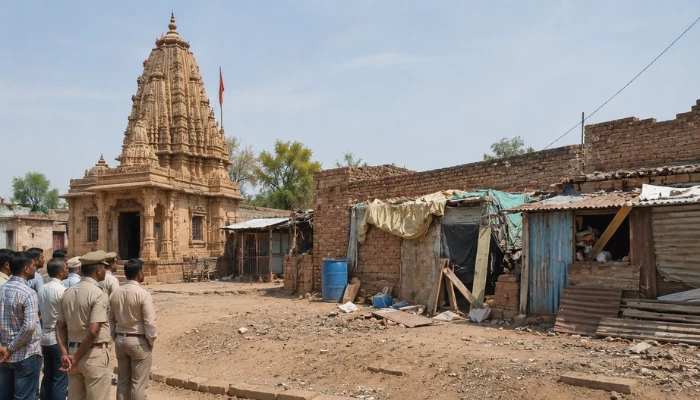
Case Summary
In Jaisalmer district, Rajasthan, the sacred temple land of the Nagababa Temple in Mandawa was forcibly encroached upon by illegal occupants, after which the administration issued a strict ultimatum directing them to vacate the land by 18 May. The miscreants encroached over 20 bighas of land using wire fencing, net barriers and had constructed three rooms with stone slabs. The matter surfaced after the local administration and revenue authorities identified unauthorised occupation of the temple land. Acting on complaints regarding the encroachment, officials reached the site and warned that strict legal action would be taken if the land was not vacated within the given deadline. According to the report, the administration made it clear that no illegal occupation of temple property would be tolerated. Officials stated that action would be taken against all those found to be involved in the encroachment. The administration also directed the concerned individuals to remove their belongings and structures from the temple land before the deadline expired. The case drew attention due to the recurring issue of encroachments on Hindu temple lands in Rajasthan. The administration’s intervention came after continued concerns over the illegal occupation of religious property and demands for the restoration of temple land to its rightful management.
Why it is Hate Crime ?
The primary category selected in this case is- Attack on Hindu religious representations. The subcategory selected is- Encroachment or illicit takeover of temple land/land near temple. In Hinduism, a temple is the abode of the Deity. The Deity in the Temple is consecrated, thereby making it a real, breathing entity. Hindus believe that not just the Deity but the temple premises itself are sacred to Hindus since Hindus hold the faith that the entire Temple space is an amalgamation of the divine energy of the deity. Not only the Temple but the Temple premises in its entirety are considered sacred by Hindus. In several cases, the premises of the Temple and/or religious centre are illicitly taken over by institutions belonging to other faiths, like the Waqf board or the Church. Other times, the temple property, land or the property of religious centres are illicitly encroached upon by non-Hindu groups. Any illicit takeover or encroachment is a crime an initio; however, when non-Hindu groups illicitly take over or encroach on the sacred land of Hindus, it is an affront to the Hindu community and is therefore classified as a religiously motivated hate crime under this category. This incident stands as a clear example of a religiously motivated hate crime, where sacred land belonging to the Nagababa Temple was illegally encroached upon for an extended period. The encroachers knowingly occupied land attached to a Hindu religious site despite being fully aware of its sacred character and importance to the local Hindu community. Such unlawful occupation of temple property demonstrated a complete disregard for Hindu religious sentiments and the sanctity attached to temple land, making this a targeted act against a Hindu place of worship. Temple land is not merely physical property in Hinduism; it forms an essential part of the entire temple ecosystem that sustains worship, rituals, religious gatherings, festivals, and the spiritual life of devotees. Illegal encroachment upon this land directly interfered with the functioning, dignity, and sanctity of the temple premises. By occupying land associated with the temple, the encroachers disrupted the sacred environment surrounding the Mandawa temple and weakened the religious space that devotees relied upon for worship and spiritual connection. Such acts go beyond ordinary land disputes because they damage spaces deeply tied to the Hindu faith and religious continuity. The prolonged encroachment deeply hurt Hindu sentiments, as devotees witnessed sacred temple property being unlawfully occupied while the sanctity of the religious site was undermined. For Hindus, temples are living centres of faith and devotion, and any illegal occupation of temple land creates feelings of anger, insecurity, helplessness, and humiliation within the community. The act sent a wider message that Hindu religious spaces could be encroached upon and misused without regard for their holiness, reinforcing fears of systemic neglect towards the protection of Hindu sacred institutions. Such targeting of temple property constitutes an attack on the broader temple ecosystem that includes the land, structures, rituals, priests, and devotees connected to the sacred site. Hindu temples hold immense civilisational and spiritual value, serving as centres of worship, cultural preservation, and community life for generations. Encroachment upon temple land, therefore, does not remain a mere administrative issue; it becomes an assault on the continuity and dignity of Hindu religious life itself. Since the illicit takeover of a site sacred to Hindus is seen as an affront to the Hindu community, this incident has therefore been classified as a religiously motivated hate crime and added to the hate crime database of the Hinduphobia Tracker. Disclaimer: The Hinduphobia Tracker records incident dates based on when the crime occurs. In this case, the report states that the temple land had been under illegal encroachment for an extended period, but the exact date the encroachment began is not specified. Henceforth, the date when the report was published is used as the indicative incident date for documentation purposes only.


Case Status
Complaint filed


Perpetrators Details
Perpetrators
Unknown
Perpetrators Range
Unknown
Perpetrators Gender
unknown
 Sources




