Hindu temple vandalised, sacred idols and ornaments looted by unidentified miscreants in Shillong, Meghalaya
 Shillong, Meghalaya, India
  9 May, 2026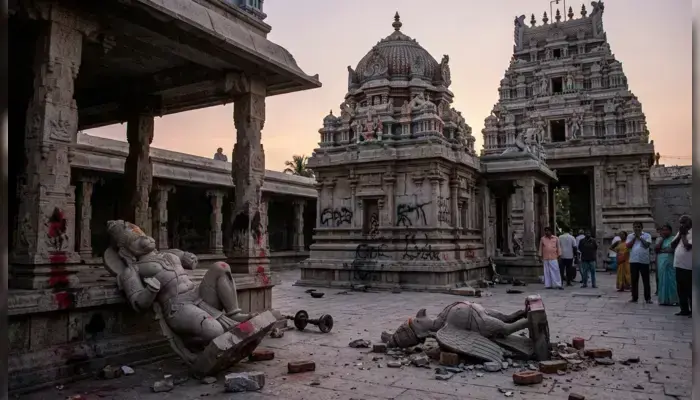
Case Summary
A Hanuman temple in the Garikhana area of Shillong, Meghalaya, was targeted by miscreants. The accused desecrated the temple premises and looted idols, silver ornaments, and cash after disabling the closed‑circuit television (CCTV) cameras. This occurred on 10 May 2026 at around 1:00 a.m. under the jurisdiction of Lumdiengjri Police Station. According to the police, the accused entered the temple by breaking open a side entrance before ransacking the premises. Based on a complaint filed by Ravi Sharma, the miscreants had stolen idols of Lord Krishna and Radha, a small idol of Lord Hanuman, silver ornaments, and several brass ritual items, including water pots, lamps, and plates. An undisclosed amount of cash was also taken from the temple’s donation box. The main idol inside the shrine, however, remained untouched. The police said the intruders also set fire to the CCTV cameras installed inside and outside the temple in an attempt to destroy evidence before fleeing the scene. Investigators had, however, obtained footage from surveillance cameras installed in neighbouring houses, which captured the accused while escaping. The footage was handed over to the police as part of the investigation. The incident triggered concern among residents of Garikhana and nearby Jhalupara over security arrangements and night patrolling in the locality. The police registered a case and launched an investigation. Locals expressed fears over the safety of religious places and rising incidents of theft during nighttime hours. At the time of writing this report, no arrests of the perpetrators were made.
Why it is Hate Crime ?
The primary category selected in this case is- Attack on Hindu religious representations. The subcategory selected is- Attack on Temples. In Hinduism, a temple is the abode of the Deity. The Deity in the Temple is consecrated, thereby, making it a real, breathing entity. Hindus believe that not just the Deity but the temple premises itself are sacred to Hindus since Hindus hold the faith that the entire Temple space is an amalgamation of the divine energy of the deity. Given the central significance of Temples in Hindu Dharma, any attack against a Hindu Temple or its peripheral premises is an attack on the faith itself and is born out of animosity towards the faith, of which, the Temple is a central tenet. Any manner of attack against a Temple and/or its premises would therefore be considered a religiously motivated hate crime. The other subcategory selected is- Desecration of Hindu religious symbol. Icons and symbols or a religious representation of a spiritual ideal are widely revered in Hinduism. Iconography is of vital significance in the Hindu milieu. It helps connect people’s spiritual beliefs with the real world. Iconography within the Hindu faith takes several shapes and forms. Murtis are of most significance to Hindus, to which daily rituals, prayers and offerings are done. Besides the murtis, there are several other symbols which have deep significance in the Hindu faith – the Om and Swastika for example. Since these Hindu religious symbols hold paramount importance in Hinduism, any desecration of symbols, icons, murtis, religious representations and manifestations, is driven by animosity towards the faith itself which manifests itself through these murtis, icons and symbols. Therefore, any desecration of these Hindu religious symbols and representations is considered religiously motivated hate crimes under this category. This case is a clear instance of a religiously motivated hate crime because the miscreants targeted a sacred Hindu temple dedicated to Lord Hanuman in Shillong, vandalised its premises and looted temple idols and ornaments. The act was not a random burglary or an attack on any ordinary structure; it was a deliberate assault on a place of worship deeply revered by Hindus. By targeting a Hindu temple, damaging its sanctity and stealing its sacred objects, the perpetrators inflicted harm that goes beyond material loss and strikes directly at religious identity and community sentiments. This pattern of behaviour, selecting a Hindu religious site, desecrating it and then looting its sacred symbols, marks the incident as a hate crime motivated by hostility towards Hinduism. In Hindu tradition, a temple is understood as the abode of the deity, where the divine presence is believed to reside through consecrated rituals and worship. Temples are not merely buildings; they are living institutions held with grave respect, where communities gather for prayer, festivals and rites of passage. For Hindus, the temple is a sacred space that connects the human and the divine, and its premises are treated as spiritually charged and inviolable. To desecrate a temple, break its doors, damage its structures, and sanctity is therefore to attack the very heart of Hindu religious life. Such an act deeply wounds the religious sentiments of Hindus, conveying a message of contempt and exclusion towards their faith and sacred spaces, which is why this incident must be recognised as a religiously motivated hate crime. The religious significance of Hindu idols further intensifies the gravity of this crime. In Hinduism, idols or murtis are not simple decorative pieces; they are ritually consecrated images treated as living embodiments of the deity. Through elaborate rituals, mantras and offerings, the idol is awakened and revered as a vessel through which the divine presence is experienced. The temple ecosystem is carefully arranged around these idols, with specific altars, rituals and daily worship that maintain their sanctity. When idols are installed in a temple, they are not stored as commodities; they are placed in positions of honour and worshipped as central figures of devotion. The perpetrators not only stole the idols, but they also desecrated and vandalised the temple itself. The decision to damage the premises, destroy religious symbols and then remove the consecrated idols suggests that the theft was not driven by mere greed or economic motive. The fact that the temple was targeted for desecration before the idols were taken shows that the act was rooted in religious malice. To forcibly take these idols away from a desecrated temple is to rupture the sacred ecosystem in which they are meant to remain and to treat something regarded as divine as disposable loot. In Hindu belief, removing a consecrated idol from its proper place amounts to a serious religious desecration, because the idol is a sacred symbol of the deity and a focal point of worship. Therefore, the act of removing the idols from the temple premises after desecrating the premises showcases a deep‑seated religious animosity towards the Hindu community. This was not a blind robbery; it was a targeted assault on Hindu religious symbols carried out in a context of deliberate vandalism. The perpetrators did not simply loot a building; they attacked a place of worship and its sacred objects in a way that communicates hostility towards Hinduism itself. Even though the perpetrators in this case have not been identified, the nature of the crime clearly showcases religious animosity. Therefore, this case is being added to the hate crime database of the tracker.


Case Status
Complaint registered


Perpetrators Details
Perpetrators
Unknown
Perpetrators Range
Unknown
Perpetrators Gender
unknown
 Sources




