Hindus attacked with stones for resisting road named after Islamic tyrant Tipu Sultan, demanding Lord Hanuman's name
 Andhra Pradesh, India
  8 May, 2026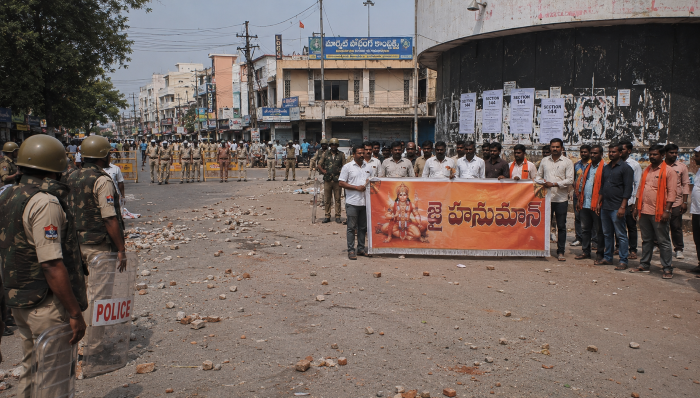
Case Summary
Hindus in Kadapa, Andhra Pradesh, faced stone pelting and violent protests after resisting demands made by the Muslim community that the Almas Pet junction be named after Mughal tyrant Tipu Sultan. The Hindus, instead, demanded that the road be named after Lord Hanuman [one of the most widely venerated deities in Hinduism, revered as the divine embodiment of strength, devotion, and protection]. The Muslim community's insistence on naming a shared civic space after an Islamic tyrant and violent opposition to the Hindu community's assertion of Lord Hanuman's name instead triggered clashes that led to the imposition of Section 144 [a provision under Indian law prohibiting the assembly of four or more persons in a designated area to maintain public order] across the area. The dispute has surfaced intermittently over the past 12 years, establishing a sustained pattern of Muslim opposition to Hindu claims over the junction's name. On May 9, 2026, (Saturday), stone pelting and protests broke out as the Muslim community resisted the Hindu community's demand. Police dispersed the crowds using mild force and other measures. Security was intensified in the area following the clashes to protect the Hindu community and prevent further violence. Kadapa District Collector Sridhar Cherukuri and Superintendent of Police Shelke Nachiket Vishwanath held a joint press conference, describing the clashes as unfortunate and stating that anti-social and malicious elements had attempted to disturb communal harmony in the town. Officials warned against the circulation of false information on social media, stating that false propaganda was creating fear among people. Police registered cases under relevant sections of law in connection with the clashes. Several individuals involved in the violence were identified, and arrests were stated to be imminent. Steps were being taken to foster unity and maintain a peaceful atmosphere in the district.
Why it is Hate Crime ?
The primary category for this case is "Attack not resulting in death". The sub-category for the case is "Communal clash/attack". Communal clash is a form of collective violence that involves clashes between groups belonging to different religious identities. For a communal clash between Hindus and non-Hindus to qualify as a religiously motivated hate crime, the trigger of the violence itself would have to be anti-Hindu in essence. For example, if there is a Hindu religious procession that comes under attack from a non-Hindu mob and after the initial attack, Hindus retaliate in self-defence, leading to a communal clash between the two religious communities. While at a later stage, both communities are involved in the clash/violence, the initial trigger of the violence was by the non-Hindu mob against the Hindus and therefore, it could safely be termed as an anti-Hindu violence. Further, the trigger would also have to be religiously motivated. In the cited example, the attack by the non-Hindu mob was against religious processions and therefore, can be concluded to be religiously motivated. In some cases, the trigger may be non-religious, however, it develops into religious violence against Hindus at a later stage. In such cases too, the foundational animosity towards Hindus becomes the motivating factor of the crime and therefore, it would be classified as a religiously motivated hate crime against Hindus under this category. The violence in this case carries clear religious markers because the conflict was centred around the symbolic control and religious identity of a shared public space. The Hindu community was targeted after asserting that the junction should be named after Lord Hanuman, one of the most revered deities in Hinduism, instead of Tipu Sultan, an Islamic ruler associated in Hindu historical memory with persecution and forced conversions of Hindus. For many Hindus, Tipu Sultan is not remembered as a neutral historical figure but as a ruler linked to anti Hindu persecution, temple destruction, and forced conversions. Several historical accounts record instances of Tipu’s forces carrying out forced conversions, kidnappings, and violence against Hindus during his military campaigns. Many temples are also stated to have been demolished during his reign. Historians such as Khan Hussain Ali Kirmani wrote about Tipu Sultan’s hostility towards local Hindus and tribal communities. Historian Roderick Mackenzie, writing in 1793 about Tipu’s campaign to Trinomaly during his southern expeditions, recorded the brutality unleashed upon Hindu populations in areas through which his forces passed. His account is frequently cited in discussions concerning allegations of temple destruction, forced conversions, and religious persecution associated with Tipu Sultan’s campaigns. Despite this historical background, sections of the Muslim community continued insisting that the junction be named after Tipu Sultan while strongly opposing the Hindu demand to name it after Lord Hanuman. This reflected more than a simple civic disagreement. The glorification of a ruler associated with anti-Hindu violence, while simultaneously resisting the naming of the space after a Hindu deity, pointed towards a deeper pattern of Islamic supremacist assertion in public spaces. Figures such as Tipu Sultan are often defended not merely as historical personalities but as symbols of Islamic political power and domination over non-Muslims. This reflects a Ummah-centred mindset in which loyalty is extended towards Islamic rulers and conquerors, even when those figures are associated with violence against local Hindu communities. The violent opposition to naming the junction after Lord Hanuman further exposed this mentality. The assertion of a Hindu deity’s name in a shared civic space was treated as unacceptable, while the glorification of a controversial Islamic ruler was aggressively defended through stone pelting and mob mobilisation. The fact that this dispute has continued intermittently for more than a decade further demonstrates that this was not an isolated clash but part of a long-standing struggle over religious visibility, symbolic dominance, and control over public identity in the locality. The use of stone pelting and mob aggression against Hindus for asserting the name of a Hindu deity demonstrates an attempt to suppress Hindu religious expression through intimidation and violence. Such acts send the message that Hindus may face collective hostility for publicly asserting their religious identity or challenging symbols associated with Islamic political dominance. Taken together, the violent targeting of Hindus, the opposition to naming the junction after Lord Hanuman, and the insistence on commemorating a ruler associated in Hindu memory with anti Hindu persecution point towards a religiously motivated conflict rooted in communal assertion, Islamic supremacist symbolism, and hostility towards Hindu religious representation in public spaces.


Case Status
Complaint registered


Perpetrators Details
Perpetrators
Muslim Extremists
Perpetrators Range
Unknown
Perpetrators Gender
unknown
 Sources




