Hindu procession attacked and stone-pelted by Muslims while crossing a Muslim-majority area in Hapur, Uttar Pradesh
 Hapur, Uttar Pradesh, India
  8 May, 2026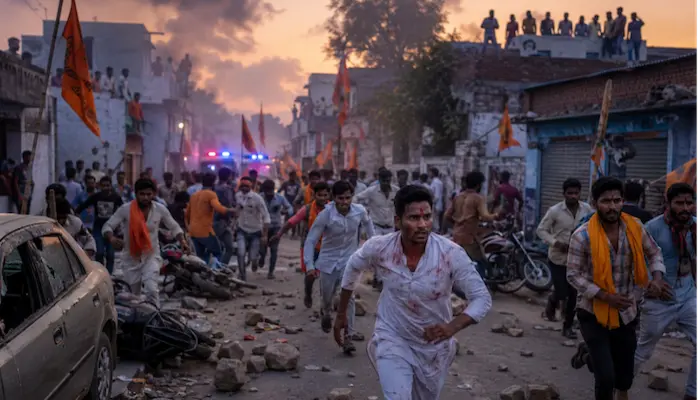
Case Summary
In the Dehra village of Hapur district, Uttar Pradesh, Hindu devotees participating in a Maharana Pratap Jayanti procession were attacked and stone-pelted by members of the Muslim community, as the procession passed through a Muslim-majority locality. Thousands of Hindu devotees had gathered in Dehra village on 9 May 2026 to participate in a grand Maharana Pratap Jayanti procession and bike rally. The procession was organised to commemorate Maharana Pratap, a revered Hindu Rajput king whose legacy holds deep cultural and religious significance for many Hindus. Large numbers of Hindu youths participated in the rally using motorcycles and four-wheelers. A garland laying ceremony was also being conducted near a statue of Maharana Pratap as the procession moved through the locality. As the Hindu procession entered a Muslim-majority area of the village, tensions escalated following an altercation involving local Muslim men and Hindu youths near a roadside shop. Within minutes, stone pelting began in the area. Stones were hurled directly at the Hindu procession by the Muslim community, causing stampede-like conditions among devotees and participants who had gathered for the celebration. Several videos from the scene showed stones being thrown from rooftops and nearby buildings towards the crowd assembled for the procession. The attack created widespread panic among Hindu participants, many of whom began running to protect themselves from the barrage of stones. Several Hindu youths sustained injuries during the violence. Out of the six injured victims, one injured participant was reported to be in critical condition and required hospitalisation. Multiple vehicles participating in the rally suffered damage after their windows were smashed during the stone pelting. Eyewitness accounts from the scene described chaos spreading rapidly through the route of the procession as participants attempted to escape the violence. During the violence, some members of the procession climbed onto rooftops after identifying individuals involved in the stone pelting. Videos circulating from the incident showed clashes taking place on rooftops and inside nearby structures. Reports from the scene also described vandalism in the surrounding locality, with several vehicles being damaged amid the unrest. Fear spread across the area as the violence intensified around the route of the Hindu religious procession. Following the outbreak of violence, police forces from multiple police stations were deployed to the scene. Officers used force to disperse the groups involved and gradually brought the situation under control. Additional police personnel were stationed throughout the locality following the clashes in order to prevent further escalation. Senior police officials later conducted patrols and monitoring operations across the affected area. Police confirmed that multiple people sustained injuries during the clashes, and several damaged vehicles were seized from the scene. Two individuals involved in the stone pelting were arrested, while additional perpetrators were being identified through video footage and closed-circuit television recordings collected from the area. Authorities stated that investigations into the violence, vandalism, and assault connected to the attack on the Maharana Pratap Jayanti procession remained ongoing.
Why it is Hate Crime ?
This case has been added to the tracker under the primary category of- Attack not resulting in death. Within it, the sub-category selected is- Attack on Hindu religious procession. The outward celebration and display of religious symbols in an intrinsic part of Hinduism. Religious processions on various festivals are age-old traditions and a way to manifest faith and form a part of the religious practices of Hindus. On several occasions, such religious processions come under attack by non-Hindu mobs, in a manifestation of their animosity towards Hinduism and their practices. The reasons cited for such violent attacks are many and range from crossing a non-Hindu resident-dominated area to playing loud music, crossing from an area where there is a religious structure of another faith etc. The violent attacks are triggered by the outward display of religiosity by Hindus. The attacks are mainly a manifestation of religious supremacist doctrine which believes that idolatry, essentially the Hindu faith, is one that deserves to be annihilated since the very tenets of Hinduism, its practices and traditions are considered a sin in those doctrines. Since these attacks emanate from intrinsic and doctrinal animosity towards Hindus and Hinduism, it is considered a religiously motivated hate crime under this category. The other subcategory selected in this case is- Attack against Hindu devotees. Hindu devotees are a few of the easiest targets of religiously motivated hate crimes because during the festival/procession/puja etc, for non-Hindus it is easy to profile their victims on the basis of religion. Hindu devotees come under attack on several occasions by individual non-Hindus or mobs of non-Hindus owing to their animosity against Hinduism, its symbols and tradition/practices. There are several instances of Hindu devotees being attacked while they worship in temples or temporary religious structures, during religious processions, doing bhajan/kirtan/puja in their own homes, in the residential society etc. These attacks are perpetrated by non-Hindus primarily because of their animosity towards Hindus and their faith. In some cases, the trigger for the violence may be non-religious, however, there are two elements that make these hate crimes. First, the Hindus who come under attack are attacked violently while indulging in religious activity. Whether they are in a place of worship or not is immaterial to the crime. When individuals are attacked while indulging in religious practices, the attack in itself is a hindrance to their freedom to practice religion and therefore constitutes a hate crime. Secondly, religious supremacist doctrines and ideologies deem religious practices of Hindus to be offensive ab initio since they are considered “sinful” by these ideologies, worthy to be annihilated by force or coercion. Driven by these religious supremacist ideologies and doctrines, the attacks against Hindu devotees stem from intrinsic animosity towards Hinduism. In some cases, the trigger for the violence may be non-religious, however, it develops into a religiously motivated crime during the course of the violence. Since these attacks stem from animosity towards Hindus and Hinduism, they are considered religiously motivated hate crimes under this category. The other subcategory selected is- Attacked for crossing 'Muslim area'. One of the reasons that Hindus get attacked unprovoked specifically by Islamists is for crossing ‘Muslim areas’. Essentially, Muslim mobs often attack Hindus crossing or present in certain areas which have a majority Muslim population. It has often been cited as one of the reasons to blame Hindus for attacks against themselves, signalling that Hindus displaying religious symbols, taking our religious processions or crossing any area which is dominated by Muslim residents is a provocation in and of itself. These areas are mostly ghettoized areas where mobs mobilize quickly to attack Hindus for a variety of reasons like playing music during a religious procession, crossing a mosque, wearing a tilak or any other religious symbol in a Muslim-dominated area, praying at a local temple in that area etc. There have been cases where the few local Hindus of that area have been attacked on their way to the Temple for prayers as well, simply because the area is considered a Muslim-dominated area. Several times, it is entirely possible that the immediate trigger for the violence against Hindus was non-religious in nature, however, the violence became religiously motivated in nature because the area was Muslim dominated and the residents on the whole harboured animosity towards Hindus, evidenced from the actions of the mob, the slogans, and the nature of the attack. Such crimes are motivated by the religious identity of the victims and are therefore classified as hate crimes under this category. The other subcategory selected is- Communal Clash/Attack. Communal clash is a form of collective violence that involves clashes between groups belonging to different religious identities. For a communal clash between Hindus and non-Hindus to qualify as a religiously motivated hate crime, the trigger of the violence itself would have to be anti-Hindu in essence. For example, if there is a Hindu religious procession that comes under attack from a non-Hindu mob and after the initial attack, Hindus retaliate in self-defence, leading to a communal clash between the two religious communities. While at a later stage, both communities are involved in the clash/violence, the initial trigger of the violence was by the non-Hindu mob against the Hindus and therefore, it could safely be termed as an anti-Hindu violence. Further, the trigger would also have to be religiously motivated. In the cited example, the attack by the non-Hindu mob was against religious processions and therefore, can be concluded to be religiously motivated. In some cases, the trigger may be non-religious, however, it develops into religious violence against Hindus at a later stage. In such cases too, the foundational animosity towards Hindus becomes the motivating factor of the crime and therefore, it would be classified as a religiously motivated hate crime against Hindus under this category. This case constituted a clear instance of a religiously motivated hate crime, as Hindu devotees participating in a Maharana Pratap Jayanti procession were attacked and stone-pelted by members of the Muslim community in a Muslim majority area, while publicly expressing their religious and cultural identity. The violence unfolded during a sacred Hindu commemorative event in Dehra village of Hapur district, Uttar Pradesh, where thousands of Hindu participants had gathered to celebrate the legacy of Maharana Pratap through a religious procession, bike rally, devotional chants, and ceremonial offerings. The attack on the procession transformed a peaceful act of Hindu religious expression into a site of communal violence and fear, demonstrating hostility directed at Hindus because of their visible participation in a Hindu religious observance. Maharana Pratap occupies a deeply revered position in Hindu consciousness, particularly among Rajput and wider Hindu communities, as a symbol of resistance, honour, valour, and protection of dharma against Islamic invasions. Processions organised on Maharana Pratap Jayanti are not merely cultural gatherings but public affirmations of Hindu identity, heritage, and devotion, where participants collectively celebrate a historical figure regarded as a defender of Hindu civilisation. Such events involve devotional slogans, symbolic displays, music, processions, and ceremonial tributes, making them visible manifestations of Hindu faith and community solidarity. Therefore, an attack on such a procession amounts not only to physical violence against individuals but also to an assault on the community’s collective religious and cultural identity. By targeting devotees engaged in commemorative worship and celebration, the perpetrators directly infringed upon the Hindus’ right to publicly practise and express their faith without fear or intimidation. The sequence of events further demonstrated the targeted nature of the violence. Reports stated that tensions escalated when the procession entered a Muslim-majority locality, after which an altercation broke out near a roadside shop involving local Muslim men and Hindu youths participating in the rally. Within minutes, organised stone pelting began against the Hindu procession. Stones were hurled from rooftops and nearby buildings directly at the devotees and vehicles participating in the Maharana Pratap Jayanti celebrations. The nature of the attack, particularly the use of elevated positions such as rooftops for pelting stones, reflected preparation and coordination rather than a spontaneous scuffle. The victims were identifiable solely because they were publicly participating in a Hindu religious procession, meaning their Hindu identity and visible religious participation became the basis for their targeting. The fact that the attack occurred while the procession was passing through a Muslim-majority area also demonstrates that the attack was motivated by religious animosity. Muslims often consider areas near mosques, dargahs, or places where their community is in the majority as "Muslim areas" or "Muslim ghettos". This reveals a disturbing sense of Islamic supremacy held by the Muslim attackers, who viewed the area near the mosque as an exclusive zone where non-Muslims, particularly Hindus, were unwelcome. This sense of entitlement and superiority reflects deep-seated prejudice and an attempt to assert religious dominance over public spaces. The assault on the Hindu devotees was motivated by this supremacist ideology, with Muslims in the area looking down upon Hindus and believing they had the right to control who could move freely in "their area". Such an act illustrates a dangerous mindset rooted in exclusion, intolerance, and religious animosity, making this case an ideal example of a crime motivated by anti-Hindu hatred. Such attacks on visibly identifiable Hindu religious gatherings are intended not merely to injure immediate victims but to create fear within the broader Hindu community and discourage future public expressions of Hindu faith and identity. The violence thus carried a strong intimidatory character aimed at disrupting Hindu religious life in public spaces. The conduct of the perpetrators demonstrated that the violence was not directed at any specific individual grievance but at the Hindu procession itself as a visible symbol of Hindu identity and collective devotion. The devotees had assembled peacefully to celebrate Maharana Pratap Jayanti and were attacked while exercising their right to religious expression. If the Muslim side genuinely had concerns regarding the altercation near the roadside shop or believed that any dispute had occurred, lawful avenues such as approaching the police, filing a complaint, or seeking administrative intervention were readily available to them. Instead of pursuing any peaceful or legal remedy, the Muslim mob resorted to coordinated stone pelting, vandalism, and violent assault against the Hindu procession and its devotees. This disproportionate and collective use of violence against a religious gathering demonstrated that the objective was not dispute resolution but intimidation and disruption of a visible Hindu religious celebration. The targeting of a religious procession through coordinated stone pelting, vandalism, and assault, therefore, established a clear pattern of hostility rooted in religious animosity against Hindus and their public religious practices. Taken together, the attack on the Maharana Pratap Jayanti procession, the coordinated stone pelting from rooftops, the targeting of visibly identifiable Hindu devotees, the resulting injuries and vandalism, and the attempt to disrupt a sacred Hindu commemorative event collectively demonstrated that the violence was religiously motivated in nature. The victims were attacked because they were Hindus publicly expressing their faith and cultural identity through a religious procession. The incident, therefore, met the criteria of a religiously motivated hate crime and warranted documentation as an act of anti-Hindu communal violence. Disclaimer: The Hinduphobia Tracker acknowledges that multiple individuals were involved in the attack on the Maharana Pratap Jayanti procession. However, as of the date of writing this report, police had arrested two accused persons, while stating that efforts were underway to identify and apprehend additional perpetrators involved in the violence. Therefore, for documentation purposes, the perpetrator count has presently been recorded as 2.
Victim Details
Total Victim
6
Deceased
0
Gender
- Male 0
- Female 0
- Third Gender 0
- Unknown 6
Caste
- SC/ST 0
- OBC 0
- General 0
- Unknown 6
Age Group
- Minor 0
- Adult 0
- Senior Citizen 0
- Unknown 6


Case Status
Arrested


Perpetrators Details
Perpetrators
Muslim Extremists
Perpetrators Range
From 2 To 5
Perpetrators Gender
unknown
 Sources




