Hindu temple land encroached upon by Islamic shrine in Shahjahanpur, Uttar Pradesh
 Shahjahanpur, Uttar Pradesh, India
  24 December, 2025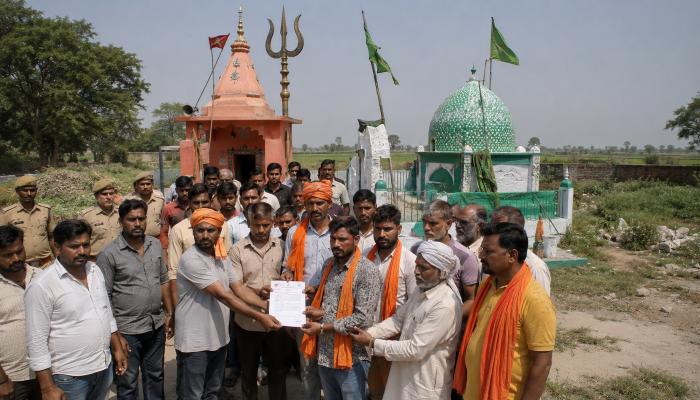
Case Summary
In the Marena village, Puwayang area, Uttar Pradesh, tensions escalated after a Hindu temple's land was encroached upon and a mazar (Islamic shrine) was built on top of it. Hindu villagers stated that a mazar [an Islamic shrine or tomb, typically built over the grave of a Muslim holy figure and used as a site of Islamic veneration] has been established on land belonging to a Hindu temple. As the controversy intensified, Hindu activists associated with Hindu Yuva Sangathan reached the spot and joined villagers in demanding that the administration remove the encroachment from the temple land. Protesters warned that they would launch an agitation if prompt action was not taken by the authorities. The dispute escalated into a communal confrontation between two communities, prompting police intervention to prevent further unrest and restore order in the village. The police claimed that the matter was old in nature and that no recent construction activity had taken place at the site. Officials further said that strict action would be taken against anyone attempting to disturb communal harmony or provoke unrest in the area.
Why it is Hate Crime ?
The primary category for this case is "Attack on Hindu religious representations". The sub-category for this case is "Encroachment or illicit takeover of temple land/land near temple". In Hinduism, a temple is the abode of the Deity. The Deity in the Temple is consecrated, thereby, making it a real, breathing entity. Hindus believe that not just the Deity but the temple premises itself are sacred to Hindus since Hindus hold the faith that the entire Temple space is an amalgamation of the divine energy of the deity. Not only the Temple but the Temple premises in its entirety are considered sacred by Hindus. In several cases, the premises of the Temple and/or religious centre are illicitly taken over by institutions belonging to other faiths – like the Waqf board or the Church. Other times, the temple property, land or the property of religious centres are illicitly encroached by non-Hindu groups. Any illicit take over or encroachment is a crime an initio, however, when non-Hindu groups illicitly take over or encroach the sacred land of Hindus, it is an affront to the Hindu community and is therefore classified as a religiously motivated hate crime under this category. This incident stands as a stark example of a religiously motivated hate crime, where perpetrators forcibly encroached upon sacred temple land and built a mazar over it. The establishment of a mazar on land belonging to a Hindu religious site in Marena village was not a neutral act of religious expression. It was the occupation of Hindu sacred land by an Islamic religious structure, converting a space that belonged to the Hindu community's devotional life into a site of Islamic veneration. The displacement of Hindu religious use of the land by the physical presence of a mazar represents a form of religious encroachment that goes beyond property dispute into the domain of sacred space contestation. The location of the mazar specifically on land designated as a Hindu religious site establishes the religious character of the encroachment. The land was not neutral or unclaimed. It was Hindu devsthan [land designated for Hindu religious use and traditionally maintained as sacred ground for the Hindu community's devotional life]. The establishment of an Islamic shrine on such land was not incidental. It was an act that directly displaced the Hindu religious function of the land and replaced it with an Islamic religious presence, altering the sacred character of the site in a manner that could not be separated from the religious identity of what was displaced. Encroaching upon temple land deeply wounds the religious sentiments of the Hindu community, as they witness their most sacred temples illegally invaded by anti-Hindu elements who show utter contempt for their faith, traditions, and the inviolable sanctity of these holy sites. Hindus feel a profound sense of violation and betrayal when outsiders trample upon spaces that embody their millennia-old devotion, generating fear, anger, and a chilling message of intolerance. This targeted aggression against Hindu religious identity and sacred precincts by those indifferent to Hindu reverence marks it unequivocally as a religiously motivated hate crime. Such targeting of temples constitutes a direct attack on the entire temple ecosystem, from the land and structures to the priests, rituals, and devotees who sustain it, effectively strangling the lifeblood of Hindu worship. Temples hold unparalleled significance in Hinduism as living embodiments of divinity, community gathering points, and custodians of ancient knowledge, where gods are invoked, and societal bonds are forged through shared faith. Attacks like this encroachment not only physicalise hostility but shatter Hindu sentiments, evoking collective trauma and reinforcing perceptions of systemic anti-Hindu prejudice. The age of the mazar, acknowledged by the Kotwali In-charge as a pre-existing structure rather than a recent construction, does not mitigate the significance of the encroachment. The passage of time does not convert an illegitimate occupation of Hindu religious land into a legitimate one. If anything, the long-standing presence of an Islamic shrine on Hindu sacred land reflects a sustained displacement of Hindu religious use that has persisted without correction or accountability for an extended period. The Hindu community's continued awareness of and objection to the encroachment, expressed through the protest and the demand for administrative action, establishes that the occupation was never accepted as legitimate by the Hindu community whose land was affected. Given that this case met the parameters of a religiously motivated hate crime, the establishment and continued presence of a mazar on Hindu devsthan land reflected more than a property boundary dispute. By occupying land designated for Hindu religious use with an Islamic religious structure and maintaining that occupation over an extended period, the perpetrators demonstrated a sustained displacement of Hindu sacred space in favour of Islamic religious presence. This reflects an underlying hostility toward Hindu religious identity that cannot be characterised as anything other than religiously motivated. Given that this case met the parameters of a religiously motivated hate crime, it was added to the hate crime database of the tracker. Disclaimer: The Hinduphobia Tracker records incident dates based on when the crime occurred rather than when it was reported or published. The exact date on which the mazar was established on Hindu devsthan land was not confirmed in the source, as the encroachment was acknowledged to be an old matter predating the publication. 25 December 2025 has been used as the primary incident date, derived from the source's publication date, which coincides with the date the Hindu community's protest and demand for administrative action came to light. This was recorded for documentation purposes only.


Case Status
Unknown


Perpetrators Details
Perpetrators
Muslim Extremists
Perpetrators Range
Unknown
Perpetrators Gender
unknown
 Sources




