Minor Hindu students subjected to religious indoctrination and incited against Hindu deities by Christian headmistress
 Janjgir-Champa, Chhattisgarh, India
  6 May, 2026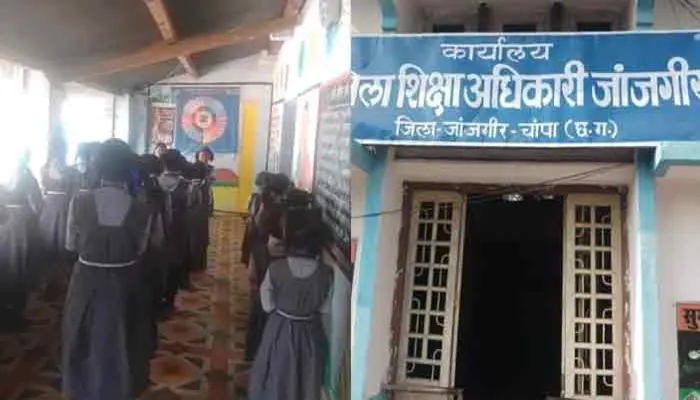
Case Summary
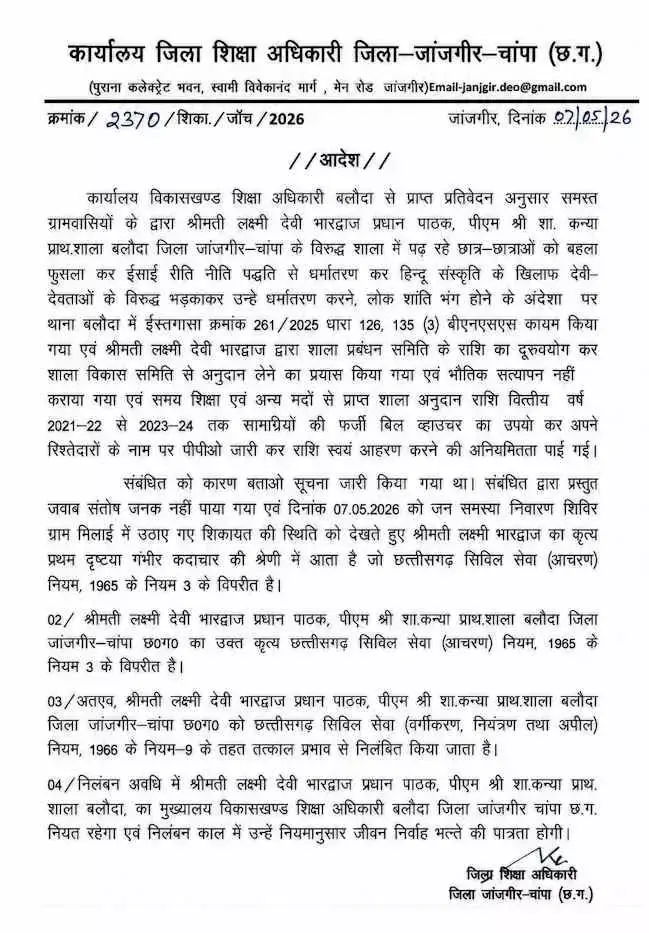
In the Baloda block of Janjgir-Champa district, Chhattisgarh, minor Hindu students were subjected to religious indoctrination and incited against Hinduism for religious conversion by their school headmistress, Lakshmi Devi Bhardwaj. The incident came to light during a public grievance camp where villagers submitted complaints against Lakshmi Devi Bhardwaj, the headmistress of PM Shri Girls Primary School, stating that she was making students recite songs such as “God is Great” or “Hallelujah” during morning prayer assemblies instead of the national anthem, Jana Gana Mana. Jana Gana Mana”. Residents further stated that students were being influenced against Hindu deities and exposed to Christian customs and practices in an attempt to shape their religious beliefs from a young age. The controversy triggered concern within the local community and the education department, particularly because the institution involved was a government school entrusted with the education of minor children. Additionally, complaints were also raised against the headmistress regarding financial irregularities, including fraudulent bills and vouchers linked to the functioning of the school administration. Furthermore, an FIR (No. 261/2025) was registered against her in 2025, at Baloda Police Station, under relevant sections of the Bharatiya Nyaya Sanhita (BNS), including Sections 126 and 135(3), over fears of disturbing public peace due to the religious activities. Bhardwaj was booked but later released on bail. Following the complaints, the District Education Officer issued a show-cause notice to the headmistress seeking an explanation regarding her conduct and the activities reported by villagers. After reviewing her response, the education authorities deemed it unsatisfactory and treated the matter as serious misconduct. Consequently, Lakshmi Devi Bhardwaj was suspended with immediate effect by the education department.
Case Images
Why it is Hate Crime ?
This case has been added to the tracker under the primary category of - Predatory Proselytisation. Within it, the sub-category selected is - Proselytisation by grooming, brainwashing, manipulation or subtle indoctrination, with the tertiary category being - Conversion of minor. Religious brainwashing essentially means the often subtle and forcible indoctrination to induce someone to give up their religious beliefs to accept contrasting regimented ideas. Religious grooming or brainwashing also involves propaganda and manipulation. It involves the systematic effort, driven by religious malice and indoctrination, to persuade “non-believers’ to accept allegiance, command, or doctrine to and of a contrasting faith. Cases of such grooming or brainwashing are far more nuanced than direct threats, coercion, inducement and violence. In such cases, it is often seen that there is repeated, subtle and continual manipulation of the victim to induce disaffection towards their own faith and acceptance of the contrasting faith of the perpetrator. While subtle indoctrination is widely acknowledged as predatory, an element which is often understated in such conversions or the attempts of such conversion is the role of loyalty and trust which might develop between the perpetrator and the victim. Fiduciary relationships are often abused to affect such religious conversion. For example, an educator transmitting religious doctrine of a competing faith to a Hindu student. The Hindu student is likely to accept what the teacher is transmitting owing to existence of the fiduciary relationship. The exploitation of the fiduciary relationship to religiously indoctrinate victims would also be included in this category. Since the underlying animosity towards the victim’s faith forms the basis of predatory proselytization, such cases are considered religiously motivated hate crimes The other sub-category selected here is - Attempting to convert/converting by denigrating Hinduism. In several cases, Hindus are converted or an attempt is made to convert Hindus by denigrating their faith, Hinduism. In such cases, the Hindus associate with the non-Hindu perpetrators often by choice and then, the attempt to convert them by insulting their faith, showing the faith down etc begins. An example of this would be a non-Hindu gathering where the Hindus are attending the gathering of their own free will. However, once they attend the gathering, there is an explicit attempt to convert them by abusing their faith and hailing the faith of the perpetrator. The denigration of the Hindu faith is often based on misrepresentation of the Hindu faith, its doctrine and scriptures and insult to espoused traditions if not blatant lies about Hindu beliefs and ways. Such conversions or attempts at conversions are driven by animosity towards the Hindu faith and are therefore documented as religiously motivated hate crimes. This case has been added to the tracker because minor Hindu students studying at a government primary school in Janjgir-Champa district of Chhattisgarh were subjected to religious indoctrination, exposed to Christian religious practices, and influenced against Hinduism by the school headmistress, Lakshmi Devi Bhardwaj, in an attempt to shape their religious beliefs and distance them from their native faith. Firstly, it is important to note here that the victim was a minor, which means the element of consent and genuine change of conscience was missing ab initio. Minors, due to their young age and lack of maturity, are particularly vulnerable to manipulation and coercion. They may not have the ability to fully understand the implications of converting to another religion, and the Christian perpetrator purposely targeted and exploited this vulnerability of the victim. Since this case exemplifies the use of coercion and manipulation to achieve religious conversion, it is a blatant act of religious hate, which is why it has been documented here in the hate tracker. Secondly, minor Hindu students were taught and compelled to recite Christian religious phrases such as “Hallelujah” during the school prayer assembly instead of the national anthem, “Jana Gana Mana”. This is significant because school prayer assemblies are formal institutional activities meant to foster civic values and collective discipline, not platforms for promoting the religious doctrines of a particular faith. Introducing Christian religious instruction into a state-run educational setting, especially before impressionable children, amounted to a deliberate attempt to normalise and familiarise them with Christian religious practices from a young age. The students were also exposed towards Christian customs and practices within the school environment. Such actions reflected a pattern of religious conditioning where repeated exposure to Christian faith was used to gradually influence the beliefs and identities of Hindu children and convert them to Christianity. Thirdly, Hindu students were also being influenced against Hindu deities in an effort to convert them to Christianity. This aspect of the incident is particularly serious because it went beyond passive religious preaching and entered the realm of denigration of the victims’ faith. Such actions are designed to demean and undermine the faith of Hindus and intend to create an inferiority complex in the minds of the victims against their own faith. This fosters an environment of hostility and disrespect towards the Hindu community and Hindu deities. These acts of insulting Hinduism stem from Christian theology, which harbours disdain and hatred for polytheistic faiths, and which categorises Hindus as ‘polytheists’, thereby fostering hatred against them. Such actions make the religiously motivated nature of the crime even more evident. The Christian faith, by its very theological foundations, places a strong emphasis on proselytisation. In pursuit of conversion objectives, Christian evangelists/individuals often employ unethical means, ranging from psychological pressure and misinformation to inducements such as money or jobs. Even in this case, the combination of exposing children to Christian religious practices, replacing the national anthem during school assembly with Christian verses, and influencing students against Hindu deities reflected an attempt to alienate Hindu children from their own religious identity while normalising another faith within the school environment. Because the victims were minors placed under the authority and supervision of a school headmistress, the possibility of free and informed consent was fundamentally compromised. The use of an educational setting to condition children against their native faith and encourage religious conversion represented a serious breach of institutional trust and displayed clear elements of religiously motivated targeting of Hindu students. For these reasons, this case was added to the tracker under categories relating to coercive religious influence, anti-Hindu prejudice, and conversion-related targeting of vulnerable Hindu minors. Disclaimer: The Hinduphobia Tracker records incidents based on when an event occurred or when the victim's ordeal began. It is important to clarify that none of the media sources covering this case has specified the exact date when the headmistress began targeting Hindu students. Therefore, for documentation purposes, we have recorded the date of the incident based on the date of her suspension letter, 7 May 2026.


Case Status
Complaint filed


Perpetrators Details
Perpetrators
Christian Extremists
Perpetrators Range
One Person
Perpetrators Gender
female
 Sources




