Hindu woman deceived into marriage and pressured for religious conversion by Muslim man posing as Hindu
 Sonipat, Haryana, India
  1 May, 2026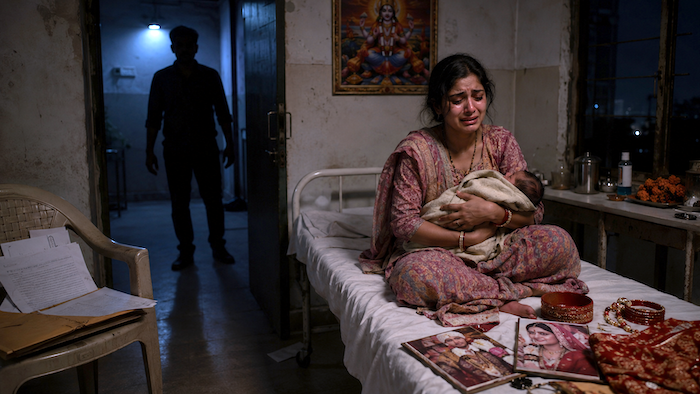
Case Summary
In Kondli of Sonipat district, Haryana, a Hindu woman was deceived into marriage and pressured for religious conversion by a Muslim man named Mohammad Baris, who concealed his religious identity and posed as a Hindu. According to reports, the Hindu woman, originally from Gorakhpur, Uttar Pradesh, lived with her father in Kondli, Haryana. During this period, she came into contact with the Muslim accused, Mohammad Baris, who lived opposite her residence. He introduced himself to the victim as a Hindu man named Sonu Dubey, aka Pandit. By concealing his Muslim identity and presenting himself as a Hindu man, he gained the trust of the Hindu woman and her family. Over time, he developed a relationship with her and later married her in an Arya Samaj temple as per Hindu marriage rituals. After the marriage, the Hindu woman began living with the accused in Kondli. Throughout this period, she remained unaware that he was Muslim. The marriage and domestic relationship continued under this false identity. The concealment of his religious identity remained undisclosed until after the Hindu woman gave birth to a child. Following the birth of the child in the hospital, the accused revealed to the victim that he was a Muslim and his real name was Mohammad Baris. Soon after revealing his identity, he began pressuring her to convert to Islam. She was subjected to repeated coercion to abandon her Hindu faith and adopt Islam after already being tied to the relationship through marriage and motherhood. The Hindu woman was also physically assaulted and threatened for conversion. The violence escalated after the disclosure of the perpetrator’s identity and after pressure to convert intensified. Fearing for her safety, the Hindu woman escaped from the residence of the accused and travelled to Delhi to seek refuge with her sister. On 2nd May 2026, the Hindu woman approached Nabi Karim police station in Central Delhi and lodged a complaint regarding the deception, coercion, violence, and threats she had faced. In her complaint, she detailed how Mohammad Baris had concealed his Muslim identity by posing as a Hindu man named Sonu Dubey and had married her through Hindu religious customs before later forcing her to convert to Islam after childbirth. The Hindu woman’s statement was subsequently recorded before the court under Section 164 of the Indian Penal Code at Tis Hazari Court. On 8th May 2026, Delhi Police registered a zero First Information Report at Nabi Karim police station under Section 69, sexual intercourse by false promise of marriage, and Section 506, criminal intimidation, of the Indian Penal Code. Since the case originated from Kondli, Haryana, the zero First Information Report was transferred there for further legal action and investigation. Officials associated with the Sakhi Centre at Lok Nayak Jai Prakash Hospital assisted the Hindu woman after she reached Delhi. The Sakhi Centre provided institutional support that contributed to the registration of the case. Delhi Police officials confirmed that the Hindu woman’s complaint had been formally recorded and transferred to the concerned jurisdiction for investigation. During the course of the matter, sources connected to the Sakhi Centre stated that Mohammad Baris and several members of his family possessed two Aadhaar cards each. The matter remained under investigation following the transfer of the zero First Information Report from Delhi to Haryana authorities.
Why it is Hate Crime ?
This case has been added to the tracker under the primary category - Crimes against women in relationships and other sexual crimes. Within this, the subcategory selected is - Man pretends to be Hindu. Under this, the tertiary categories selected are - Name changed, and Marries as per Hindu rituals. When a non-Hindu man pretends to be a Hindu to deceive a Hindu woman into a relationship, the act is seen as triggered by malafide intentions. In some cases, the woman eventually accepts the man’s original religious identity and converts after the man’s identity is revealed. These cases could be argued as cases of religious brainwashing and a result of the pressure a woman feels after getting into a relationship with a man. The woman, it can be argued, also changed her religious identity because of the stigma she believes she might face if she chooses to walk out of a deceptive relationship. However, for the purpose of documenting hate crimes, the cases in this subcategory are limited to those where there is explicit violence aimed at religious conversion against the wishes of the victim (force-feeding beef, blackmailing with intimate videos, rape on refusal to convert, etc), or if the woman herself complains of the man’s religious deception. In such cases, it is established that the deception of the non-Hindu man had a specific aim of religious conversion or targeting of the victim due to her Hindu religious identity, therefore, making it a religiously motivated hate crime. The other sub-category selected for this case is - Brainwashed and/ or groomed. Under this, the tertiary category selected is - Rape and sexual assault/harassment. In our database, we have not added incidents where women have converted to another religion of their free will and no allegations of forced/involuntary conversion have been made. However, there are certain cases of conversion where the consent itself is a result of the brainwashing or grooming of a minor by the non-Hindu perpetrator trying to victimise a woman for her Hindu religious identity. The phenomenon of grooming points to non-Hindu perpetrators identifying their Hindu victims’ vulnerabilities and exploiting them over months and sometimes years, to extract the supposed ‘consent’ in order to convert their religion. In most cases of grooming, the victims are minors or the grooming started when the victim was a minor. In other cases of grooming, the non-Hindu perpetrator brainwashes and grooms a minor victim to extract their trust and then proceeds to rape them repeatedly with the intent of converting them to their faith. It is pertinent to understand here that when the victim is a minor, the ‘consent’ to convert or enter into a romantic relationship with an adult itself is redundant – addressed by POCSO. While every case of conversion of a minor and incidents of establishing a physical relationship with a minor by an adult is a crime, for the purpose of this database, a case would be considered a hate crime only if there is a distinct religious angle to the grooming. For example, in the UK, if a Hindu minor is targeted by Pakistani grooming gangs, it would be considered a hate crime because the victims are specifically targeted owing to their non-Muslim religious identity with the perpetrators being Muslim. In other cases, if a Hindu minor is brainwashed into entering a physical relationship with the non-Hindu adult perpetrator and the family alleges grooming/brainwashing of the minor to convert her religion, it would form a part of this database. If the victim is a Hindu adult, the case would form a part of this database only if the victim herself says that she was brainwashed/groomed to convert her religion. However, if the victim is deceased (murdered or otherwise), the case would form a part of this database if her family/friends provided testimony that the victim was brainwashed/groomed to convert her religion. Since these crimes have a distinct religious angle where the victim is being targeted owing to her Hindu religious identity, these cases are considered a hate crime. Another subcategory selected for this case is - Forced conversion after marriage. In such cases, a non-Hindu man marries a Hindu woman, and the force/pressure to convert to any Abrahamic faith, like Islam, begins after marriage. In such cases, typically, two patterns emerge. First, when the relationship is consensual, and the religious identity of the perpetrator is known to the Hindu woman in the relationship. The marriage could be under the Special Marriages Act, where neither parties are required to convert their religion for the marriage to be considered legitimate. While the victim in such cases enters matrimony assuming that religious identity is not a barrier, the non-Hindu man starts to pressure the woman to convert her religion after marriage. The second is when the woman gets into a marriage with the man, pretending to share her faith. Later, when the truth is revealed, the man starts pressuring the woman to convert her religion and give up her religious identity. In both situations, there is application of force by the perpetrator, including the denial of the woman’s religious rights. Some of the means by which the woman is forced/pressured to convert include force-feeding beef, being forced to read the Kalma, being forced to wear a hijab, forced to undergo Halala, etc. There are several instances where, after marriage, the woman voluntarily converts to Islam. Such cases are often argued to be a result of religious brainwashing, however, for the purpose of documenting religiously motivated hate crimes, in the absence of the victim complaining of forced conversion, such cases do not form a part of the database. This case qualified as a religiously motivated hate crime because a Hindu woman was deliberately deceived into marriage and later pressured for religious conversion by the Muslim accused, Mohammad Baris, who concealed his religious identity and posed as a Hindu. The Muslim perpetrator concealed his religious identity throughout the relationship and intentionally presented himself as a Hindu man in order to gain the trust of the Hindu victim and secure marriage through fraudulent means. The coercion began only after the Hindu woman had become emotionally attached, socially tied to the marriage, and dependent through motherhood. The violence, threats, deception, and pressure to convert were all directed specifically at the Hindu woman’s religious identity and demonstrated a calculated effort to exploit her Hindu faith as a tool for control and subjugation. The first religious marker in this case was the deliberate concealment of the perpetrator’s Muslim identity and his conscious decision to pose as a Hindu man. The accused deliberately concealed his religious identity to initiate and sustain a relationship with a Hindu woman. This itself is a clear manifestation of bias and malicious intent towards the victim's religion. By concealing his true identity, he exploited her trust, targeting her under false pretences. This indicates a premeditated intent to manipulate her based on her religious background. In cases like these, the tactic of adopting a false Hindu identity to manipulate and "ensnare" a Hindu individual is not just an act of personal betrayal but can also be interpreted as an expression of disdain or disregard for Hinduism and its customs that reflects a deeper animosity towards Hindus and their beliefs. The second religious marker was the decision to marry the Hindu woman through Hindu rituals inside an Arya Samaj temple. The marriage was not conducted neutrally or privately. It was specifically performed using Hindu customs and Hindu religious rites. This was religiously significant because Hindu marriage rituals carry sacred meaning for Hindu women and symbolise spiritual legitimacy, familial honour, and religious sanctity. The perpetrator deliberately participated in Hindu rituals while concealing his real identity in order to deepen the Hindu woman’s trust and emotionally bind her into the marriage under false religious pretences. The use of Hindu marriage customs was not symbolic coincidence. It was a calculated act designed to convince the Hindu woman that she was entering a legitimate Hindu marriage with a Hindu husband. By exploiting sacred Hindu rituals as part of the deception, the perpetrator transformed the Hindu woman’s own religious faith into the mechanism through which she was trapped. This demonstrated clear intent to misuse Hindu religious traditions as instruments of manipulation against a Hindu victim. The third religious marker was the grooming and emotional manipulation carried out throughout the relationship. The Hindu woman spent the entire relationship believing she was emotionally attached to a Hindu man who shared her identity and values. In reality, the relationship was built on a fabricated religious identity from the very beginning. This was religiously significant because the Hindu woman’s emotional consent, physical intimacy, and eventual pregnancy were all obtained through deception rooted in religious animosity. The manipulation became even more severe because the perpetrator waited until after the birth of the child to reveal his Muslim identity, ensuring that the Hindu woman was already tied to him emotionally, socially, and maternally before beginning conversion pressure. This sequence demonstrated calculated exploitation rather than spontaneous disclosure. The fourth religious marker in this case was the forced conversion aspect of the Hindu woman. After the birth of the child, the accused pressured her to convert to Islam. In Islam, marriage to a non-Muslim partner is prohibited, which is why she was pressured for religious conversion. Pressuring a Hindu individual to discard her religious faith and embrace another was a direct attack on her religious identity and dignity. It was not a matter of personal choice; it was coercion rooted in hostility towards the victim's Hindu identity. Such an attempt reflects religious animosity because the act was not simply about personal differences but about erasing the victim’s Hindu faith, making it a religiously motivated crime. Furthermore, the accused also physically assaulted and threatened the victim for conversion. Often in such cases, violence and threats serve a dual purpose: physical subjugation and religious humiliation. The intention was to break the victim down, emotionally, physically, and spiritually, so that she could be converted. This was not random violence; it was systematic, targeted, and rooted in religious animosity. Additionally, the attempt to force the Hindu woman to convert to Islam after marriage and childbirth. The conversion pressure began only after the perpetrator had secured marriage and after the Hindu woman had given birth to a child. This timing was religiously significant because it showed that the perpetrator intentionally waited until the Hindu woman was tied to him through motherhood before revealing his true identity and demanding religious change. By delaying disclosure until after childbirth, the perpetrator maximised the Hindu woman’s emotional vulnerability and dependence. The pressure to convert, therefore, did not emerge from mutual discussion or personal belief. It emerged only after the Hindu woman had already been trapped inside a relationship created through deception. The perpetrator deliberately exploited marriage and motherhood as tools to weaken the Hindu woman’s ability to resist abandoning her religion. This demonstrated a calculated effort to erase the Hindu woman’s religious identity after first securing emotional and familial control over her. This incident is not an isolated case but part of a broader pattern where Hindu women are deliberately targeted through deception and emotional blackmail for religious conversion and sexual exploitation. This stems from inherent hostility towards the victim's professed faith since Abrahamic faiths believe that any non-adherent to the faith is subject to being dehumanised till they convert. Such predatory actions stem from doctrinal animosity towards the Hindu faith and its adherents. Given that this case met the parameters of a religiously motivated hate crime, it was added to the hate crime database of the tracker. Disclaimer: The Hinduphobia Tracker records incidents based on when an event occurred or when the victim's ordeal began. It is important to clarify that the report does not specify the exact date when the accused initially came into contact with the victim. Therefore, for documentation purposes, we have recorded the date based on when the FIR was filed, 2 May 2026.
Victim Details
Total Victim
1
Deceased
0
Gender
- Male 0
- Female 1
- Third Gender 0
- Unknown 0
Caste
- SC/ST 0
- OBC 0
- General 0
- Unknown 1
Age Group
- Minor 0
- Adult 1
- Senior Citizen 0
- Unknown 0


Case Status
Complaint registered


Perpetrators Details
Perpetrators
Muslim Extremists
Perpetrators Range
One Person
Perpetrators Gender
male
 Sources




