Hindus in Banswara assaulted for recording covert Christian conversion activities taking place under the guise of prayer meetings
 Banswara, Rajasthan, India
  1 May, 2026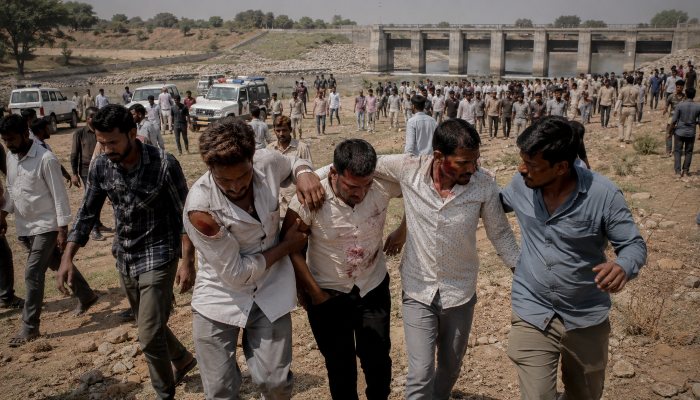
Case Summary
Hindus in Banswara were violently attacked for opposing suspected cow-related crimes and recording covert Christian conversion activities taking place during a prayer gathering in Kalinjara village under the Kushalgarh police station area. According to the FIR filed by Ravi Bhamor, Hindu activists had received information that a prayer meeting was being conducted near the village dam, where activities related to harming cows and carrying out religious conversions were taking place. Acting on this information, they reached the location to verify the activities. When the Hindu activists attempted to record videos at the spot, the people present there objected, leading to an argument that quickly escalated into violence. Around 15 named accused, including Joseph, along with nearly 100 unidentified individuals, attacked the Hindu activists. Three Hindus sustained serious head injuries in the assault, while four activists were reported to have been severely injured overall. One injured Hindu was stated to be in critical condition and was referred to Dahod in Gujarat for treatment. Following the attack, tension prevailed in the area for some time. Police arrived at the scene after receiving information and brought the situation under control. Four accused individuals were detained, while raids were launched to trace the remaining accused. Kushalgarh police registered a case under relevant sections of the Bharatiya Nyaya Sanhita (BNS). Station House Officer Praveen Singh stated that although no concrete evidence of cow slaughter had been found at the location, all aspects of the matter, including the allegations surrounding conversion activities, were being investigated. The incident drew attention to the long-standing tensions in tribal regions such as Banswara and Dungarpur regarding allegations of religious conversions targeting vulnerable tribal Hindus. Hindu organisations have repeatedly alleged that conversions are being carried out through inducements and covert religious activities, while Christian groups have denied these allegations.
Why it is Hate Crime ?
The primary category for this case is "Attack not resulting in death", and within this, the subcategory selected is "Attacked for opposing radicals or trying to save a victim" In several cases, Hindus are attacked for opposing religiously motivated crimes being committed against a fellow Hindu or simply for voicing an opinion opposing radical elements, who either have in the past or continue to persecute Hindus. In such cases, the initial attack against the victim, against which the Hindu was trying to defend the victim, would also need to be classified as a religiously motivated hate crime. Since the initial crime itself was religiously motivated and the subsequent crime of attempting to save the victim or speaking against the radical elements ends up inviting a violent attack, it would also be classified as a religiously motivated hate crime under this category. "Predatory Proselytisation". Another sub-category for this case is "Proselytisation by grooming, brainwashing, manipulation or subtle indoctrination". The tertiary category here is "Pattern of targeting Hindus". Religious brainwashing essentially means the often subtle and forcible indoctrination to induce someone to give up their religious beliefs to accept contrasting regimented ideas. Religious grooming or brainwashing also involves propaganda and manipulation. It involves the systematic effort, driven by religious malice and indoctrination, to persuade “non-believers’ to accept allegiance, command, or doctrine to and of a contrasting faith. Cases of such grooming or brainwashing are far more nuanced than direct threats, coercion, inducement and violence. In such cases, it is often seen that there is repeated, subtle and continual manipulation of the victim to induce disaffection towards their own faith and acceptance of the contrasting faith of the perpetrator. While subtle indoctrination is widely acknowledged as predatory, an element which is often understated in such conversions or the attempts of such conversion is the role of loyalty and trust which might develop between the perpetrator and the victim. Fiduciary relationships are often abused to affect such religious conversion. For example, an educator transmitting religious doctrine of a competing faith to a Hindu student. The Hindu student is likely to accept what the teacher is transmitting owing to the existence of the fiduciary relationship. The exploitation of the fiduciary relationship to religiously indoctrinate victims would also be included in this category. Since the underlying animosity towards the victim’s faith forms the basis of predatory proselytisation, such cases are considered religiously motivated hate crimes. The attack on the Hindu activists in Banswara carries clear religious markers because the violence was triggered when they attempted to oppose and document activities linked to suspected cow-related offences and covert Christian conversion efforts targeting vulnerable tribal communities. A key religious marker in this case is the assault on Hindus for opposing activities they believed were undermining Hindu religious and cultural interests. The Hindu activists were not accused of initiating violence or targeting individuals over personal disputes. They were attacked after objecting to suspected cow-related offences and attempting to record conversion activities taking place during a prayer gathering. This indicates that the violence was directed specifically at Hindus who were resisting and exposing activities perceived as threatening to the Hindu faith and tribal Hindu identity. The connection to cow-related activities is also significant because the cow holds deep religious importance in Hinduism and is revered as sacred by Hindus. Allegations relating to harm caused to cows are therefore viewed not merely as criminal concerns but as acts affecting Hindu religious sentiments and beliefs. The Hindu activists had reportedly reached the location after receiving information about activities involving harm to cows alongside ongoing conversion efforts, making their intervention closely tied to the protection of Hindu religious values. Another important religious marker is the allegation of covert Christian conversion activities taking place under the cover of a prayer meeting in a tribal area. Tribal Hindu communities in regions such as Banswara and Dungarpur have frequently been identified as vulnerable targets for conversion campaigns because of economic and social vulnerability. According to the complaint, tensions escalated when Hindu activists attempted to record the activities taking place at the gathering. The violent reaction to attempts at documenting the activities suggests an effort to prevent public scrutiny and opposition to suspected conversion-related conduct. The scale and nature of the assault further strengthen the religious dimension of the incident. The violence was severe and collective, indicating an attempt not only to stop the recording of activities but also to intimidate Hindus from opposing or exposing similar activities in the future. Taken together, the assault on Hindus for resisting suspected conversion activities and cow-related offences demonstrates religiously motivated hostility towards individuals defending Hindu beliefs, symbols, and community interests. The violence functioned as both punishment and intimidation directed at those attempting to challenge activities perceived as threatening to the Hindu faith and tribal Hindu social cohesion. Disclaimer: While reports mention that nearly 100 unidentified individuals were present during the assault, the FIR specifically names 15 accused persons, including Joseph. Since the identities and exact involvement of the remaining individuals have not yet been established, the perpetrator count has been recorded as 15 for documentation purposes based on the named accused in the FIR.


Case Status
Complaint registered


Perpetrators Details
Perpetrators
Christian Extremists
Perpetrators Range
From 10 to 100
Perpetrators Gender
unknown
 Sources




