Hindu minor girl abducted, pressured into conversion after death threats by Muslims perpetrators, her family threatened for ransom
 Lucknow, Uttar Pradesh, India
  4 May, 2026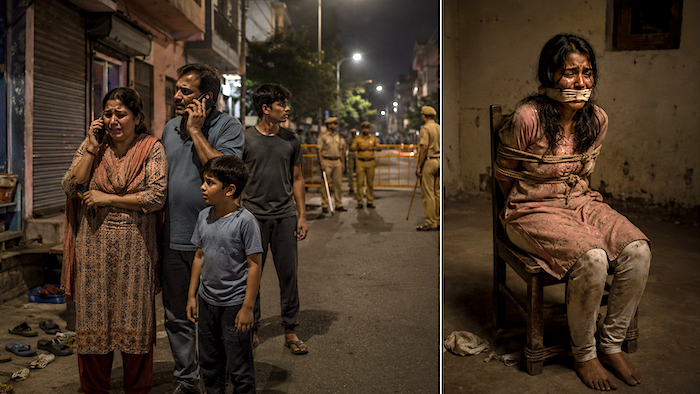
Case Summary
A 17 year old Hindu minor girl disappeared from the Gomti Nagar area of Lucknow, Uttar Pradesh, after leaving her home in the evening on 5th May 2026. Her family suddenly lost contact with her and began searching for her in panic. Within hours, the Hindu girl’s father discovered that she had been taken away by Muslim men and subjected to violent coercion and religious conversion pressure. The case quickly escalated after the Hindu family accused the perpetrators of abducting the minor Hindu girl, assaulting her, threatening to kill her, and forcibly converting her to Islam. Rajkumar Vishwakarma, a resident of Vishal Khand in Gomti Nagar, stated that his 17 year old daughter, Khushi, had gone to a nearby shop at around 8 pm on 5th May 2026. She did not return home afterwards. Her disappearance immediately caused concern within the family, who began searching nearby areas and contacting acquaintances in an attempt to trace her movements. During the course of the search, the Hindu girl’s father identified Muslim individuals involved in taking his daughter away. He named Sarukh Waradat, a resident of Ujriyav, Ammar Rais, identified as a Qazi associated with Darul Walema Warsia, and several other individuals. The Hindu girl was removed from her familiar surroundings and taken away from her family without their knowledge or consent. The perpetrators acted together in transporting the minor Hindu girl away from her locality and isolating her from immediate family protection. The Hindu girl’s father stated that after being abducted, she was forcibly converted to Islam. During the period she remained in the custody and control of the perpetrators, the Hindu girl was beaten when she resisted conversion efforts. She was also threatened with death if she opposed them or attempted to escape. The coercion directed against the Hindu girl combined physical violence, intimidation, and religious pressure in order to force her to abandon her Hindu identity. At one stage during the incident, the Hindu girl managed to briefly speak with her father over the phone. During the call, she tearfully described the violence and threats being inflicted upon her. While she was speaking, the perpetrators forcibly snatched away her mobile phone and cut off communication between the Hindu girl and her family. Following this, the family again lost contact with her and remained unable to determine her exact whereabouts. The Hindu family further stated that the perpetrators demanded 20 lakh rupees from them after abducting the Hindu girl. Following the incident, the perpetrators returned to the Ujriyav area. The family repeatedly approached Gomti Nagar police station seeking immediate intervention and protection for the minor Hindu girl. The Hindu girl’s father stated that despite multiple visits to the police station, the complaint submitted by the family was altered and no immediate concrete action was taken against the named perpetrators. The Hindu family expressed fear regarding the safety and wellbeing of the minor Hindu girl and stated that they feared further harm could be inflicted upon her. The case also generated serious concern after accusations emerged that police personnel changed portions of the First Information Report submitted by the family. The Hindu girl’s father continued pursuing action while attempting to secure his daughter’s safe recovery. Police later stated that a case had been formally registered in connection with the abduction and forced conversion of the Hindu girl. An investigation into the involvement of the named Muslim perpetrators and the circumstances surrounding the abduction, assault, threats, ransom demand, and conversion was stated to be ongoing.
Why it is Hate Crime ?
This case has been added to the tracker under the primary category - Predatory Proselytisation. Within this, the subcategory selected is - Proselytisation by grooming, brainwashing, manipulation or subtle indoctrination. Under this, the tertiary categories selected are - Conversion of minor, Victim says she was brainwashed/groomed, and Family claims grooming. Religious brainwashing essentially means the often subtle and forcible indoctrination to induce someone to give up their religious beliefs to accept contrasting regimented ideas. Religious grooming or brainwashing also involves propaganda and manipulation. It involves the systematic effort, driven by religious malice and indoctrination, to persuade “non-believers’ to accept allegiance, command, or doctrine to and of a contrasting faith. Cases of such grooming or brainwashing are far more nuanced than direct threats, coercion, inducement and violence. In such cases, it is often seen that there is repeated, subtle and continual manipulation of the victim to induce disaffection towards their own faith and acceptance of the contrasting faith of the perpetrator. While subtle indoctrination is widely acknowledged as predatory, an element which is often understated in such conversions or the attempts of such conversion is the role of loyalty and trust which might develop between the perpetrator and the victim. Fiduciary relationships are often abused to affect such religious conversion. For example, an educator transmitting religious doctrine of a competing faith to a Hindu student. The Hindu student is likely to accept what the teacher is transmitting owing to existence of the fiduciary relationship. The exploitation of the fiduciary relationship to religiously indoctrinate victims would also be included in this category. Since the underlying animosity towards the victim’s faith forms the basis of predatory proselytization, such cases are considered religiously motivated hate crimes. The other subcategory selected in this case is - Harassment, threats, coercion for conversion. Harassment covers a wide range of behaviours of an offensive nature. It is commonly understood as behaviour that demeans, humiliates, and intimidates a person, including threats and coercion. Harassment and threats, in this case, find their root on discriminatory grounds which has the effect of nullifying a person’s rights or infringing upon his freedom to exercise his right specifically owing to the victim’s religious identity. Verbal and physical threats and psychological or physical harassment are often used against Hindu victims because they choose to practice their professed religion. Religious harassment also includes forced and involuntary conversions by harassment, threats or coercion. Coercion includes intimidatory tactics like force-feeding a Hindu victim beef to convert to another religion, forceful circumcision etc. In several cases documented, non-Hindu perpetrators or those who harbour specific animosity towards Hinduism, harass victims simply based on their religious identity. Such cases often also include harassment to ensure the Hindu victim abandons his/her professed religion and adopts the religion of the perpetrator. Such cases where Hindu victims are harassed to convert to the perpetrator’s religion are rooted in animosity towards the victim’s religious identity and are therefore documented as religiously motivated hate crimes. This case qualified as a religiously motivated hate crime because a minor Hindu girl was deliberately targeted, abducted from her locality, isolated from her family, and forcibly subjected to conversion pressure by Muslim perpetrators. The perpetrators did not merely abduct the Hindu girl for personal or financial reasons. The acts committed against her centred upon changing her religious identity through intimidation, violence, and sustained coercion. The victim was specifically targeted as a vulnerable Hindu minor whose age, isolation, and dependence on family protection made her easier to manipulate and control for the purpose of religious conversion. The primary religious marker in this case was the predatory proselytisation directed against the minor Hindu girl. The Hindu victim was intercepted while carrying out an ordinary daily activity near her home on 5th May 2026 and was forcibly removed from her familiar surroundings by Muslim perpetrators. This was religiously significant because the perpetrators specifically targeted a Hindu minor and removed her from the protection of her Hindu household and community environment in order to place her under their direct control. The perpetrators deliberately chose to isolate the Hindu girl from the locality where she felt safe because such separation increased her vulnerability and reduced her ability to seek immediate help from her family or neighbours. The abduction itself functioned as the foundation for the later conversion pressure because the perpetrators first needed physical control over the Hindu victim before attempting to alter her religious identity. This revealed a clear intent to target the Hindu girl not randomly, but specifically because her Hindu identity and young age made her vulnerable to religious manipulation, coercion, and forced conversion. The second religious marker was the conversion of a Hindu minor. The perpetrators forcibly converted the 17-year-old Hindu girl to Islam after abducting her and isolating her from her family. This was religiously significant because the victim was not an adult exercising independent freedom in a protected environment, but a Hindu minor who was especially vulnerable to intimidation, fear, and psychological pressure. The perpetrators deliberately selected a minor Hindu girl because children and teenagers are easier to overpower, isolate, and manipulate than adults. Her age reduced her ability to resist organised coercion and increased her dependence upon the perpetrators once separated from her family. The sequence of abduction followed by conversion demonstrated that the conversion itself was central to the crime from the very beginning. The latter ransom demand reinforced that the perpetrators viewed the Hindu girl both as a target for religious conversion and as leverage against her Hindu father. This revealed deliberate intent to exploit the vulnerability of a Hindu child in order to erase her religious identity while simultaneously terrorising her family. Following this was the direct evidence from the Hindu victim herself describing the coercion and fear imposed upon her by the Muslim perpetrators. During a brief phone call with her father, the Hindu girl cried while recounting the violence, threats, and pressure being inflicted upon her. This was religiously significant because the victim herself communicated that she was being controlled through fear while under the custody of individuals attempting to forcibly convert her. The other religious marker was the harassment, threats, violence, and coercion used to force compliance with the conversion. The Hindu minor was beaten when she resisted and was threatened with death if she opposed the perpetrators. This was religiously significant because violence and terror were deliberately used to force submission from a Hindu victim who resisted abandoning her religion. The perpetrators chose threats of murder, physical assault, and ransom demands in order to maximise fear both for the Hindu girl and for her family. By threatening to do worse to the Hindu girl or prevent her return unless the family complied, the perpetrators weaponised her captivity to psychologically terrorise her Hindu household. These acts were not random intimidation. They were specifically designed to crush resistance to the conversion process and ensure continued control over the Hindu victim. This revealed deliberate intent to use violence, fear, and emotional torture as instruments to force a Hindu minor into religious submission while traumatising her entire family. This stems from inherent hostility towards the victim's professed faith since Abrahamic faiths believe that any non-adherent to the faith is subject to being dehumanised till they convert. Such predatory actions stem from doctrinal animosity towards the Hindu faith and its adherents. Given that this case met the parameters of a religiously motivated hate crime, it was added to the hate crime database of the tracker.
Victim Details
Total Victim
1
Deceased
0
Gender
- Male 0
- Female 1
- Third Gender 0
- Unknown 0
Caste
- SC/ST 0
- OBC 0
- General 0
- Unknown 1
Age Group
- Minor 1
- Adult 0
- Senior Citizen 0
- Unknown 0


Case Status
Complaint filed


Perpetrators Details
Perpetrators
Muslim Extremists
Perpetrators Range
From 2 To 5
Perpetrators Gender
male
 Sources




