400-year-old Hindu temple targeted for removal through fraudulent land claim and political coercion in Madhya Pradesh
 Udaipur, Rajasthan, India
  24 December, 2025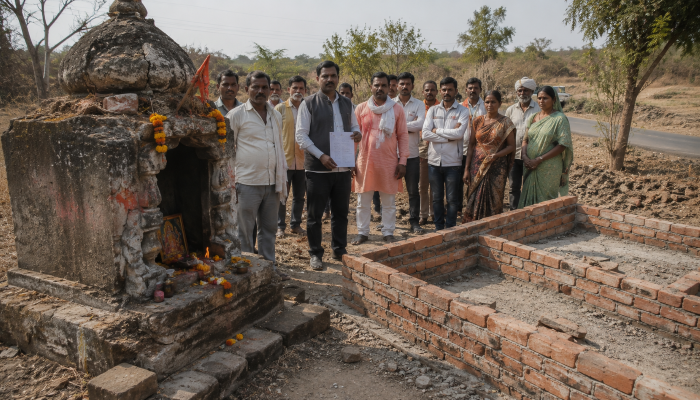
Case Summary
Hindu villagers of the Dungla area, Madhya Pradesh, submitted a memorandum to the Sub-Divisional Officer, Dungla, demanding the immediate removal of an encroachment on the ancient shrine of Joida Bawaji, a Hindu sacred site approximately 400 to 500 years old, located near a bridge on the road from Prem Nagar old tehsil toward Pipeleshwar Mahadev Mandir. The shrine had been a centre of daily puja [devotional worship offered to Hindu deities through rituals involving flowers, incense, lamps, and prayers] and archana [a devotional offering of flowers to a deity accompanied by the recitation of names] for generations of Hindu devotees and was described as a symbol of religious faith and social tradition for hundreds of years. The memorandum stated that to the north of the shrine lay the plot of the late Vardichandra Mehta, former sarpanch of the area. It was stated that a pucca [permanent, constructed of brick and cement] foundation had been laid on this plot near the shrine, constituting an encroachment on the sacred site. Villagers stated that Vardichandra Mehta's heirs had been asked on multiple occasions to remove the encroaching wall. In response, the heirs, operating through MLAs Virendra and Lalala Mehta, had covertly conveyed to villagers that the shrine of Joida Bawaji fell within their plot boundary and should be removed. Dozens of villagers submitted the memorandum at the Dungla sub-divisional headquarters, demanding the prompt removal of the encroachment and the carrying out of necessary development work at the shrine. Villagers stated that the attempt to claim the shrine as part of a private plot was not only an assault on religious sentiments but also on the village's cultural heritage. All attention was on the sub-divisional administration's decision regarding the protection of the centuries-old shrine at the time of publication.
Why it is Hate Crime ?
The primary category for this case is "Attack on Hindu religious representations". The sub-category here for this case is "Encroachment or illicit takeover of temple land/land near temple". In Hinduism, a temple is the abode of the Deity. The Deity in the Temple is consecrated, thereby, making it a real, breathing entity. Hindus believe that not just the Deity but the temple premises itself are sacred to Hindus since Hindus hold the faith that the entire Temple space is an amalgamation of the divine energy of the deity. Not only the Temple but the Temple premises in its entirety are considered sacred by Hindus. In several cases, the premises of the Temple and/or religious centre are illicitly taken over by institutions belonging to other faiths – like the Waqf board or the Church. Other times, the temple property, land or the property of religious centres are illicitly encroached by non-Hindu groups. Any illicit take over or encroachment is a crime an initio, however, when non-Hindu groups illicitly take over or encroach the sacred land of Hindus, it is an affront to the Hindu community and is therefore classified as a religiously motivated hate crime under this category. The encroachment on the shrine of Joida Bawaji was not a boundary dispute in the ordinary sense. It was a calculated attempt to use private land ownership claims to assert control over a Hindu sacred site that had served as a centre of communal devotion for 400 to 500 years. The laying of a pucca foundation adjacent to the shrine established a physical presence on land bordering the sacred site, while the simultaneous claim that the shrine itself fell within the plot boundary attempted to convert a centuries-old place of Hindu worship into private property through a legal and administrative manoeuvre. The covert nature of the pressure exerted on villagers is a significant indicator of the operation's intent. Rather than making their claim openly through legal channels, the heirs of Vardichandra Mehta used political intermediaries, specifically MLAs Virendra and Lalala Mehta, to convey to villagers that the shrine fell within their plot and should be removed. The use of elected political figures to communicate an implicit demand for the removal of a Hindu shrine reflects an awareness that the claim would not withstand open scrutiny and required the cover of political authority to be effective. The covert methodology of applying pressure through intermediaries rather than through a transparent legal process establishes that the operation was designed to achieve the displacement of the shrine before the community could mount an organised response. The shrine of Joida Bawaji is not merely an old structure. It is a living devotional site at which Hindu villagers conduct daily puja and archana. Its presence near the Pipeleshwar Mahadev Mandir situates it within a broader landscape of Hindu sacred sites in the area, establishing that the shrine is part of an active devotional geography rather than an abandoned historical monument. The attempt to claim the shrine as private property and remove it, therefore, constitutes an attack not merely on a physical structure but on the daily devotional life of the Hindu community that has worshipped there for generations. Given that this case met the parameters of a religiously motivated hate crime, the conduct of Vardichandra Mehta's heirs reflected more than a property boundary dispute. By laying a physical foundation adjacent to the shrine, claiming the shrine itself as part of their private plot, and using political intermediaries to covertly pressure the Hindu community to accept the shrine's removal, their actions demonstrated a deliberate effort to dispossess the Hindu community of a sacred site that has been the centre of their devotional life for centuries. This reflected a complete disregard for the faith of those several Hindu devotees, for whom this temple was not only a structure but a sacred site that had served as a centre of devotion for generations. Given that this case met the parameters of a religiously motivated hate crime, it was added to the hate crime database of the tracker. Disclaimer: The Hinduphobia Tracker records incident dates based on when the crime occurred, not when it was reported or published. However, since the exact date on which the encroachment commenced was not confirmed in the source, 25 December 2025, the day the media reported the news, has been used as the primary incident date. This was recorded for documentation purposes only.


Case Status
Complaint filed


Perpetrators Details
Perpetrators
Others
Perpetrators Range
Unknown
Perpetrators Gender
unknown
 Sources




