800 year old Hindu temple demolished by state government in Warangal
 Warangal, Telangana, India
  7 May, 2026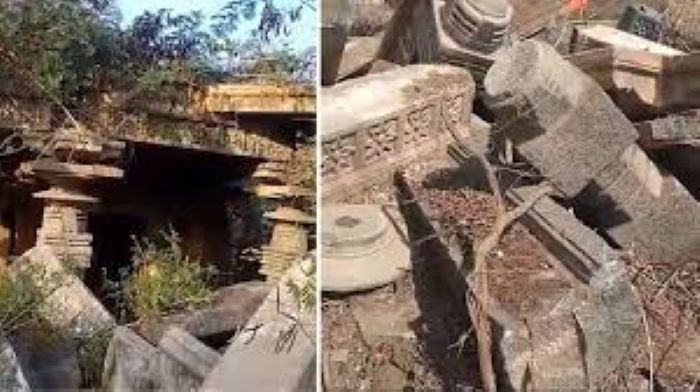
Case Summary
An 800-year-old Hindu temple of Lord Shiva from the Kakatiya period was demolished in Ashok Nagar village, Khanapur Mandal, Warangal district, Telangana, on 6 May 2026, during land-clearing work for the construction of a Young India Integrated Residential School under the Telangana Congress government's education initiative. The demolition triggered widespread outrage among historians, heritage activists, opposition leaders, and residents. The temple was believed to date to the reign of the Kakatiya ruler Ganapatideva and contained a rare seven-line Telugu inscription dated February 1231 AD, which referred to Ganapatideva with titles including Maharaja and Rajadhirajulu, meaning "king of kings". The temple stood within the historic Kota Katta mud fort zone, an area associated with ancient Kakatiya-era defensive structures. The Heritage Department had documented the temple as far back as 1965. The structure occupied less than half an acre within the larger 20 to 30-acre site identified for the school project. Historians stated that the granite pillars and inscriptions were buried under debris following the demolition. Some reports indicated that the sanctum sanctorum was dug up during the process, raising suspicions of attempts to search for hidden treasure beneath the structure. Following backlash, a joint inspection on 6 May, involving officials from the Revenue Department, the Archaeology Department, the Telangana State Education Welfare and Infrastructure Development Corporation, and local revenue authorities, was carried out, after which the Warangal district administration issued a clarification. The administration denied intentional demolition, stating that the area had been heavily covered with thick bushes and trees, and that remnants of a dilapidated structure were found on the ground during vegetation clearing. Officials stated that no dismantling activity had been carried out by the executing agency and that the land belonged to the government and was not listed as endowment land. Archaeology Department officials stated that the temple was not notified or recorded in the list of protected monuments or archaeological sites. Historians and activists rejected this explanation, noting that the temple had long been known locally and should have been protected regardless of its formal listing status. Telangana rights lawyer Immaneni Rama Rao filed a complaint with the National Monuments Authority, seeking legal action under Section 30 of the Telangana Heritage Act, against officials who allowed the demolition without the mandatory approvals from the Archaeology and Endowments Departments. The complaint also accused the state government of failing to form the required Heritage Conservation Committee under the law. Following the complaint, both the Union Ministry of Culture and the Archaeology Department registered a case regarding the demolition. Warangal District Collector Dr Satya Sharada and Narsampet MLA Donthi Madhava Reddy visited the site and assured locals that the temple would be reconstructed. The Collector described ancient monuments as rare heritage assets and stated that the administration would work with historians and archaeology experts to restore the structure. MLA Reddy assured residents that the Shiva temple would be rebuilt at the same location alongside the proposed school project and that an idol of Goddess Saraswati would be installed at the reconstructed shrine. BJP District General Secretary Rana Pratap Reddy condemned the demolition and demanded the reconstruction of the temple in its original design, accusing the government of proceeding without the Archaeology Department's clearance. Former BRS MLA Peddi Sudarshan Reddy demanded strict action against the contractor and questioned whether official approvals had been obtained before the structure was razed.
Why it is Hate Crime ?
The primary category for this case is "Attack on Hindu religious representations". The sub-category for this case is "Attack on temples". In Hinduism, a temple is the abode of the Deity. The Deity in the Temple is consecrated, thereby, making it a real, breathing entity. Hindus believe that not just the Deity but the temple premises itself are sacred to Hindus since Hindus hold the faith that the entire Temple space is an amalgamation of the divine energy of the deity. Given the central significance of Temples in Hindu Dharma, any attack against a Hindu Temple or its peripheral premises is an attack on the faith itself and is born out of animosity towards the faith, of which, the Temple is a central tenet. Any manner of attack against a Temple and/or its premises would therefore be considered a religiously motivated hate crime. Another sub-category for this case is "Desecration of Hindu religious symbol". Icons and symbols or a religious representation of a spiritual ideal are widely revered in Hinduism. Iconography is of vital significance in the Hindu milieu. It helps connect people’s spiritual beliefs with the real world. Iconography within the Hindu faith takes several shapes and forms. Murtis are of most significance to Hindus, to which daily rituals, prayers and offerings are done. Besides the murtis, there are several other symbols which have deep significance in the Hindu faith – the Om and Swastika for example. Since these Hindu religious symbols hold paramount importance in Hinduism, any desecration of symbols, icons, murtis, religious representations and manifestations, is driven by animosity towards the faith itself which manifests itself through these murtis, icons and symbols. Therefore, any desecration of these Hindu religious symbols and representations is considered religiously motivated hate crimes under this category. The demolition of the Kakatiya-era Shiva temple in Warangal was not an unavoidable consequence of development. It was a choice. Historians and heritage advocates who became aware of the demolition were unequivocal on this point: the temple could have been built around, left standing, or carefully dismantled and reassembled at an alternative location. The state government chose none of these options. It chose a bulldozer. The temple that was destroyed was not a generic historical structure. It was a Shiva temple dated to February 1231 AD, built during the reign of Kakatiya ruler Ganapatdeva, one of the most significant Hindu dynasties in the history of the Deccan. The inscription on its mandapa pillar addressed Ganapatdeva as Maharaja and Rajadhirajulu, establishing the temple as a site of direct royal Hindu patronage and devotional significance. The Department of Heritage Telangana had recorded the temple's inscriptions as far back as 1965, confirming its protected status under the State Archaeology department. A site that the state itself had officially recognised and recorded as a heritage asset for over six decades was demolished by that same state for a school construction project. The physical character of the temple underscores the magnitude of what was destroyed. Its pillars, which appeared machined rather than sculpted, its carved beams and jambs, and its mandapa formed part of the ancient Kota Katta fort complex, a multi-component Hindu heritage site that included the temple, an ancient mud fort, and ponds on all four corners. The demolition did not merely destroy a building. It destroyed an irreplaceable physical record of 13th century Hindu civilisation, devotional life, and royal patronage in Telangana, along with the seven-line Telugu inscription that Satyanarayana had deciphered and that constituted a primary historical document of the Kakatiya period. The administration's disregard for the temple's protected status is a form of institutional desecration. A Hindu temple under the purview of the State Archaeology department carries legal protection precisely because the state has recognised its historical and cultural significance. The decision to demolish it without exploring preservation alternatives reflects an institutional indifference toward Hindu religious heritage that, in its practical effect, is indistinguishable from deliberate desecration. The temple was not destroyed because its protection was unknown. It was destroyed despite its protection being on record for over six decades. Given that this case met the parameters of a religiously motivated hate crime, the state government's conduct reflected more than administrative negligence or developmental prioritisation. By demolishing a protected 800-year-old Shiva temple under the State Archaeology department using a bulldozer, without exploring any of the available preservation alternatives, and destroying in the process an irreplaceable 13th century inscription and a multi-component Kakatiya-era heritage complex, the administration demonstrated a structural indifference toward Hindu religious and civilisational heritage that cannot be separated from the religious identity of what was destroyed. The Shiva temple in Warangal was demolished specifically because it was a Hindu religious site whose protection was not treated as a binding constraint on developmental priorities, and its destruction reflects an underlying institutional subordination of Hindu religious heritage to non-Hindu administrative objectives. This reflects an underlying hostility toward Hindu religious identity that cannot be characterised as anything other than religiously motivated. Given that this case met the parameters of a religiously motivated hate crime, it was added to the hate crime database of the tracker. Disclaimer: The Hinduphobia Tracker records incident dates based on when the crime occurred rather than when it was reported or published. The exact date on which the temple was demolished was not confirmed in the source. 8 May 2026 has been used as the primary incident date, derived from the source's publication date. This was recorded for documentation purposes only.


Case Status
Complaint not filed


Perpetrators Details
Perpetrators
State and Establishment
Perpetrators Range
Unknown
Perpetrators Gender
unknown
 Sources




