Brahmin community targeted with explicit public call for violence as Madhya Pradesh man posts reward offer for killings
 Bhind, Madhya Pradesh, India
  30 April, 2025
Case Summary
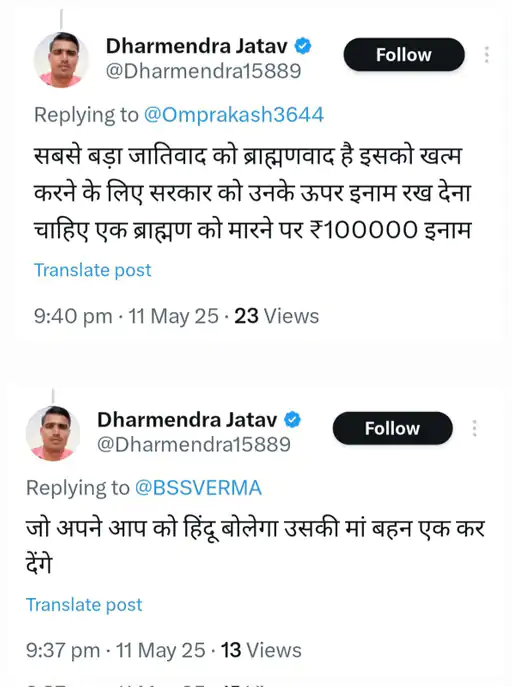
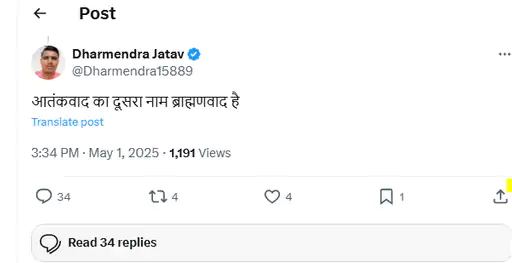
The Brahmin community in India was subjected to an explicit public call for violence when Dharmendra Jatav, a medical store operator from Nakhnoli, Ater area, Bhind district, Madhya Pradesh, posted inflammatory content against them on social media platform X, formerly known as Twitter. The posts caused widespread outrage among Hindu organisations across the country. In one post, Jatav wrote: "Brahminism is terrorism, the government should give Rs 1 lakh for killing a Brahmin." The post explicitly called for financial reward for the killing of members of the Brahmin community. In a separate post, he used objectionable and insulting language directed at the Hindu community more broadly. The posts went viral and provoked anger across social media nationally. As the controversy grew, Jatav attempted to apologise in a subsequent post but the outrage among Hindu organisations did not subside. Parshuram Sena district president Devesh Sharma alias Sonu filed a formal complaint at Bhind Kotwali police station after Jatav's identity and location were confirmed. Police registered an FIR against Dharmendra Jatav on Wednesday. Kotwali TI Brajendra Sengar confirmed that the FIR had been registered and that Jatav would be taken into custody soon. Strict action on objectionable and inflammatory social media posts was stated to be forthcoming.
Case Images
Why it is Hate Crime ?
The primary category for this case is "Hate speech against Hindus". The sub-category for this case is "Call for genocide/violence against Hindus/specific sects of Hindus". Hate speech is defined as any speech, gesture, conduct, writing, or display that is prejudicial against a specific individual and/or group of people, which is leading to or may lead to violence, prejudicial action or hate against that individual and/or group. Often, animosity against Hindus or a specific panth/sampradaya/group of Hindus or a specific ideology they hold manifests itself into hate speech and calls for genocide/violence against that specific section of Hindus. For example, it has often been seen that those who hold animosity against the Hindu faith use specific sects/sampradaya/pant of Hindus as a proxy to express hate against Hindus as a whole. It has been seen that the word ‘Hindutva’ has been used to call for violence against those who say they believe in ‘Hindutva’. It is observed that ‘Hindutva’ is only used as a proxy to call for violence against Hindus as a whole, as seen in the Dismantling Global Hindutva conference where speakers admitted that ‘Hindutva’ cannot be eradicated till ‘Hinduism’ is eradicated. The eradication of an entire faith, in turn, is a genocidal call against the entire community that practices that faith. Further, it is also observed that violence against a specific section of Hindus is made, justifying these calls by weaving exaggerated tales of historical injustices. Often, those who hold animosity towards Hindus and their faith attempt to make their animosity more palatable by justifying their hate for a specific section, claiming that they are against that particular section because of their faith in the broader community and the religion they process. Such calls for violence against specific sections of Hindus, as mentioned, is a proxy for their animosity against the entire community and the faith they profess, and therefore, would be considered hate speech under this category. Another sub-category for this case is "Anti-Hindu slurs, mocking faith". Anti-Hindu slurs and the deliberate mocking of the Hindu faith owing to religious animosity involve the usage of derogatory terms, stereotypes, or offensive references to religious practices, symbols, or figures. One of the common anti-Hindu slurs used against Hindus is “cow-worshipper” and “cow piss drinker”. The intention of using this term is to demean and mock Hindus as a group and their religious beliefs since Hindus consider the cow holy. Additionally, some symbols and the slurs attached to them have a historical context that exacerbates the insult, hate, stereotyping, dehumanisation and oppression against Hindus. Cow worship has been used for centuries to denigrate Hindus, insult their faith and oppress Hindus specifically as a religious group. There has been overwhelming documentation about how cow slaughter has been used to persecute Hindus with cow meat being thrown in temples and places of worship. There has also been overwhelming documentation where cow meat (beef) has been force-fed to Hindus to either forcefully convert them to Islam or denigrate their faith. Apart from cow worship, the Swastika – which holds deep religious significance for the Hindus – has also been misinterpreted and distorted to use as a slur against Hindus. Similarly, the worship of the Shivling has been used by supremacist ideologies and religions to denigrate Hindus owing to religious animosity. Such slurs and denigration stem out of inherent animosity and hate towards Hindus and their faith, therefore, it is categorised as hate speech targeted at Hindus specifically owing to their religious identity. Dharmendra Jatav's posts were not expressions of political disagreement or social criticism. They were explicit incitement to violence against a specific Hindu community and a broader attack on Hindu religious identity. The post calling for a government reward of Rs 1 lakh for killing a Brahmin was not rhetorical excess or hyperbole. It was a direct, public, and monetised call for the murder of members of a specific Hindu community, published on a platform with national reach and viral potential. The framing of Brahminism as terrorism is a deliberate ideological move that goes beyond criticism of caste hierarchy. Brahminism as a concept encompasses not merely social organisation but the custodianship of Hindu scriptural tradition, ritual practice, and religious knowledge that has been central to Hindu civilisational continuity for millennia. To characterise it as terrorism is to characterise the preservation and transmission of Hindu religious tradition itself as a violent and criminal enterprise. This framing does not merely attack a social group. It attacks the religious and civilisational foundations of Hinduism by equating its oldest institutional form with the most extreme category of criminal conduct recognised in modern law. The call for state-sponsored financial reward for killing Brahmins represents a particularly dangerous form of anti-Hindu incitement. By invoking government authority as the mechanism through which violence against Brahmins should be incentivised, Jatav was not merely expressing personal hostility but was calling for the institutional legitimisation of anti-Hindu violence. The post was designed to normalise the idea that the killing of Brahmins was not merely permissible but deserving of official recognition and financial compensation. The viral spread of the post across social media amplified this normalisation to a national audience. The separate objectionable post directed at the broader Hindu community establishes that Jatav's hostility was not limited to the Brahmin community but extended to Hindu religious identity as a whole. The two posts together reflect a sustained and directed anti-Hindu animus that targeted both a specific Hindu community and the broader Hindu religious identity simultaneously. The attempted apology issued by Jatav after the posts went viral does not mitigate the severity of the original conduct. The apology was reactive, issued only after the posts attracted national attention and organised Hindu community pushback. Its timing and context establish it as damage control rather than a genuine retraction of the expressed hostility toward the Brahmin and Hindu communities. Given that this case met the parameters of a religiously motivated hate crime, Jatav's conduct reflected more than offensive social media activity. By publicly calling for financial reward for the killing of Brahmins, characterising a foundational strand of Hindu religious tradition as terrorism, and directing additional objectionable language at the broader Hindu community, his actions demonstrated a deliberate and public campaign of incitement against Hindu religious identity at both the community and civilisational level. The Brahmin community and the broader Hindu community were targeted specifically because of their Hindu religious identity, and the posts were designed to incite violence against them and delegitimise their religious tradition in the eyes of a national audience. This reflects an underlying hostility toward Hindu religious identity that cannot be characterised as anything other than religiously motivated. Given that this case met the parameters of a religiously motivated hate crime, it was added to the hate crime database of the tracker.


Case Status
Complaint registered


Perpetrators Details
Perpetrators
Others
Perpetrators Range
One Person
Perpetrators Gender
male
 Sources




