Anti-Hindu hate speech: Bangladeshi Muslim cleric incites Indian Muslims to commit violence against Hindus and their political leaders
 Bangladesh
  4 May, 2026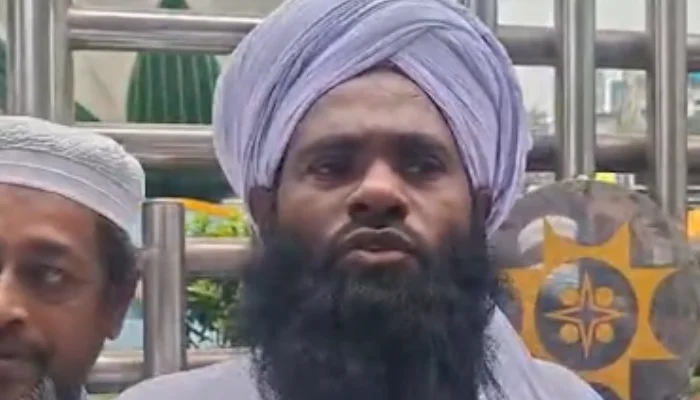
Case Summary
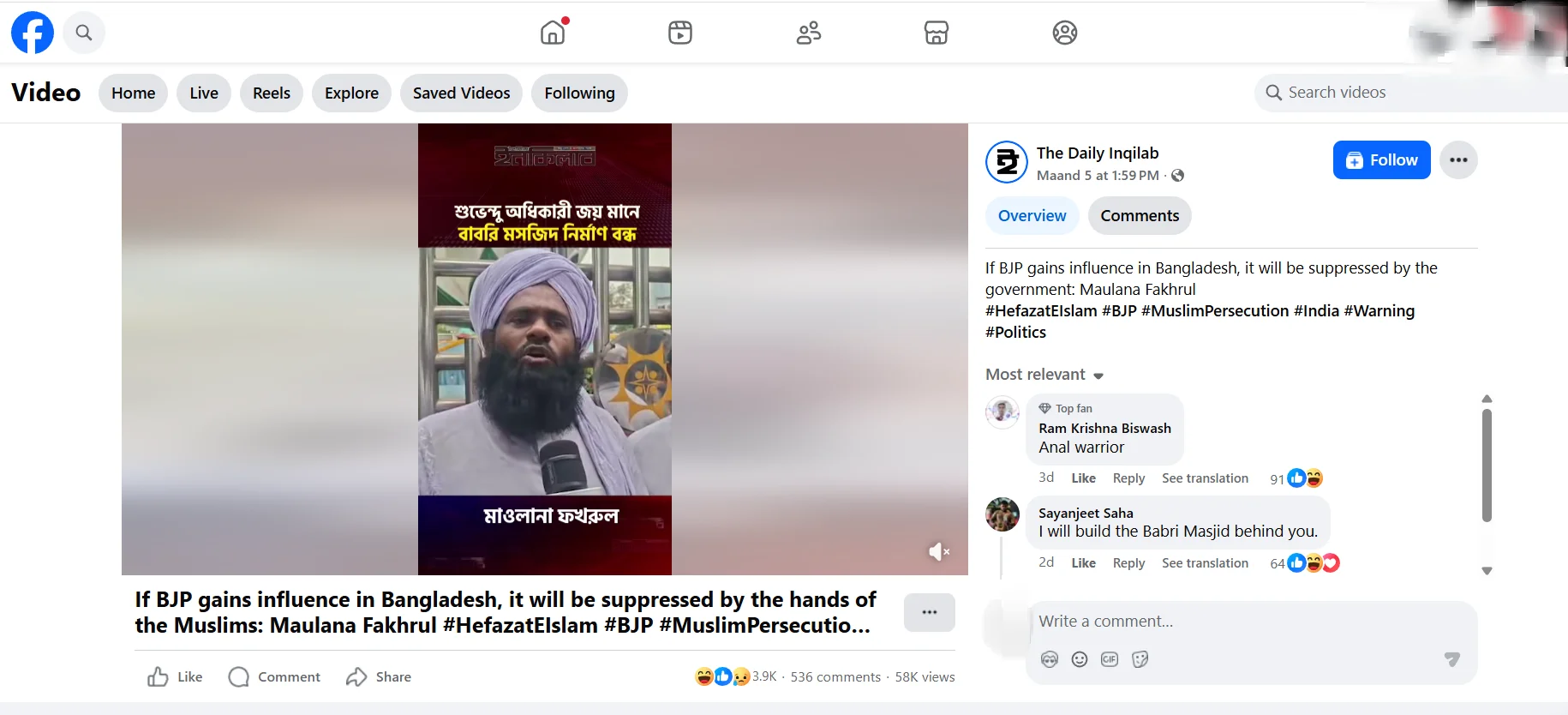
An anti-Hindu hate speech was made by Bangladesh Muslim cleric Maulana Fakhrul of Hefazat-e-Islam, a radical Islamic group. The accused incited Indian Muslims after the Bharatiya Janata Party's (BJP) West Bengal state election victory in May 2026 and tried to mobilise them against Narendra Modi and the BJP. He also tried to incite Muslims to commit violence against the Indian state, indirectly targeting the majority Hindu community. The backdrop of this incident is the West Bengal Assembly Elections, which saw the Bharatiya Janata Party achieve a historic landslide victory, sweeping over 200 seats in the 294-member assembly and ending the Trinamool Congress's 15-year rule under Mamata Banerjee. Held in multiple phases during late April 2026, with counting on 4 May 2026, the Bharatiya Janata Party capitalised on anti-incumbency, consolidated Hindu votes, fragmented Muslim support for the Trinamool Congress, strong urban performance, and welfare schemes. After the victory, Bharatiya Janata Party workers and ordinary Hindu citizens celebrated by raising Bharatiya Janata Party flags with slogans of "Jai Shri Ram" and by applying saffron gulal, coloured powder, on each other. The accused, Maulana Fakhrul, while interacting with Bangladeshi media on 5 May 2026, said that after the Bharatiya Janata Party comes to power in West Bengal, the lives of Indian Muslims would be miserable and they would face persecution under Bharatiya Janata Party rule, which he called a "Hindu rule". He also tried to incite Indian Muslims by saying that when Suvendu Adhikari, a Bharatiya Janata Party leader, becomes the Chief Minister of Bengal, he would throw out Muslims and persecute them to the point that they would either have to flee or convert to Hinduism to survive. He also tried to incite Indian Muslims to go to war against Narendra Modi and the Bharatiya Janata Party and said that all Bangladeshi Muslims were in support of Indian Muslims in this goal. The accused indirectly incited all Indian Muslims to get out on the street and commit violence. The accused also tried to invoke the Babri Masjid demolition incident and said that the Bharatiya Janata Party and Narendra Modi demolished the Babri Masjid and that Indian Muslims should remember that. He again incited them to commit violence and said that if the Bharatiya Janata Party ran Bengal, their lives would be miserable. Videos of the accused's remarks went viral on social media, triggering outrage from Hindu users who stated that the Maulana was trying to mass mobilise Muslims to commit violence against Hindus and the Indian state. Journalist Subhi Vishwakarma made a post regarding this on her official X account. She said: "They do not know the future of their own country but are concerned about ours: Meet Hefazot-e-Islam leader Maulana Fakhrul from Bangladesh. He is saying, 'Bharatiya Janata Party's victory in Bengal indicates great trouble for Indian Muslims.'" She further added: "He is asking Muslims in India to wage a war against Bharatiya Janata Party and Narendra Modi, who demolished their Babri Mosque. Ironically, their country is running at the mercy of many nations, including the one administered by Modi, whom they are abusing. Zombies for a reason."
Case Images
Why it is Hate Crime ?
This case was added to the tracker under the primary category selected: Hate Speech against Hindus. Within this, the sub-category selected was: Violent Threats. Violent threats, explicit, implicit or implied, were the most dangerous form of hate speech since they went beyond discriminatory and prejudicial language to express the intent of causing harm to an individual or a group of people based on their religious identity and faith. There could have been several different kinds of threats that were issued to Hindus based on religious animosity. An explicit threat would have meant the direct threat of violence towards an individual Hindu, a group of Hindus or Hindus at large. Physical violence, death threats, threats of destruction of property belonging to Hindus and threats of genocide would have meant explicit threats against Hindus for their religious identity. Implicit threats may not have been a direct threat but implied through the use of symbols or actions – for example – in the Nupur Sharma case, other than explicit threats, there were also implicit threats when Islamists took to the streets to burn and beat her effigies. It implied that they wanted to do the same to Nupur Sharma – thereby considered an implicit threat. Violent threats could have been delivered in person, through letters, phone calls, graffiti, or increasingly through social media and other online platforms. It would have been important to understand that a threat – explicit or implicit, online or offline – to an individual who happened to be a Hindu did not qualify as a religiously motivated threat. Such a threat, while vile and dangerous, could have been owing to non-religious reasons and/or personal animosity. To qualify as a religiously motivated threat, it would have needed to exhibit an indication that the individual was being targeted for religious reasons and/or owing to his/her religious identity as a Hindu. This incident exemplifies religiously driven hate speech targeting Hindus, their revered politicians, and the Indian nation state, which the Muslim cleric perceived as embodying Hindu essence, linking the Bharatiya Janata Party and Narendra Modi's leadership to Hindu self-assertion and cultural revival. The Muslim speaker issued incendiary statements vilifying India, Prime Minister Narendra Modi's administration, and the Bharatiya Janata Party (BJP). He sought to provoke Muslims into violent action against the Bharatiya Janata Party and the Modi regime, cementing its status as religiously motivated hate speech. It is pertinent to note that Muslim extremists harbour specific animosity towards Hindus and their faith and also view India as a Hindu collectivity. The very basis of the partition of India and the creation of Pakistan, including modern-day Bangladesh, was that Muslims believed Islam was a nation unto itself, which could not survive alongside a Hindu collectivity like India. Consequently, when Muslim individuals, such as Maulana Fakhrul of Hefazat-e-Islam, invoke religious identity, weaponise the idea of the global Ummah (global Muslim brotherhood and unity), and call for collective Muslim mobilisation against the Indian state, it is not merely political provocation but an ideological assertion that frames Hindus and the Indian nation as adversaries. In this context, Maulana Fakhrul's call for Bangladeshi Muslims to unite behind Indian Muslims in opposing Narendra Modi and the Bharatiya Janata Party demonstrated more than support for a political cause; it portrayed religious hostility against India as a Hindu-majority nation. The Muslim cleric held no personal stake in India or the Hindu community. Yet he brazenly sought to rally Indian Muslims under the banner of pan-Islamic Ummah solidarity against the Indian state and its Hindu collectivity, viewed by them as a direct challenge to Hindus and their political leadership in the Bharatiya Janata Party. Muslims perceive the Bharatiya Janata Party as a staunchly Hindu or Hindutva outfit championing pro-Hindu rights. To the perpetrator, opposition to the Bharatiya Janata Party transcended mere politics; it targeted the party as an emblem of Hindu empowerment and advocacy. Such acts reveal a clear case of anti-Hindu hate speech, deeply rooted in animosity towards Hinduism and the Hindu community, which bristles at Hindus claiming their rightful voice and political strength. By rallying Muslims under the expansive banner of a global pan-Islamic Ummah, a transnational brotherhood that overrides national loyalties, the cleric unleashed overtly anti-Hindu rhetoric, explicitly portraying the Hindu community as irredeemable enemies or kafirs whose very existence demands destruction, subjugation, or forced conversion to Islam. This calculated provocation builds on Islamic supremacist theology that deems non-Muslims as perpetual threats, with his brazen incitement of Muslims through Islamic exhortations against the Indian state and the Modi government directly targeting core Hindu interests, such as cultural preservation and political self-determination. It unequivocally marks this as religiously motivated hate speech, maliciously recasting sovereign India, a nation rooted in Hindu civilisational ethos, as a pernicious Hindu stronghold bent on the annihilation of Muslim life, thereby justifying retaliatory violence in the name of faith. His explicit invocation of cross-border solidarity, boldly declaring that all Bangladeshi Muslims stood ready to support Indian Muslims in their violent goal against Hindu-led India, masterfully exposes how he weaponised religious identity to dismantle national boundaries and ignite a borderless jihad (holy war against non-Muslims). This ploy transcends local grievances, fuelling mass mobilisation against Hindu-majority India solely because of its demographic and cultural Hindu collectivity, invoking the sacrosanct global Ummah's supremacy to portray Hindus as collective oppressors. By urgently calling upon every Muslim nationwide to launch attacks on the Bharatiya Janata Party's electoral triumphs, the Indian state itself, and Narendra Modi personally, he laid utterly bare his profound, unyielding religious enmity towards the Hindu community at large, its elected leaders who champion Hindu rights, and India as an enduring civilisational Hindu power, framing every democratic Hindu victory, like West Bengal's, as an apocalyptic harbinger of Muslim persecution that demands immediate, unified retribution. Furthermore, the invocation of the Babri Masjid demolition shows the malicious and religiously provocative intent of the accused more clearly. The Babri Masjid was a mosque built by the Islamic invader Babur after destroying the Ram Janmabhoomi temple, a sacred temple of Lord Ram in Ayodhya, under the Mughal rule. The Hindu community, through persistent activism, finally reclaimed the site in the 1990s when Kar Sevaks (Hindu activists) demolished the illegal mosque. This was an act of civilisational justice, not motivated by anti-Islamic hostility, but a renaissance to rebuild the temple destroyed by Islamic invaders. Even this act of Hindus reclaiming their sacred site and demolishing the illegal mosque is used by Islamic clerics as a way to mobilise Muslims against the Hindu community, the Indian state, Narendra Modi and the Bharatiya Janata Party. This showcases how Islamic clerics harbour deep-seated religious animosity to stoke communal tensions in India, where Hindus have often been victims of riots at the hands of Muslim mobilisation. This exemplifies Islamist supremacist narratives to incite Muslim mobs against non-Muslims, making it a clear case of religiously motivated hate speech and violent threats. Given that this case meets the parameters of an anti-Hindu hate speech, it is added to the hate crime database of the Hinduphobia Tracker.


Case Status
Unknown


Perpetrators Details
Perpetrators
Muslim Extremists
Perpetrators Range
One Person
Perpetrators Gender
male
 Sources




