Hindu temple in Haryana desecrated and robbed at night as thieves steal sacred idol and vandalise idol murti
 Panipat, Haryana, India
  6 May, 2026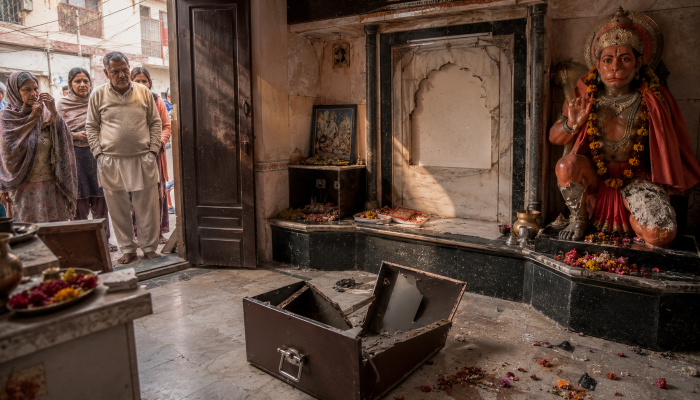
Case Summary
A Hindu temple in Manmohan Nagar, Kila police station area, Panipat, Haryana, was violated at approximately 2am on 7th May 2026 when thieves entered the premises and committed theft and desecration. Colony residents discovered the violation when they arrived at the temple in the morning. The thieves broke open the donation box and stole cash. A brass bell and the idol of Bhagwan Shri Krishna [one of the principal deities of Hinduism, revered as the eighth avatar of Lord Vishnu and a central figure of Hindu devotional life] were stolen from the temple. The idol of Bhagwan Hanuman [the divine devotee of Lord Ram, revered in Hinduism as the embodiment of strength, courage, and selfless service] was physically desecrated. The violation of the temple caused outrage among colony residents and Bajrang Dal workers. Resident Deepak Verma confirmed the details of the discovery to the media. Police registered an FIR and initiated an investigation. CCTV camera footage from the area was being examined to identify the perpetrators. No arrests were confirmed at the time of publication.
Why it is Hate Crime ?
The primary category for this case is "Attack on Hindu religious representations". The sub-category for this case is "Attack on Temples" In Hinduism, a temple is the abode of the Deity. The Deity in the Temple is consecrated, thereby, making it a real, breathing entity. Hindus believe that not just the Deity but the temple premises itself are sacred to Hindus since Hindus hold the faith that the entire Temple space is an amalgamation of the divine energy of the deity. Given the central significance of Temples in Hindu Dharma, any attack against a Hindu Temple or its peripheral premises is an attack on the faith itself and is born out of animosity towards the faith, of which, the Temple is a central tenet. Any manner of attack against a Temple and/or its premises would therefore be considered a religiously motivated hate crime. Another sub-category for this case is "Desecration of Hindu religious symbols". Icons and symbols or a religious representation of a spiritual ideal are widely revered in Hinduism. Iconography is of vital significance in the Hindu milieu. It helps connect people’s spiritual beliefs with the real world. Iconography within the Hindu faith takes several shapes and forms. Murtis are of most significance to Hindus, to which daily rituals, prayers and offerings are done. Besides the murtis, there are several other symbols which have deep significance in the Hindu faith – the Om and Swastika for example. Since these Hindu religious symbols hold paramount importance in Hinduism, any desecration of symbols, icons, murtis, religious representations and manifestations, is driven by animosity towards the faith itself which manifests itself through these murtis, icons and symbols. Therefore, any desecration of these Hindu religious symbols and representations is considered religiously motivated hate crimes under this category. The violation of the Manmohan Nagar temple targeted objects of direct devotional significance to the Hindu community it served. The theft of the idol of Bhagwan Shri Krishna and the physical desecration of the idol of Bhagwan Hanuman were not equivalent to the theft of generic valuables. In Hindu devotional practice, temple idols are not representations of deities. They are understood as living embodiments of the divine, consecrated through ritual and maintained as the devotional centre of the community's relationship with their chosen deities. The removal of the Krishna idol did not merely deprive the temple of a physical object. It removed the divine presence around which the community's daily worship was organised. The desecration of the Hanuman idol carries a particular religious significance. Bhagwan Hanuman is not merely a devotional figure but a protector, revered across Hindu communities as the embodiment of strength, courage, and divine guardianship. His idol's presence in a neighbourhood temple is understood as a source of protection for the community it serves. The physical desecration of this idol was therefore not an act directed at an inanimate object but an act directed at the community's sense of divine protection and religious security. The deliberate breaking of the Hanuman idol, in contrast to the theft of the Krishna idol and the cash, suggests that the desecration was a purposeful act rather than collateral damage from a theft operation. The breaking of the donation box alongside the theft of sacred items and the desecration of the Hanuman idol establishes that the violation extended across every dimension of the temple's religious and material life simultaneously. The donation box represents the community's collective financial investment in their place of worship. Its destruction alongside the theft of sacred items indicates that the temple was targeted comprehensively rather than selectively, with every element of its religious and material character violated in a single operation. Given that the perpetrators remain unidentified and religious motivation has not been established beyond the targeting of a Hindu sacred site, the degree to which this constitutes a religiously motivated act cannot be fully determined on the available evidence. However, the physical desecration of the Hanuman idol, which served no material purpose for a theft operation, introduces a dimension of deliberate religious hostility that goes beyond opportunistic theft of valuables. The selectivity of the desecration, directed at the most spiritually significant protective figure in the temple, is consistent with an act motivated by hostility toward Hindu religious identity rather than purely by material gain. Given that this case involved the desecration of a Hindu religious site and met the documentation threshold for the Attack on Hindu religious representations category, it was added to the tracker's database.


Case Status
Complaint registered


Perpetrators Details
Perpetrators
Unknown
Perpetrators Range
Unknown
Perpetrators Gender
unknown
 Sources




