Hindu politicians targeted for their faith and subjected to death threats by members of Trinamool Congress in West Bengal
 Kolkata, West Bengal, India
  3 May, 2026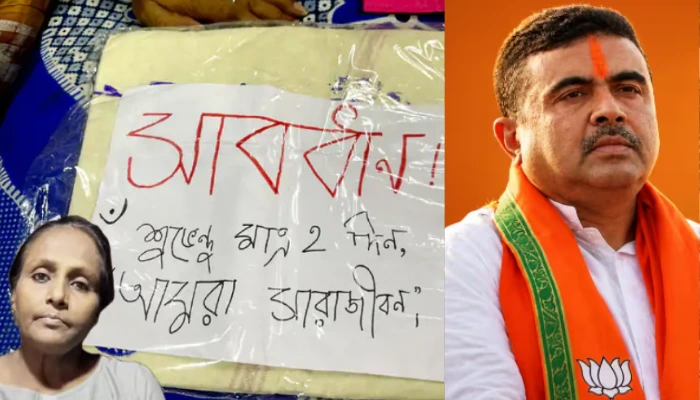
Case Summary
In Kalighat, Kolkata, West Bengal, the Hindu Bharatiya Janata Party leader Suvendu Adhikari was targeted because of his religious identity. He received death threats and threats of physical violence from individuals linked to the ruling All India Trinamool Congress (also known as Trinamool Congress). The accused sent a white saree to Rita Dutta, wife of a Bharatiya Janata Party politician, which in Hindu culture is associated with mourning, widowhood, or death rituals, and threatened to murder Suvendu Adhikari while also warning that Bharatiya Janata Party workers across West Bengal would be physically assaulted. Notably, the incident took place while the 2026 West Bengal state legislative elections were still underway, intensifying the political atmosphere and the sense of fear surrounding the threats. According to media reports, Rita Dutta, who lived in the Turf Road area of Kalighat, said that her husband had been associated with the Bharatiya Janata Party for 38 years. She stated that one day, Suvendu Adhikari visited their home, and barely ten minutes after he left, three young men, believed to be around 20 to 22 years old, arrived carrying a packet. They told her it had been sent by the All India Trinamool Congress. Inside the packet was a white saree with the words, “Suvendu only for two days, All India Trinamool Congress for a lifetime,” written on it. The packet also contained a symbol that, according to Rita, is commonly associated with death rituals. She understood the message as a direct threat against both her husband and Suvendu Adhikari because of their political affiliation and Hindu identity. Rita later stated, “Even after this, we kept receiving threats. It was said that we would see after 4 May 2026, the election results day. They would break the hands and legs of all Bharatiya Janata Party workers. We conveyed this matter to Suvendu da. With his help, we filed a First Information Report at Kalighat police station and got those people arrested.” Rita preserved the saree and the packet as evidence. Written in red ink on the packet was the word “Beware,” followed by the message: “Suvendu will stay for two days and All India Trinamool Congress for a lifetime.”
Why it is Hate Crime ?
This case is added to the tracker under the primary category selected in this case is: Hate Speech against Hindus. Within this, the sub-category selected is: Violent Threats. Violent threats, explicit, implicit or implied, is the most dangerous form of hate speech since it goes beyond discriminatory and prejudicial language to express the intent of causing harm to an individual or a group of people based on their religious identity and faith. There could be several different kinds of threats that are issued to Hindus based on religious animosity. An explicit threat would mean the direct threat of violence towards an individual Hindu, a group of Hindus or Hindus at large. Physical violence, death threats, threats of destruction of property belonging to Hindus and threats of genocide would mean explicit threats against Hindus for their religious identity. Implicit threats may not be a direct threat but implied through the use of symbols of actions – for example – in the Nupur Sharma case, other than explicit threats, there were also implicit threats when Islamists took to the streets to burn and beat her effigies. It implies that they want to do the same to Nupur Sharma – thereby is considered an implicit threat. Violent threats can be delivered in person, through letters, phone calls, graffiti, or increasingly through social media and other online platforms. It would be important to understand that a threat – explicit or implicit, online or offline – to an individual who happens to be a Hindu does not qualify as a religiously motivated threat. Such a threat, while vile and dangerous, could be owing to non-religious reasons and/or personal animosity. To qualify as a religiously motivated threat, it would need to exhibit an indication that the individual is being targeted for religious reasons and/or owing to his/her religious identity as a Hindu. This case stands as a clear example of a religiously motivated hate crime, as the Hindu Bharatiya Janata Party leader Suvendu Adhikari and the husband of Rita Dutta, a longtime Bharatiya Janata Party worker, were targeted explicitly for their faith identity, with Rita Dutta herself threatened as their associate. The perpetrators weaponised Hindu religious symbols against them, pairing death threats and promises of physical violence with items laden with Hindu religious and cultural significance. This created a potent mix of religiously motivated hate speech and violent intimidation, all aimed at terrorising the primary victims because of their Hindu identity, intertwined with their political affiliations, while extending fear to all other Bharatiya Janata Party workers. The deliberate choice to invoke symbols tied to Hindu mourning and death rituals stripped away any pretence of mere political rivalry, revealing a deeper prejudice against the victims due to their religion. It amounted to far more than simply giving a white saree to the wife of a Bharatiya Janata Party worker; it involved a chilling threat that Suvendu Adhikari had only two days left, while asserting that the All India Trinamool Congress would endure forever. This demonstrated a stark case of violent threats designed to target and kill a Hindu activist and politician like Suvendu Adhikari, driven by his religious identity and political stance. In Hinduism, the white saree holds profound symbolic weight; it is worn by widows in mourning or other Hindus during death rituals, evoking finality and loss. By sending this saree in a packet alongside a death symbol and the ominous warning, the perpetrators issued a direct, violent threat to Suvendu Adhikari's life, rooted in his Hindu identity and Bharatiya Janata Party affiliation, marking it unmistakably as a religiously motivated hate crime. Some might dismiss this case by calling it a routine political threat and not a hate crime. This argument could have been held valid if no Hindu symbolisms were involved, but the deliberate use of the white saree to menace the wife of a Bharatiya Janata Party worker proved the primary targets, Suvendu Adhikari and her husband, were singled out not just for politics, but for their Hindu identity. Targeting Hindu victims with such brutal death threats over their faith and political involvement exposes a profound, deep-seated religious animosity towards the Hindu community. The cultural specificity of the threat elevated it beyond partisan squabbles, turning a political contest into an act of communal hatred. The fact that the primary victims were associated with the Bharatiya Janata Party further underscores the religious motivations behind the crime. The religious threats embedded in the act make it evident that targeting these Bharatiya Janata Party figures stemmed from more than political affiliation. Anti-Hindu groups, such as leftists, Islamists and their allies in parties like the All India Trinamool Congress, have long viewed the Bharatiya Janata Party as a Hindutva party, essentially a Hindu party championing Hindu interests. Threatening Suvendu Adhikari, Rita Dutta's husband, and other workers with religious symbolism over their faith and politics reveals that the animosity was religious at its core, not merely political differences, solidifying this as a clear instance of religiously motivated hate speech. The perpetrators went beyond targeting just Suvendu Adhikari; they menaced Rita Dutta, the wife of a Bharatiya Janata Party worker, and vowed savage violence against all other Bharatiya Janata Party workers, including her husband. They were promising to break their limbs after the election results on 4 May 2026. This chilling escalation reveals not mere political posturing, but deep religious animosity: by delivering a white saree, a Hindu symbol of widowhood, mourning, and death, directly to a Hindu family home, they invoked profound cultural trauma, taunting Rita Dutta with the threat of her husband's loss just as they issued a death warning against Suvendu Adhikari. The pattern shows it was no isolated incident, but a broader assault on all Hindus advancing Hindu causes under the Bharatiya Janata Party banner, designed to shatter Hindu families, instil terror in Hindu communities, and assert dominance over Hindu spaces. By extending these threats to the entire network of Hindu party workers through religiously charged symbols and graphic promises of brutality, the act exemplified a religiously motivated hate crime, rooted in prejudice that seeks to intimidate, dehumanise, and ultimately suppress Hindu voices and identity. This incident was not the first of its kind. Similar targeting and attacks on Hindu Bharatiya Janata Party workers occurred during the brutal post-poll violence that followed the 2021 West Bengal state legislative elections, showcasing an established pattern of violence by All India Trinamool Congress members and supporters, including Muslim mobs, against Hindu citizens, activists, and politicians in Bengal under the guise of political rivalry. In 2021, these perpetrators unleashed a horrific wave of savagery across the state, systematically targeting Hindu Bharatiya Janata Party workers and ordinary Hindu citizens with extreme brutality. They murdered several workers in cold blood, raped women from their families in acts of unimaginable cruelty, slaughtered innocent children, razed homes to the ground, desecrated sacred Hindu temples, and set Bharatiya Janata Party offices ablaze. These calculated atrocities, though dressed up as political retribution, specifically zeroed in on the victims' Hindu religious identity and their dedication to protecting Hindu interests and civilisational values through the Bharatiya Janata Party. The consistent pattern of communal targeting, religious desecration, and unrestrained violence seen in 2021, mirrored by the current case's deliberate use of Hindu mourning symbols, confirms both as unmistakable instances of religiously motivated hate crimes against Hindus. Additionally, this is not the first time the All India Trinamool Congress government has targeted Hindus, Hindu activists, or the community in general. Over the past several years, a disturbing pattern has emerged in West Bengal, where incidents targeting Hindus, their temples, and festivals occurred with apparent support from the state administration. This targeting became institutionalised under Chief Minister Mamata Banerjee's leadership, as her government stood accused of deliberately shielding anti-Hindu elements while clamping down on Hindu rights. There are increasing instances where the state actively suppresses Hindu religious expression. Hindus have been arrested simply for chanting “Jai Shri Ram”, a phrase vilified by the administration and the ruling party. Permission for Hindu processions, especially during festivals like Ram Navami or Hanuman Jayanti, is routinely denied on grounds of "law and order concerns", while Muslim religious gatherings face no such hurdles. Moreover, over the years, the Mamata-led government issued numerous prejudicial directives, like orders restricting Durga Puja immersions citing Muharram processions. Inaction on anti-Hindu mob violence in areas like Dhulian, Islampur, and Kaliachak. Public endorsements and appeasement of radical clerics and Islamist leaders, while dismissing concerns raised by Hindu groups as “communal provocation”. The systematic suppression of Hindu voices, denial of communal violence, and criminalisation of Hindu identity expressions such as “Jai Shri Ram” reflect not just administrative failure but deeper ideological hostility towards the Hindu community. Even communal attacks against Hindus have been downplayed by the state and police authorities. A glaring example of this systemic whitewashing appears in the handling of the Murshidabad violence, as well as multiple other incidents in Basirhat, Malda, Midnapore, and Uttar Dinajpur. In the Basirhat case (March 2025), for instance, when a Kali temple was vandalised and the idol desecrated, the police quickly dismissed the communal nature of the attack and labelled the perpetrator as “mentally unstable” without serious investigation or due process. In the aftermath of widespread anti-Hindu violence in Murshidabad and Malda (April 2025), which included arson, looting, and idol desecration, the West Bengal Police attempted to present the violence as “minor clashes” or “local disputes” unrelated to religion. Reports indicated that despite credible accounts of Hindu homes and temples being attacked, the police either failed to act in time or took a biased stance that allowed the violence to escalate. In many cases, police statements contradicted eyewitness reports and video evidence shared on social media, showcasing institutionalised bias against Hindus who are victims of hate crimes. Given that this case unequivocally meets all parameters of a hate-driven offence, featuring explicit religious targeting through Hindu mourning symbols, death threats, and communal intimidation, it merits formal documentation. Accordingly, it has been added to the Hinduphobia Tracker's hate crime database, joining a growing record of similar incidents to expose institutional patterns of anti-Hindu violence in West Bengal and drive accountability. Disclaimer: The Hinduphobia Tracker records incident dates based on when the hate crime actually occurred, rather than media reporting dates. In this case, Rita Dutta did not specify the precise date she received the threatening white saree and death symbol. The only date mentioned was 4 May 2026, when perpetrators warned they would attack Bharatiya Janata Party workers by breaking their limbs after the election results. With the exact threat date unverified and media reports surfacing on 7 May 2026, documentation uses 4 May 2026 as the indicative incident date for reference purposes. Although Suvendu Adhikari and Rita Dutta's husband were the specifically named victims, along with other Bharatiya Janata Party workers, the total number of party workers targeted remains unspecified. Rita Dutta was also directly targeted as the recipient of the threatening white saree. For documentation purposes, the victim count is recorded as three, referring to Rita Dutta, her husband, and Suvendu Adhikari.
Victim Details
Total Victim
3
Deceased
0
Gender
- Male 2
- Female 1
- Third Gender 0
- Unknown 0
Caste
- SC/ST 0
- OBC 0
- General 3
- Unknown 0
Age Group
- Minor 0
- Adult 3
- Senior Citizen 0
- Unknown 0


Case Status
Arrested


Perpetrators Details
Perpetrators
State and Establishment
Perpetrators Range
From 2 To 5
Perpetrators Gender
male
 Sources




