Hindu minor lured from Faridabad to Ghaziabad for forced conversion and nikah by Muslim youth
 Ghaziabad, Uttar Pradesh, India
  7 May, 2026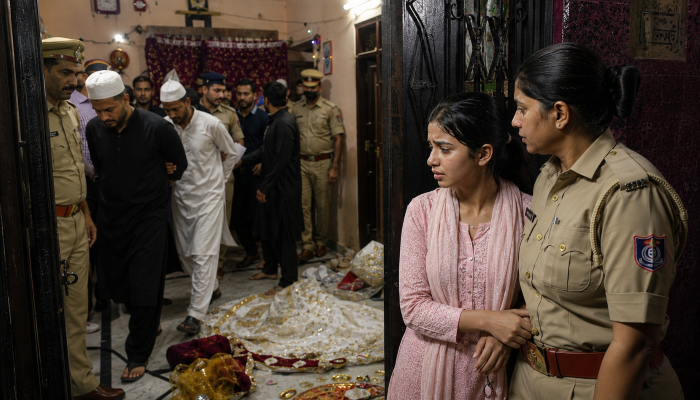
Case Summary
A Hindu minor girl from Faridabad, Haryana, was lured to the Kanauni area, Indirapuram, Ghaziabad, Uttar Pradesh, by a Muslim youth from her neighbourhood who brought her to a relative's house where preparations for her nikah [Islamic marriage ceremony] were underway. The nikah was being arranged following preparation to convert the minor from Hinduism to Islam. On 1 February 2026, at approximately 4pm, Bajrang Dal's Harnandi Mahanagar Special Contact Head Amit Parashar received information that a minor girl's nikah was being arranged. Bajrang Dal workers proceeded to the location and confirmed the information. When they arrived at the scene and questioned those present about the event, they were told that a birthday party was being organised. Neighbours corroborated the birthday party claim. Police were subsequently informed and arrived at the scene. Upon police arrival, Bajrang Dal workers entered the house and discovered that the minor was being subjected to a forced nikah. Upon seeing the police, family members attempted to send the youth and the minor away from the premises. Police intervened and stopped the nikah. The minor was recovered and handed over to her family members. The accused youth and family members were taken into custody. An investigation was initiated. The case was published by Navbharat Times on 3 February 2026.
Why it is Hate Crime ?
The primary category for this case is "Predatory Proselytisation". The sub-category for this case is "Proselytisation by grooming, brainwashing, manipulation or subtle indoctrination". The tertiary categories for this case are "Pattern of targeting Hindus" and "Conversion of minor". Religious brainwashing essentially means the often subtle and forcible indoctrination to induce someone to give up their religious beliefs to accept contrasting regimented ideas. Religious grooming or brainwashing also involves propaganda and manipulation. It involves the systematic effort, driven by religious malice and indoctrination, to persuade “non-believers’ to accept allegiance, command, or doctrine to and of a contrasting faith. Cases of such grooming or brainwashing are far more nuanced than direct threats, coercion, inducement and violence. In such cases, it is often seen that there is repeated, subtle and continual manipulation of the victim to induce disaffection towards their own faith and acceptance of the contrasting faith of the perpetrator. While subtle indoctrination is widely acknowledged as predatory, an element which is often understated in such conversions or the attempts of such conversion is the role of loyalty and trust which might develop between the perpetrator and the victim. Fiduciary relationships are often abused to affect such religious conversion. For example, an educator transmitting religious doctrine of a competing faith to a Hindu student. The Hindu student is likely to accept what the teacher is transmitting owing to existence of the fiduciary relationship. The exploitation of the fiduciary relationship to religiously indoctrinate victims would also be included in this category. Since the underlying animosity towards the victim’s faith forms the basis of predatory proselytization, such cases are considered religiously motivated hate crimes. The operation conducted against the Hindu minor in Kanauni was not an impulsive or spontaneous act. It was a premeditated and logistically organised effort to convert and marry a Hindu minor through a sequence of deception, relocation, and concealment. The accused youth lived in the minor's neighbourhood in Faridabad, establishing that the targeting was local and deliberate. His proximity to the victim provided the access through which the grooming relationship was cultivated before she was lured away from her family to another city entirely. The relocation of the minor from Faridabad to Ghaziabad is a significant operational marker. Moving the victim across city lines placed her in an unfamiliar environment, separated from her family and social network, and placed her within a household of the accused's relatives who were actively participating in the nikah preparations. The use of a relative's house as the operational base demonstrates that the accused was not acting alone but was supported by a family network that had been prepared to receive the minor and facilitate the conversion and nikah. This family-level participation establishes that the operation was organised rather than individual. The use of a false birthday party as a cover story is a further marker of premeditation. Both the accused's family and neighbours presented the same fabricated explanation when questioned, indicating that a coordinated cover narrative had been prepared in advance. The consistency of the false story across multiple individuals demonstrates that the operation had been planned with an awareness of the possibility of community or police intervention and that measures had been taken to conceal its true character. The willingness of neighbours to participate in the cover story further reflects the degree to which the operation had embedded itself within the local social environment. A Hindu minor had been separated from her family, relocated to another city, placed in a household of Muslim relatives, and was on the verge of being converted and married against her will. The intent behind this case was conversion. Not romance, not elopement, not a consensual relationship between two individuals. The accused identified a Hindu minor in his own neighbourhood, cultivated proximity and trust, and then executed a cross-city relocation operation specifically designed to place her in a controlled environment where her conversion and nikah could be completed before her family could intervene. The preparation of a relative's house as the venue, the coordination of a false cover story across multiple individuals, and the advance preparation of nikah arrangements all confirm that the objective was fixed from the outset: the conversion of a Hindu minor to Islam and her permanent removal from her Hindu family and religious identity through forced marriage. The accused did not act on impulse. He acted on a plan. And that plan had one religious objective at its centre. It is further important to note here that the victim was a minor, which means the element of consent and genuine change of conscience was missing ab initio. Minors, due to their young age and lack of maturity, are particularly vulnerable to manipulation and coercion. They may not have the ability to fully understand the implications of converting to another religion, and the Muslim perpetrator purposely targeted and exploited this vulnerability of the victim. Since this case exemplifies the use of coercion and manipulation to achieve religious conversion, it is a blatant act of religious hate, which is why it has been documented here in the hate tracker. By grooming a Hindu minor in her own neighbourhood, luring her across city lines under false pretences, placing her in a relative's household prepared to conduct a forced nikah, and concealing the operation behind a fabricated cover story, the perpetrator's actions demonstrated a deliberate and organised effort to permanently remove a Hindu minor from her religious identity and her family through conversion and forced marriage. The victim was targeted specifically because she was a Hindu minor, and every element of the operation, being neighbourhood proximity, cross-city relocation, family network support, and cover story preparation, was chosen because it would be most effective in completing a forced conversion and nikah before her family or community could intervene. Such actions reflect an underlying hostility towards the victim's professed faith since Abrahamic faiths believe that any non-adherent to the faith is subject to being dehumanised till they convert. Since such predatory actions stem from doctrinal animosity towards the Hindu faith and its adherents, this case is being documented as a religiously motivated hate crime.
Victim Details
Total Victim
1
Deceased
0
Gender
- Male 0
- Female 1
- Third Gender 0
- Unknown 0
Caste
- SC/ST 0
- OBC 0
- General 0
- Unknown 1
Age Group
- Minor 1
- Adult 0
- Senior Citizen 0
- Unknown 0


Case Status
Complaint filed


Perpetrators Details
Perpetrators
Muslim Extremists
Perpetrators Range
One Person
Perpetrators Gender
male
 Sources




