Hindu Dalit man abused with caste slurs and beaten to death over minor dispute with Muslim men
 Ghaziabad, Uttar Pradesh, India
  24 April, 2026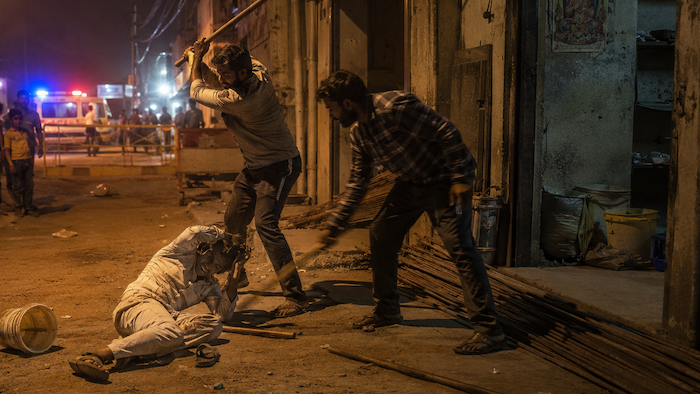
Case Summary
A Hindu Dalit man was beaten with sticks and rods by two Muslim men in Loni, Ghaziabad, Uttar Pradesh, after a dispute escalated into caste-based abuse and violence. The Hindu victim suffered severe injuries during the assault and later died during treatment. His family accused the perpetrators of targeting him with casteist slurs before the attack, demanding justice. The Hindu victim’s death triggered protests and political attention in Ghaziabad. Senior political representatives later met the victim’s family and assured them that strict action would be taken against the perpetrators involved in the killing. On 25th April 2026, Hindu Dalit man Sonu Jatav was standing outside a warehouse with several friends in Bagranp village in the Loni area of Ghaziabad district, Uttar Pradesh. During this time, a dispute arose over housecleaning work. Muslim man Aamir and his father Zaheer confronted the Hindu Dalit victim during the altercation. During the confrontation, the perpetrators used casteist slurs against Sonu Jatav before physically attacking him. The Hindu victim was beaten with sticks and rods in public view. The assault caused severe injuries to multiple parts of his body. The perpetrators continued the attack despite the victim collapsing during the beating. Following the assault, Sonu Jatav was taken for medical treatment. Due to the seriousness of his injuries, doctors referred him to Guru Teg Bahadur Hospital for advanced treatment. Despite medical efforts, the Hindu Dalit victim died during treatment from the injuries sustained in the attack. The Hindu victim’s family stated that the perpetrators had targeted Sonu Jatav during the dispute while using caste-based abuse against him. The use of casteist slurs during the assault became a central part of the family’s complaint. Relatives of the deceased Hindu Dalit man demanded strict punishment against the perpetrators and raised concerns regarding the nature of the attack. After the death of Sonu Jatav, members of his family, along with Bharatiya Janata Party legislator Nandkishore Gurjar and state minister in charge Asim Arun, met Uttar Pradesh Chief Minister Yogi Adityanath regarding the incident. During the meeting, the family provided details regarding the killing and sought strict legal action against the perpetrators responsible for the Hindu victim’s death. The Chief Minister assured the family that the perpetrators would face strict punishment under the law. He also stated that financial support and assistance would be provided to the victim’s family. Directions were issued to officials to expedite the investigation and ensure action against any police personnel found negligent in handling the matter. Police registered a case under the provisions of the Scheduled Castes and Scheduled Tribes Act in connection with the killing of Sonu Jatav. Muslim men Aamir and Zaheer were arrested in relation to the assault and death of the Hindu Dalit victim. The investigation into the case remained ongoing.
Why it is Hate Crime ?
This case has been added to the tracker under the primary category - Attack resulting in death. Within this, the subcategory selected for this case is - Attacked for Hindu identity. In several cases, Hindus are attacked merely for their Hindu identity without any perceived provocation. A classic example of this category of religiously motivated hate crime is a murder in 2016. 7 ISIS terrorists were convicted for shooting a school principal in Kanpur because they got ‘triggered’ seeing the Kalava on his wrist and tilak that he had put. In this, the Hindu victim had offered no provocation except for his Hindu religious identity. The motivation for the murder was purely religious, driven by religious supremacy. Such cases where Hindus are targeted merely for their religious identity would be documented as a hate crime. Under this category, cases where the attack led to the death of the Hindu victim/s would be documented. Another primary category selected for this case is- Hate speech against Hindus. Within this, the subcategory selected for this case is - Anti-Hindu slurs, mocking faith. Anti-Hindu slurs and the deliberate mocking of the Hindu faith owing to religious animosity involve the usage of derogatory terms, stereotypes, or offensive references to religious practices, symbols, or figures. One of the common anti-Hindu slurs used against Hindus is “cow-worshipper” and “cow piss drinker”. The intention of using this term is to demean and mock Hindus as a group and their religious beliefs since Hindus consider the cow holy. Additionally, some symbols and the slurs attached to them have a historical context that exacerbates the insult, hate, stereotyping, dehumanisation and oppression against Hindus. Cow worship has been used for centuries to denigrate Hindus, insult their faith and oppress Hindus specifically as a religious group. There has been overwhelming documentation about how cow slaughter has been used to persecute Hindus with cow meat being thrown in temples and places of worship. There has also been overwhelming documentation where cow meat (beef) has been force-fed to Hindus to either forcefully convert them to Islam or denigrate their faith. Apart from cow worship, the Swastika – which holds deep religious significance for the Hindus – has also been misinterpreted and distorted to use as a slur against Hindus. Similarly, the worship of the Shivling has been used by supremacist ideologies and religions to denigrate Hindus owing to religious animosity. Such slurs and denigration stem out of inherent animosity and hate towards Hindus and their faith, therefore, it is categorised as hate speech targeted at Hindus specifically owing to their religious identity. This case qualified as a religiously motivated hate crime because a Hindu Dalit man was subjected to caste-targeted abuse and then fatally assaulted by Muslim perpetrators during a dispute in Loni, Ghaziabad. The violence did not remain confined to a verbal disagreement over housecleaning. The perpetrators escalated the confrontation into targeted humiliation and physical brutality directed at the victim’s Hindu Dalit identity. The use of casteist slurs during the assault, followed by the fatal attack, demonstrated that the perpetrators deliberately weaponised the victim’s vulnerable social and religious identity in order to degrade, intimidate, and ultimately inflict maximum harm upon him. The first religious marker emerged from the verbal abuse directed at the Hindu Dalit victim before the physical assault intensified. The confrontation began over a minor issue connected to house cleaning work, yet the perpetrators rapidly shifted from arguing over the dispute itself to hurling casteist slurs and insults targeting the victim’s religious identity. The use of caste abuses by men belonging to another religious community transformed the incident from an ordinary altercation into targeted identity-based degradation. The perpetrators consciously selected words intended to humiliate the victim through his Hindu social identity because they understood that such insults carried deep historical and emotional trauma for Dalit Hindus. Their decision to invoke casteist abuse during a routine dispute demonstrated deliberate hostility towards the victim’s Hindu identity and revealed an intention to psychologically degrade him before physically attacking him. Here, it can be argued that a caste-specific slur is aimed at her micro identity of belonging to the Dalit section of the Hindu community and not her Hindu identity itself. However, as far as Abrahamic religions are concerned, the micro identities of caste, region, and language are secondary. It is the religious identity that drives the animosity of the perpetrator against the Hindu victim. In this case, while the perpetrators hurled caste abuses at the victim, the animosity was driven by their animosity towards Hinduism and Hindus. While the immediate trigger of the violence could be the "argument over housecleaning work" as mentioned in reports, the fact that caste slurs were hurled at the victim by the perpetrator makes it a religiously motivated hate crime against the victim. The second religious marker emerged through the fatal nature of the assault and the deliberate escalation of violence against the Hindu victim. After verbally abusing him with casteist insults, the Muslim perpetrators attacked Sonu Jatav with sticks and rods and continued beating him until he sustained severe injuries that later caused his death during treatment in the hospital. This disproportionate violence was what made the incident even more egregious. The perpetrators did not disengage after the dispute or stop after issuing verbal threats. Instead, they escalated the violence to a level that resulted in the victim’s death. The use of sticks and rods against a socially vulnerable Hindu Dalit man reflected a deliberate attempt to overpower and terrorise him through sustained physical brutality. The perpetrators exploited the victim’s weaker social standing and vulnerability in order to inflict maximum harm while asserting dominance over him. Their actions demonstrated that the victim was not attacked randomly but was specifically targeted after his Hindu Dalit identity had already been invoked through casteist abuse. The sequence of humiliation followed by lethal violence showed a conscious progression from identity-based verbal degradation to fatal physical assault. In conclusion, the deliberate use of identity-based abuse before the killing showed that the perpetrators intended not only to injure the victim physically but also to degrade him socially and psychologically as a Hindu man. This choice revealed targeted animosity towards the victim’s identity and transformed the assault into a hate-driven act rather than an ordinary dispute that escalated spontaneously. Given that this case met the parameters of a religiously motivated hate crime, it was added to the hate crime database of the tracker.
Victim Details
Total Victim
1
Deceased
0
Gender
- Male 1
- Female 0
- Third Gender 0
- Unknown 0
Caste
- SC/ST 1
- OBC 0
- General 0
- Unknown 0
Age Group
- Minor 0
- Adult 1
- Senior Citizen 0
- Unknown 0


Case Status
Arrested


Perpetrators Details
Perpetrators
Muslim Extremists
Perpetrators Range
From 2 To 5
Perpetrators Gender
male
 Sources




