Hindu youth brutally attacked by Muslim mob in Muslim-dominated area of Kolkata for celebrating BJP's West Bengal election victory
 Kolkata, West Bengal, India
  4 May, 2026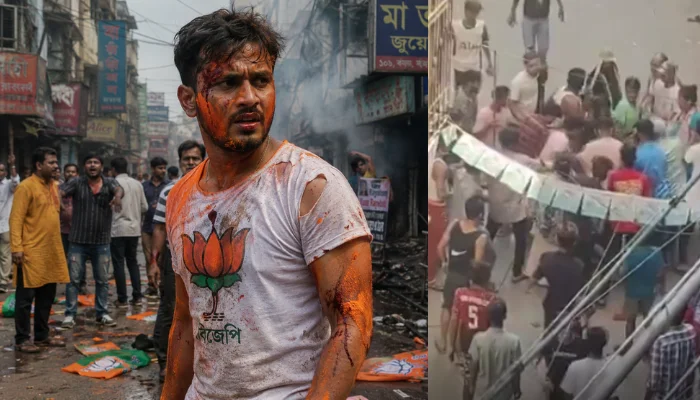
Case Summary
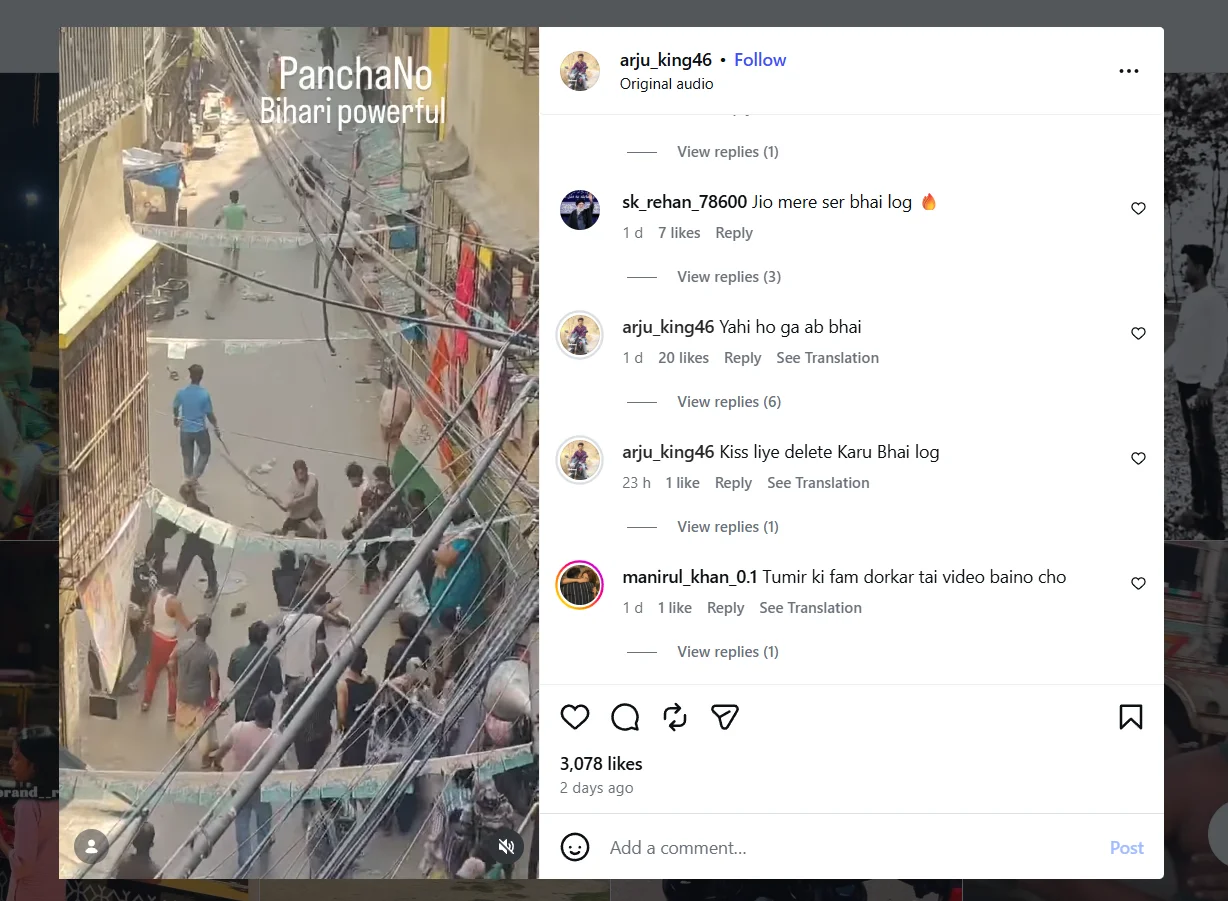
In Kolkata's Topsia area, a Muslim-majority area, a Hindu youth was brutally attacked by a Muslim mob for celebrating the Bharatiya Janata Party's (BJP) victory in the West Bengal Assembly Elections of 2026. The backdrop of this incident is the West Bengal Assembly Elections, which saw the Bharatiya Janata Party (BJP) achieve a historic landslide victory, sweeping over 200 seats in the 294-member assembly and ending the Trinamool Congress (TMC)'s 15-year rule under Mamata Banerjee. Held in multiple phases during late April 2026, with counting on 4 May 2026, the BJP capitalised on anti-incumbency, consolidated Hindu votes, fragmented Muslim support for TMC, strong urban performance, and welfare schemes. After the victory, BJP workers and ordinary Hindu citizens celebrated by raising BJP flags with slogans of "Jai Shri Ram" and by applying saffron gulal (coloured powder) on each other. This current incident came to light when a Muslim man named Aman Khan with the username "arju_king46" shared a video of the incident on Instagram. In the comments of the video, the accused wrote "Ab se yahi hoga", meaning "From now on, only this will happen". In the video, a Hindu youth was seen covered in orange gulal colour, showcasing that he was celebrating the Bharatiya Janata Party's victory in the West Bengal state elections. The video showed a huge mob of Muslim men attacking him with sharp weapons and sticks. The video showed the victim being hounded, chased, and beaten by the mob. The comment section of the video showed many Muslim users supporting the perpetrators' actions by writing "Allahu Akbar" and "Khela Hobe", a political slogan raised by the Trinamool Congress, after which Bharatiya Janata Party workers and ordinary Hindu citizens were attacked and killed during the post-poll violence in 2021. There were comments supporting the act along with chants of "Alhamdulillah". This video went viral on other social media platforms, and many Hindu users tagged Kolkata Police on various platforms, including X. Following this, Kolkata Police put out a tweet acknowledging that there were instances of severe law and order problems in the Topsia and Tiljala areas. The Kolkata Police from their X handle wrote: "Yesterday (5 May 2026) evening, a law and order problem arose in parts of Topsia and Tiljala under the South-East Division, during which certain miscreants vandalised public property, etc. Prompt and effective intervention by the local police brought the situation under control immediately." It further added: "Strict legal action has been initiated in connection with the incident. Two cases have been registered at Tiljala and Topsia Police Stations under relevant provisions of the Bharatiya Nyaya Sanhita, Prevention of Damage to Public Property Act, and West Bengal Maintenance of Public Order Act. So far, 40 accused persons have been arrested. The situation is fully under control, and adequate police deployment remains in place in the affected areas. Citizens are advised not to believe or circulate fake news, rumours, or inflammatory content on social media. Strict legal action will be taken against rumour mongers and anyone attempting to disturb public peace and harmony."
Case Images

Why it is Hate Crime ?
The primary category selected in this case is- Attack not resulting in death. The subcategory selected is- Attacked for Hindu identity. In several cases, Hindus are attacked merely for their Hindu identity without any perceived provocation. A classic example of this category of religiously motivated hate crime is a murder in 2016. 7 ISIS terrorists were convicted for shooting a school principal in Kanpur because they got ‘triggered’ seeing the Kalava on his wrist and tilak that he had put. In this, the Hindu victim had offered no provocation except for his Hindu religious identity. The motivation for the murder was purely religious, driven by religious supremacy. Such cases where Hindus are targeted merely for their religious identity would be documented as a hate crime under this category. The other subcategory selected is- Attacked for crossing "Muslim area". One of the reasons that Hindus get attacked unprovoked specifically by Islamists is for crossing ‘Muslim areas’. Essentially, Muslim mobs often attack Hindus crossing or present in certain areas which have a majority Muslim population. It has often been cited as one of the reasons to blame Hindus for attacks against themselves, signalling that Hindus displaying religious symbols, taking our religious processions or crossing any area which is dominated by Muslim residents is a provocation in and of itself. These areas are mostly ghettoized areas where mobs mobilize quickly to attack Hindus for a variety of reasons like playing music during a religious procession, crossing a mosque, wearing a tilak or any other religious symbol in a Muslim-dominated area, praying at a local temple in that area etc. There have been cases where the few local Hindus of that area have been attacked on their way to the Temple for prayers as well, simply because the area is considered a Muslim-dominated area. Several times, it is entirely possible that the immediate trigger for the violence against Hindus was non-religious in nature, however, the violence became religiously motivated in nature because the area was Muslim dominated and the residents on the whole harboured animosity towards Hindus, evidenced from the actions of the mob, the slogans, and the nature of the attack. Such crimes are motivated by the religious identity of the victims and are therefore classified as hate crimes under this category. The other subcategory selected is- Communal Clash/Attack. Communal clash is a form of collective violence that involves clashes between groups belonging to different religious identities. For a communal clash between Hindus and non-Hindus to qualify as a religiously motivated hate crime, the trigger of the violence itself would have to be anti-Hindu in essence. For example, if there is a Hindu religious procession that comes under attack from a non-Hindu mob and after the initial attack, Hindus retaliate in self-defence, leading to a communal clash between the two religious communities. While at a later stage, both communities are involved in the clash/violence, the initial trigger of the violence was by the non-Hindu mob against the Hindus and therefore, it could safely be termed as an anti-Hindu violence. Further, the trigger would also have to be religiously motivated. In the cited example, the attack by the non-Hindu mob was against religious processions and therefore, can be concluded to be religiously motivated. In some cases, the trigger may be non-religious, however, it develops into religious violence against Hindus at a later stage. In such cases too, the foundational animosity towards Hindus becomes the motivating factor of the crime and therefore, it would be classified as a religiously motivated hate crime against Hindus under this category. Another primary category selected is- Hate Speech against Hindus. The subcategory selected is- Violent Threats. Violent threats, explicit, implicit or implied, is the most dangerous form of hate speech since it goes beyond discriminatory and prejudicial language to express the intent of causing harm to an individual or a group of people based on their religious identity and faith. There could be several different kinds of threats that are issued to Hindus based on religious animosity. An explicit threat would mean the direct threat of violence towards an individual Hindu, a group of Hindus or Hindus at large. Physical violence, death threats, threats of destruction of property belonging to Hindus and threats of genocide would mean explicit threats against Hindus for their religious identity. Implicit threats may not be a direct threat but implied through the use of symbols of actions – for example – in the Nupur Sharma case, other than explicit threats, there were also implicit threats when Islamists took to the streets to burn and beat her effigies. It implies that they want to do the same to Nupur Sharma – thereby is considered an implicit threat. Violent threats can be delivered in person, through letters, phone calls, graffiti, or increasingly through social media and other online platforms. It would be important to understand that a threat – explicit or implicit, online or offline – to an individual who happens to be a Hindu does not qualify as a religiously motivated threat. Such a threat, while vile and dangerous, could be owing to non-religious reasons and/or personal animosity. To qualify as a religiously motivated threat, it would need to exhibit an indication that the individual is being targeted for religious reasons and/or owing to his/her religious identity as a Hindu. This case stands as a clear example of a religiously motivated hate crime, where a Muslim mob brutally attacked a Hindu youth in Kolkata's Topsia area solely for celebrating the Bharatiya Janata Party's victory in the 2026 West Bengal state legislative elections, which defeated the Trinamool Congress. The ferocious nature of the attack, armed assailants chasing and beating the victim with sharp weapons and sticks, combined with its ideological dimension, demonstrated that the violence stemmed directly from animosity towards the victim's religious identity as a Hindu and his ideological inclination to support the BJP. Such targeted brutality over a political celebration tied to Hindu interests reveals the perpetrators' deep-seated animosity against Hindus expressing joy in their community's electoral triumph. This incident occurred precisely because the victim celebrated the Bharatiya Janata Party's victory, a party widely perceived by Muslim radicals and even segments of the broader Muslim community as a Hindu or Hindutva party that champions Hindu interests and rights. The Trinamool Congress in West Bengal maintained a history of prioritising pro-Muslim and radical Muslim interests while suppressing Hindu ones, such as restricting Durga Puja celebrations to accommodate Ramadan or Muharram, targeting Hindu religious slogans like Jai Shri Ram, yet permitting Allahu Akbar unchallenged, arresting Hindu sadhus for opposing anti-Hindu state policies but constantly appeasing Muslim clerics and attacking Hindus and their processions and temples. This defined West Bengal under Trinamool Congress rule. The Bharatiya Janata Party's victory, a party seen as pro-Hindu by Muslims, sparked outrage and anger in the Muslim community, who interpreted it as a Hindu triumph over Muslim interests. Thus, the attack on this Hindu individual formed part of this broader backdrop, and the victim's brutal assault by an entire mob wielding sharp weapons and lathis underscored that it targeted his Hindu religious identity and support for a party backing Hindu causes in the perpetrators' eyes. This assault resulted directly from the victim's Hindu identity and interests, establishing it unequivocally as a religiously motivated hate crime. Such attacks on Hindus for supporting Hindu causes or parties expose the perpetrators' profound religious animosity towards the victim's faith and ideology, confirming it as a textbook hate crime. The nature of the attack, where an entire mob of Muslims armed with sticks and sharp weapons pursued and battered a lone Hindu youth for celebrating the Bharatiya Janata Party's Bengal election victory, indicated premeditation and laid bare its communal character. A collective mob assaulting one individual over a political expression linked to Hindu success highlights entrenched religious animosity and intolerance towards the Hindu faith and its manifestation through electoral victories, marking it as a blatant, religiously motivated hate crime and communal onslaught on Hindus. The fact that this unfolded in a Muslim-dominated area sharpened the religious motivations, as the perpetrators asserted territorial control rooted in faith-based exclusion. Muslims frequently regard areas near mosques, dargahs, or Muslim-majority zones as exclusive "Muslim areas." This exposes a disturbing Islamic supremacist mindset among the attackers, where they treat the area as a no-go zone for non-Muslims, especially Hindus. Their entitlement and superiority complex reflected ingrained prejudice and a drive to dominate public spaces religiously. The assault on the Hindu victim stemmed from this Islamic supremacist ideology, with local Muslims viewing Hindus with contempt and claiming authority to dictate movement in "their area." This behaviour exemplified a perilous, exclusionary, intolerant mindset steeped in religious bigotry and animosity, positioning the case as a prime instance of faith-driven crime. The fact that one Muslim accused posted the video on social media with an Islamic background noise, evident upon listening, revealed his gloating pride over the assault, rather than shame or regret at attacking a Hindu youth. His comment "Ab se yahi hoga" ("From now on, only this will happen") constituted explicit hate speech and a violent threat, openly declaring future attacks on Hindus celebrating their political or religious victories, thereby instilling widespread fear in the Hindu community about exercising their democratic rights. This statement amounted to a direct incitement to violence, asserting Islamic supremacy over Hindus and their rights while broadcasting triumph in suppressing Hindu celebration, with the religious audio amplifying its communal intent to terrorise. This brazen display underscored profound religious animosity, as the perpetrator celebrated violence against a Hindu's faith expression instead of condemning it, transforming a personal act into a public manifesto of hatred designed to intimidate and silence the entire Hindu community. The comment section amplified this, with numerous Muslim users endorsing the violence through religious slogans like Allahu Akbar and Alhamdulillah, alongside Khela Hobe, a Trinamool Congress chant linked to past anti-Hindu attacks. These chants, invoked specifically to celebrate the brutal assault on a Hindu youth, constituted blatant hate speech rooted in anti-Hindu hostility, as they glorified communal violence against Hindus while invoking Islamic supremacy and political triumphalism over Hindu suffering. Allahu Akbar and Alhamdulillah, typically religious affirmations, became weapons of intimidation here, signalling divine endorsement of attacking Hindus for their faith-based celebrations, while Khela Hobe recalled Trinamool Congress-led pogroms against Hindus, repurposed to revel in fresh Hindu blood. This widespread support signalled the larger Muslim community's backing for anti-Hindu aggression, normalising communal violence as collective vengeance against Hindu electoral success. Such an open celebration of harm targeting Hindu identity transforms individual bias into communal endorsement, fulfilling every criterion of a religiously motivated hate crime. Given that this case meets the parameters of a religiously motivated crime, it is being added to the hate crime database of the Hinduphobia Tracker. Disclaimer: The Hinduphobia Tracker records incident dates based on when the victim's ordeal begins. Here, the only mention of the exact date of the incident came from the police statement referring to the law and order issues that arose on 5 May 2026 in the Topsia and Tiljala areas. Henceforth, 5 May 2026 has been selected as the indicative incident date for documentation purposes only. In this case, the total number of perpetrators has not been specified. The police stated there were instances of law and order issues in Topsia in which 40 people were arrested, but there is no confirmation that all 40 were involved in this particular attack. The only identified perpetrator is the Muslim man who posted the video on social media and threatened Hindus by saying, "Ab se yahi hoga". Henceforth, the perpetrator count has been recorded as one (1). This is recorded for documentation purposes only, as it represents a conservative estimate since an entire mob of Muslims had attacked the Hindu victim.
Victim Details
Total Victim
1
Deceased
0
Gender
- Male 1
- Female 0
- Third Gender 0
- Unknown 0
Caste
- SC/ST 0
- OBC 0
- General 0
- Unknown 1
Age Group
- Minor 0
- Adult 1
- Senior Citizen 0
- Unknown 0


Case Status
Unknown


Perpetrators Details
Perpetrators
Muslim Extremists
Perpetrators Range
One Person
Perpetrators Gender
male
 Sources




