Anti-Hindu prejudice: Western leftist media portrays Hindu nationalism and Hindu community as a "threat to religious minorities in India"
 United States
  3 May, 2026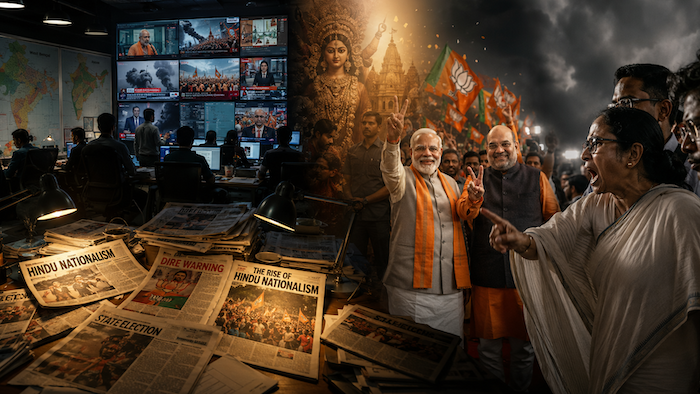
Case Summary
The Hindu community and Hindutva (Hindu nationalism and civilisational movement) became the focus of repeated negative framing in international media coverage following the Bharatiya Janata Party’s (BJP) electoral victories in West Bengal and Assam. Hindu voters and supporters of the Bharatiya Janata Party were portrayed through narratives centred on “Hindu nationalism”, “Hindu first politics”, and alleged threats to Muslim minorities. The coverage triggered criticism from the Hindu community, who viewed the reporting as hostile towards Hindu political expression and Hindu civilisational identity. Following the Bharatiya Janata Party’s victories in the West Bengal and Assam Assembly elections on 4th May 2026, several foreign media organisations, including The New York Times, Reuters, Al Jazeera, and The Guardian, published reports examining the electoral outcome and the political rise of the Bharatiya Janata Party. The reporting repeatedly associated the party’s success with “Hindu nationalism” and framed the victories within discussions surrounding minority anxiety and the future of secularism in India. The New York Times described the Bharatiya Janata Party’s electoral gains in West Bengal as a “conquest” by “Modi’s Hindu nationalists”. The report referred to the party’s politics as “expansionist Hindu first politics” and contrasted Bengali secularism with political movements that “define India as a Hindu nation and abhor the thousand-year presence of Islam”. Hindu political identity and Hindu electoral consolidation were repeatedly presented through language associating Hindu assertion with religious exclusion and communal hostility. The reporting further linked the Bharatiya Janata Party’s victories to the Special Intensive Revision of electoral rolls conducted in West Bengal. Multiple reports stated that Muslim voters and minorities were disproportionately affected during the revision process. The articles described the exercise as controversial and framed it as part of a broader political strategy connected to Hindu nationalist governance. Hindu political mobilisation and Hindu majority voting patterns were repeatedly connected with accusations of minority suppression and democratic backsliding. References to “Hindu nationalists”, “Hindu hardliners”, “Hindutva outfit”, and “Hindu first politics” appeared throughout the coverage. Hindu political participation was repeatedly framed as a religiously motivated project rather than an electoral or ideological movement. The reports connected the rise of the Bharatiya Janata Party with fears surrounding the future of Muslims and secularism in India, while presenting Hindu political identity as inherently majoritarian and exclusionary. Several reports also contrasted the Bharatiya Janata Party with political figures portrayed as defenders of secularism and minority rights. Coverage discussing West Bengal politics referred to opposition leaders as barriers against “religious nationalist agendas” and positioned Hindu political assertion in opposition to pluralism and coexistence. Hindu civilisational identity and support for the Bharatiya Janata Party were repeatedly associated with intolerance, hostility towards Islam, and anti minority politics. The reporting additionally revisited earlier controversies surrounding Hindu religious practices in West Bengal, including restrictions linked to Durga idol immersion processions during Muharram periods and debates surrounding Hindu temple access and administration. These references were incorporated into broader narratives portraying Hindu political demands and Hindu religious mobilisation as sources of communal tension. Throughout the coverage, Hindu identity remained central to the framing of the electoral outcome. The reports repeatedly characterised Hindu political consolidation as a threat to minorities, secularism, and democratic institutions. Hindu voters and Hindu political organisations were specifically identified and discussed through frameworks linking Hindu identity with extremism, religious majoritarianism, and communal aggression. No police complaint, court proceedings, or criminal investigation were reported in connection with the publication of the reports. The matter remained part of an ongoing public debate concerning the portrayal of Hindu identity, Hindu political participation, and international media coverage of Indian electoral politics.
Why it is Hate Crime ?
This case has been added to the tracker under the primary category - Hate speech against Hindus. Within this, the subcategory selected is - Anti Hindu subversion and prejudice. Hate speech is defined as any speech, gesture, conduct, writing, or display that is prejudicial against a specific individual and/or group of people, which is leading to or may lead to violence, prejudicial action or hate against that individual and/or group. Media plays a specific and overarching reach in perpetuating prejudicial attitudes towards a community owing to unfair, untrue coverage and/or misrepresentation/misinterpretation, selective coverage and/or omission of facts of/pertaining to issues affecting a specific religious group. This type of bias can dehumanise the victim group, making it easier for others to justify harmful actions against them, which aligns with the objectives of hate speech laws aimed at preventing such harm. It is often observed that the media takes a prejudicial stand against the Hindu community driven by their need to shield the aggressor community which happens to be a numeric minority, however, is the one perpetrating violence against Hindus. For example, the media is often quick to contextualise religiously motivated crimes against Hindus, omit or misrepresent facts that point towards religiously motivated hate crimes, justify and/or downplay religiously motivated hate crimes or simply present fake news to stereotype Hindus. Such media bias leads to the denial of persecution and is often used to dehumanise Hindus, leading to justification for violence against them. For example, the media covered several fake allegations of Hindus targeting Muslims and forcing them to chant Jai Shree Ram. Most of these cases were proved false and fabricated after police investigation. These fake news reports were subsequently never retracted or clarified. Such fake news led to the justification of violence and dehumanisation of Hindus based on the argument that since Hindus targeted Muslims and forced them to chant Jai Shree Ram, the dehumanisation of Hindus and violence against them was par for the course and merely a retaliation. Such media bias leads to prejudicial portrayal of Hindus and offers a justification for violence against them and therefore, is considered hate speech under this category. The case qualified as a religiously motivated hate speech incident because the Hindu community and Hindu nationalism were repeatedly framed as dangerous, exclusionary, and inherently threatening through the coverage published after the Bharatiya Janata Party’s electoral victories in West Bengal and Assam. The reporting did not merely criticise a political party or election result. It consistently connected Hindu political assertion, Hindu civilisational identity, and Hindu majority participation with extremism, intolerance, and hostility towards other religious minorities. Hindu voters, Hindu political organisations, and Hindu ideological positions were collectively portrayed through language designed to stigmatise Hindu identity itself. The repeated use of hostile framing tied specifically to Hindu identity demonstrated that religion was not incidental to the reporting but central to how the political developments were presented. The first religious marker emerged through the repeated portrayal of Hindu political participation as inherently threatening and socially dangerous. The reports repeatedly framed Hindu political identity, Hindu civilisational identity, and Hindu majority support as aggressive forces that endangered minorities and secularism. References to “Hindu nationalism”, “Hindu first politics”, and the rise of “Hindu hardliners” positioned Hindu political consolidation as a communal threat rather than a democratic outcome. This was religiously significant because Hindu identity was not treated as a neutral cultural or political characteristic. It was presented as something uniquely capable of producing intolerance and democratic decline. The choice to repeatedly connect Hindu identity with extremism demonstrated deliberate prejudicial framing. The reporting could have discussed the election in terms of governance, economics, electoral strategy, or regional politics. Instead, the coverage consistently centred Hindu identity itself as the source of concern. This showed a conscious decision to portray Hindu assertion as inherently suspect and socially dangerous. The repeated targeting of Hindu political identity revealed an intent to stigmatise Hindus collectively by framing Hindu public participation as a threat to pluralism and coexistence. The New York Times described the Bharatiya Janata Party as “Modi’s Hindu nationalists” and referred to its ideology as “expansionist Hindu first politics”. Hindu political leadership was repeatedly discussed not simply as conservative, nationalist, or ideological, but explicitly through a Hindu religious framing. This was religiously significant because the criticism was rooted in the leaders’ perceived Hindu ideological identity rather than solely their policies or governance decisions. The deliberate use of terms such as “Hindu nationalists” and “Hindu first politics” transformed Hindu identity into the defining characteristic through which the leaders were to be viewed. This framing was designed to associate Hindu leadership with communal aggression and religious intolerance in the minds of readers. The choice to foreground Hindu identity in a negative and alarmist context demonstrated deliberate intent to delegitimise Hindu political representation, specifically because it was Hindu. The repeated association of Hindu leaders with democratic danger and anti minority hostility revealed an effort to stigmatise Hindu political authority as morally and socially unacceptable. The third religious marker involved the hostile and stigmatising language directed towards Hindu identity and Hindu civilisational concepts. Terms such as “Hindu first politics”, “Hindu nationalists”, and descriptions claiming that movements defining India as a Hindu nation “abhor the thousand-year presence of Islam” were repeatedly used throughout the reporting. These phrases did not merely describe political positions. They attached hostility, exclusion, and religious hatred directly to Hindu identity itself. This was religiously significant because Hindu civilisational beliefs and Hindu majority political aspirations were framed as inherently oppressive and dangerous. The reporting did not criticise specific acts of violence or unlawful conduct. Instead, it portrayed Hindu identity and Hindu ideological assertion as fundamentally incompatible with secularism, coexistence, and minority safety. The deliberate use of such framing showed an intention to stigmatise Hindu identity in a hostile manner. The language selected was designed to create fear and suspicion around Hindu political participation and Hindu cultural self-assertion. By repeatedly presenting Hindu identity through the lens of aggression and exclusion, the reports reinforced prejudicial narratives portraying Hindus as a collective threat. This revealed a deliberate intent to socially and politically marginalise Hindu identity by associating it with intolerance and communal hostility. The fourth religious marker was the repeated portrayal of Hindu majority support and Hindu electoral consolidation as evidence of communal prejudice. The reports linked the Bharatiya Janata Party’s electoral victories with accusations that minorities, particularly Muslims, were under threat. Coverage surrounding the Special Intensive Revision of electoral rolls framed the process as disproportionately targeting Muslims while repeatedly connecting it to Hindu nationalist governance. Hindu majority political participation was therefore presented not as a democratic choice but as evidence of religious majoritarianism and institutional discrimination. This was religiously significant because Hindu voters as a collective group were depicted as participants in a system allegedly designed to marginalise minorities. The reporting deliberately chose to interpret Hindu electoral success through a religious lens centred on fear and suspicion. The repeated emphasis on Hindu majority politics as inherently threatening demonstrated a very conscious effort to portray Hindu democratic participation as morally suspect. This framing revealed intent to stigmatise Hindu political behaviour specifically because it reflected Hindu demographic and cultural influence. By presenting Hindu majority support as a danger to minorities and democratic institutions, the reporting reinforced negative stereotypes targeting Hindus as a religious community rather than treating the election as a standard democratic event. Essentially, the reports portrayed opposition political figures and regional political traditions as defenders of secularism and coexistence while presenting Hindu political movements as hostile to pluralism. Hindu civilisational identity was repeatedly contrasted against concepts of tolerance, intellectualism, and minority inclusion. This was religiously significant because Hindu identity was singled out as uniquely incompatible with democratic harmony and secular governance. The deliberate framing created a moral divide in which Hindu political assertion was associated with intolerance, while opposition to Hindu political influence was associated with virtue and inclusivity. This was not neutral political commentary. It involved repeated value judgements targeting Hindu identity itself as socially regressive and threatening. The decision to portray Hindu assertion as fundamentally opposed to coexistence demonstrated deliberate prejudice against Hindu ideological and cultural identity. The reporting choices revealed intent to delegitimise Hindu political participation by framing Hindu identity as morally inferior and socially harmful. Taken together, the repeated framing throughout the coverage demonstrated a sustained pattern of hostility directed specifically at Hindu identity, Hindu political participation, and Hindu civilisational expression. Hindu leaders, Hindu voters, Hindu ideological movements, and Hindu majority politics were repeatedly portrayed through language associated with extremism, intolerance, exclusion, and minority fear. The religious identity of the targets was central to the framing adopted in the reports. The repeated choice to emphasise Hindu identity in hostile and alarmist contexts demonstrated deliberate intent to stigmatise and discredit Hindus as a collective community rather than merely critique political developments. Another point to highlight is that much of this anti‑Hindu campaign appears directed primarily at the Hindutva movement, a Hindu nationalistic and civilisational movement. The term "Hindutva" is frequently used as a euphemism to make the targeting of Hindus appear more palatable. Hindutva functions as a unifying framework through which many Hindus seek to preserve the cultural identity that they regard as having been eroded by historical Islamic invasions, British colonisation, and missionary conversions. It is not inherently a destructive ideology, as some portray it; for Hindus, it provides a shared cultural and political edifice. At the same time, "Hindutva" is often invoked to single out and delegitimise Hindus and Hindu identity more broadly. Using the label to justify hostility is a semantic device that can obscure basic prejudice: it suggests that persecution of individuals is warranted because they espouse an ideology, rather than recognising that the underlying motive may be animus toward their religion. The intent to conflate Hindutva with all of Hinduism was made explicit at events such as the “Dismantling Global Hindutva” conference in the United States, where some speakers argued that Hindutva and Hinduism were indistinguishable and therefore that dismantling one required dismantling the other. Such rhetoric, and the practice of justifying victimisation and dehumanisation by framing it as opposition to an ideology, stems from and reinforces hostility towards Hindus and their cultural identity. This incident was not an isolated instance of political criticism but part of a broader pattern in which Hindu identity, Hindu civilisational beliefs, and Hindu political expression are framed in international discourse as inherently extremist, exclusionary, and threatening, with fabricated narratives alleging hostility towards minorities demonstrating sustained prejudicial framing directed specifically at Hindus as a religious and cultural community. Such predatory actions stem from doctrinal animosity towards the Hindu faith and its adherents. Given that this case met the parameters of a religiously motivated hate speech incident, it was added to the hate speech database of the tracker.


Case Status
Unknown


Perpetrators Details
Perpetrators
Others
Perpetrators Range
One Person
Perpetrators Gender
unknown
 Sources




