Hindu temple land illegally occupied by encroachers in Muzaffarpur, Bihar
 Muzaffarpur, Bihar, India
  23 April, 2026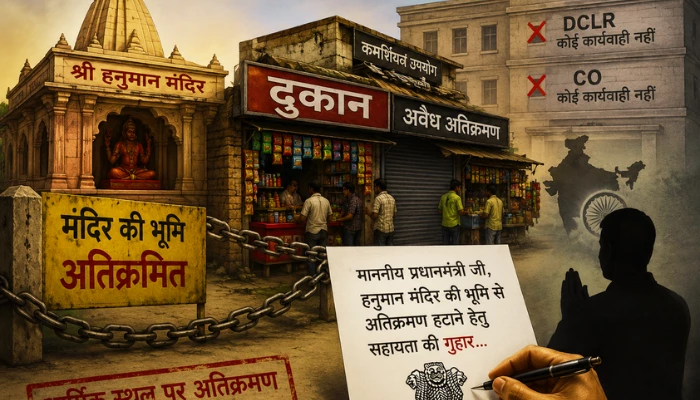
Case Summary
In Muzaffarpur, Bihar, a Hindu temple dedicated to Lord Hanuman was illegally occupied by a few encroachers. The incident came to light after priest Kumendra Das, also known as Behru Baba, wrote to the Prime Minister seeking intervention to remove the illegal occupation from the temple premises. Kumendra Das stated in his appeal that he had approached officials at the level of the Sub-Divisional Magistrate (SDM), Deputy Collector Land Reforms (DCLR), and Circle Officer (CO), but no action was taken. Following this inaction, he escalated the matter by submitting a formal appeal to the Prime Minister. He said that the temple land had been encroached upon, and shops were being operated on it. He further stated that the local administration was not taking action against the encroachers despite repeated complaints. Kumendra Das added that he had been making rounds of government offices for years in an effort to get the encroachment removed and restore the temple land.
Why it is Hate Crime ?
The primary category selected in this case is- Attack on Hindu religious representations. The subcategory selected is- Encroachment or illicit takeover of temple land/land near temple. In Hinduism, a temple is the abode of the Deity. The Deity in the Temple is consecrated, thereby making it a real, breathing entity. Hindus believe that not just the Deity but the temple premises itself are sacred to Hindus since Hindus hold the faith that the entire Temple space is an amalgamation of the divine energy of the deity. Not only the Temple but the Temple premises in its entirety are considered sacred by Hindus. In several cases, the premises of the Temple and/or religious centre are illicitly taken over by institutions belonging to other faiths, like the Waqf board or the Church. Other times, the temple property, land or the property of religious centres are illicitly encroached upon by non-Hindu groups. Any illicit takeover or encroachment is a crime an initio; however, when non-Hindu groups illicitly take over or encroach on the sacred land of Hindus, it is an affront to the Hindu community and is therefore classified as a religiously motivated hate crime under this category. This incident reflects a clear pattern where a Hindu religious site and its associated land were subjected to prolonged illegal encroachment, pointing towards a targeted disregard for spaces held sacred by the Hindu community. The land belonging to a Hanuman Temple was occupied and used for running commercial shops, despite its religious significance. The fact that the encroachment persisted for years, coupled with the absence of timely corrective action, indicates a conscious and sustained violation of temple property, undermining its sanctity and purpose. Temple land is not merely a physical asset but an integral part of the religious and cultural framework of Hindu worship. It sustains rituals, supports temple activities, and preserves the spiritual environment essential for devotees. The illegal occupation of such land for commercial purposes distorts its intended use, interrupts the functioning of the temple, and erodes the sanctity of the space. This act transforms a sacred site into a zone of unauthorised economic activity, diminishing its religious character and affecting the ability of devotees to engage in uninterrupted worship. Despite knowing the sanctity of the temple land, the perpetrators encroached upon it, which shows they did not respect the religious sentiments of Hindus who regard the temple and its precincts as sacred. Such encroachment undermines Hindu religious feelings and identity, and when Hindu sites are taken over for non‑religious purposes and their sanctity is disrupted, it amounts to a hate crime. The prolonged nature of the encroachment, alongside repeated but unsuccessful attempts by the complainant to seek administrative intervention, highlights a deeper failure of protection for Hindu religious spaces. Despite approaching authorities at multiple levels, including the SDM, DCLR, and CO, no effective action was taken. This inaction not only allowed the encroachment to continue but also signalled institutional apathy, which, in effect, emboldens such violations and leaves the affected community without recourse. For the Hindu community, witnessing the continued occupation of temple land generates a strong sense of hurt and helplessness. Temples are not just places of worship but anchors of identity, continuity, and collective faith. When such spaces are encroached upon and their sanctity compromised, it creates emotional distress and reinforces a perception that their Hindu religious rights and heritage are not being adequately safeguarded. The necessity to escalate the matter to the Prime Minister further underscores the gravity of the situation and the lack of resolution at the local level. Given the sustained encroachment on temple land, its commercial exploitation, and the continued administrative inaction despite repeated appeals, this case meets the parameters to be recorded as a religiously motivated hate crime against a Hindu religious site. Disclaimer: The Hinduphobia Tracker records incident dates based on when the crime occurs. In this case, the report indicates that the temple land had been encroached upon for several years, but the exact date of the initial encroachment is not specified. No other specific date is mentioned in the report. Therefore, the date of publication, that is, 24th April 2026, has been used as the indicative incident date for documentation purposes only.


Case Status
Complaint filed


Perpetrators Details
Perpetrators
Unknown
Perpetrators Range
Unknown
Perpetrators Gender
unknown
 Sources




