Hindu employees forced to remove their tilak and kalava at workplace; employers also mock Hindu devotion and revered deities
 Jabalpur, Madhya Pradesh, India
  26 April, 2026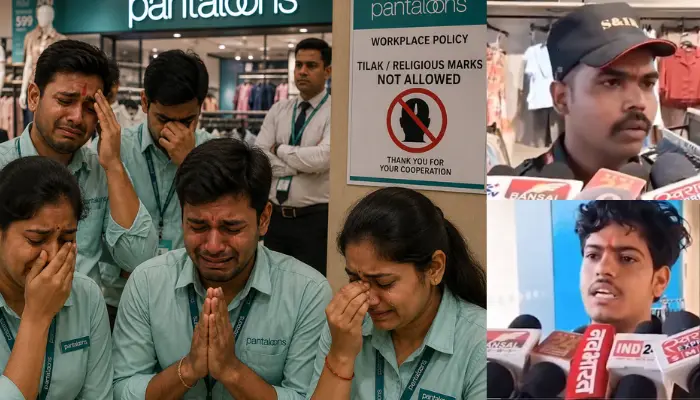
Case Summary
In Jabalpur, Madhya Pradesh, at a Pantaloons showroom in a shopping mall, Hindu employees were barred from wearing their religious symbols by the employers. They were also forced to rem9ove religious symbols like Tilak and Kalava. The accused also denigrated and mocked Hindu gods and goddesses as well as the employees' faith and devotion. Hindu employees working at Pantaloons stated that they were barred from wearing tilak and kalava. A Hindu employee, Shubham Sen, on 2 May 2026 was forbidden from applying a tilak (a mark on the forehead) or tying a sacred thread (kalava) on his wrist. He was told that, under company policy, no Hindu religious symbols or customs could be displayed within the showroom premises. He was forcibly made to remove his tilak and cut off his sacred thread. His religious sentiments were deeply hurt by this incident, leading him to resign from his job on 4 May 2026. A video of Shubham went viral on social media where he stated that he cleared his interview on 27 April 2026 and started working from 28 April 2026. But as per him, during the interview he was strictly told not to wear any Hindu symbols like tilak and kalava. But when he wore them on his work day, he was told by the store manager to wipe off the tilak and cut the kalava. Another Hindu employee who worked as a security guard stated that when he came to work wearing a tilak he was confronted by the store managers. The victim stated that when he said that he was wearing it because he was doing Hanuman Chalisa worship then the store manager mocked and insulted the Hanuman Chalisa and revered Hindu deities. Following the incident, various Hindu organisations protested outside the Pantaloons showroom and submitted a memorandum to police officials. Protesters warned the showroom owner to respect all religions, or they would intensify the protest. During the protest, showroom owner Nitin had a tilak applied with Vedic mantras on his forehead and a sacred thread tied around his wrist. Police stated that a memorandum regarding the matter had been received. The investigation was underway, and if any criminal charges were found, legal action would be taken. Meanwhile, Pantaloons showroom manager Nitin dismissed all allegations as baseless. He claimed that there was no ban on religious symbols in the showroom. Employees were simply instructed to maintain a uniform dress code and a professional appearance. Nitin also claimed that recently an employee misunderstood this very thing and quit within two days, leading to this controversy.
Why it is Hate Crime ?
This case has been documented under the first primary category: Restriction/ban on Hindu practices. Within this, the subcategory selected is: Restriction on expression of Hindu identity. An example of the state-affected prejudicial and targeted orders against the Hindu community would be a government denying the right of a Hindu or a group of Hindus to hold a religious procession owing to the animosity of non-Hindu groups. Denial of the religious right of the Hindus to assuage the non-Hindu group, which harbours animosity to a point where it could lead to violence against Hindus, is not only a failure of law and order but is a prejudicial order against Hindus, denying them their fundamental rights to express their religious identity. An example of a hate crime against Hindus by a non-Hindu would be a non-Hindu institution forcing its Hindu employees to abandon religious symbols that a Hindu would wear as an expression of faith owing to inherent prejudice against the faith professed by the victim or a non-Hindu group of people restricting a Hindu group from constructing a place of worship simply because the demography of the area in which the temple is being built is dominated by non-Hindus. Such actions are driven by religious animosity and/or prejudice against Hindus and their faith and would therefore be categorised as a hate crime. The second primary category selected is- Attack on Hindu religious representations. The subcategory selected is- Desecration of Hindu religious symbol. Icons and symbols or a religious representation of a spiritual ideal are widely revered in Hinduism. Iconography is of vital significance in the Hindu milieu. It helps connect people’s spiritual beliefs with the real world. Iconography within the Hindu faith takes several shapes and forms. Murtis are of most significance to Hindus, to which daily rituals, prayers and offerings are done. Besides the murtis, there are several other symbols which have deep significance in the Hindu faith – the Om and Swastika for example. Since these Hindu religious symbols hold paramount importance in Hinduism, any desecration of symbols, icons, murtis, religious representations and manifestations, is driven by animosity towards the faith itself which manifests itself through these murtis, icons and symbols. Therefore, any desecration of these Hindu religious symbols and representations is considered religiously motivated hate crimes under this category. The third primary category selected is- Hate Speech against Hindus. The subcategory selected is- Anti-Hindu slurs, mocking faith. Anti-Hindu slurs and the deliberate mocking of the Hindu faith owing to religious animosity involve the usage of derogatory terms, stereotypes, or offensive references to religious practices, symbols, or figures. One of the common anti-Hindu slurs used against Hindus is “cow-worshipper” and “cow piss drinker”. The intention of using this term is to demean and mock Hindus as a group and their religious beliefs since Hindus consider the cow holy. Additionally, some symbols and the slurs attached to them have a historical context that exacerbates the insult, hate, stereotyping, dehumanisation and oppression against Hindus. Cow worship has been used for centuries to denigrate Hindus, insult their faith and oppress Hindus specifically as a religious group. There has been overwhelming documentation about how cow slaughter has been used to persecute Hindus with cow meat being thrown in temples and places of worship. There has also been overwhelming documentation where cow meat (beef) has been force-fed to Hindus to either forcefully convert them to Islam or denigrate their faith. Apart from cow worship, the Swastika – which holds deep religious significance for the Hindus – has also been misinterpreted and distorted to use as a slur against Hindus. Similarly, the worship of the Shivling has been used by supremacist ideologies and religions to denigrate Hindus owing to religious animosity. Such slurs and denigration stem out of inherent animosity and hate towards Hindus and their faith, therefore, it is categorised as hate speech targeted at Hindus specifically owing to their religious identity. This case was a clear example of a religiously motivated hate crime because Hindu employees at the Pantaloons store in Jabalpur were forced to remove their kalavas and tilaks under the company’s grooming policy, which barred Hindu religious symbols from being worn during work hours. This was not a neutral workplace rule. It was a direct restriction on the expression of Hindu identity and an attack on the victims’ devotion and faith, making it a clear case of religiously motivated discrimination. To understand the depth of this violation, it is important to understand the significance of these sacred Hindu symbols. The tilak is a sacred mark worn on the forehead in Hindu tradition. It symbolises devotion, spiritual discipline, and the presence of the divine. It is often applied before prayer or worship and is closely tied to Hindu’s religious identity. Similarly, the kalava is a sacred thread tied on the wrist, usually during rituals and prayers, and is considered a symbol of protection, blessings, and commitment to dharma. Forcing Hindu employees to remove these symbols was therefore not a trivial act, but a direct interference in their religious beliefs and expression. Henceforth, the company’s ban on these symbols showed deep-seated religious animosity because it did not merely regulate appearance, but directly interfered with the employees’ ability to express their Hindu faith at work. Hindu employees were expected to hide signs of devotion that were meaningful to them in order to keep their jobs, which turned the workplace into a space of pressure rather than dignity. This was not a voluntary adjustment or a neutral policy choice. It was coercion, because the employees were effectively forced to choose between their livelihood and their religion. That is why the conduct went beyond ordinary workplace discipline and became a clear example of religiously motivated hostility aimed at restricting the public expression of the employees' Hindu faith. The act of forcing Hindu employees to remove their kalava and tilak showed the depth of hostility behind the conduct because it publicly stripped Hindu employees of symbols that were sacred to them. It was not a casual request to follow dress rules. It was a humiliating act that mocked their devotion and treated their faith as something disposable. The kalava and tilak were not decorative items, but visible markers of Hindu faith, prayer, belief, protection, and religious identity. Forcing their removal therefore amounted to a direct insult to Hindu religious practice and a clear case of desecration of sacred Hindu symbols. Another point to highlight is that this rule applied only to Hindu religious symbols, which made the discrimination especially clear. No other religious symbols were treated in the same way at Pantaloons, so the restriction was not about general neutrality or uniformity. It singled out Hindu expression and placed an unequal burden on Hindu employees alone. That selective enforcement showed institutional bias rather than fair workplace policy. It is precisely this kind of one sided targeting that turns discrimination into a hate crime. Furthermore, when a Hindu employee said that he wore the tilak because he was performing Hanuman Chalisa worship, the store manager responded by mocking the Hanuman Chalisa and denigrating revered Hindu gods and goddesses. The Hanuman Chalisa is a deeply respected devotional hymn in Hinduism, recited by devotees for strength, protection, faith, and spiritual reassurance, while Hindu deities are treated as divine and worthy of daily reverence, prayer, and devotion. By ridiculing these sacred beliefs and deities, the manager did not merely enforce a workplace rule but crossed into direct insult and humiliation of Hindu religious practice. This conduct showed open contempt for Hindu devotion and amounted to religiously motivated hate speech aimed at hurting Hindu sentiments, making it a clear case of an anti-Hindu hate crime. Given that this case met the parameters of a religiously motivated hate crime, it was added to the hate crime database of the Hinduphobia Tracker. Disclaimer: The Hinduphobia Tracker records the dates of incidents based on when the crime occurs, rather than when it is reported in the media. This incident first came to light on 4 May 2026, when victim Shubham resigned from his job. However, as per his own admission, he had been interviewed on 27 April 2026. Since this marked the beginning of the ordeal, 27 April 2026 has been selected as the indicative incident date for documentation purposes only. In this case, two Hindu victims were clearly highlighted, namely Shubham and the security guard. Henceforth, the victim count has been recorded as two. Similarly, only one perpetrator was clearly identified, namely the store manager and owner Nitin. Henceforth, the perpetrator count has been recorded as one, referring to Nitin alone.
Victim Details
Total Victim
2
Deceased
0
Gender
- Male 2
- Female 0
- Third Gender 0
- Unknown 0
Caste
- SC/ST 0
- OBC 0
- General 0
- Unknown 2
Age Group
- Minor 0
- Adult 2
- Senior Citizen 0
- Unknown 0


Case Status
Complaint filed


Perpetrators Details
Perpetrators
Others
Perpetrators Range
One Person
Perpetrators Gender
male
 Sources




