Hindu temple construction blocked, land mafia seizes land, threatens to kill any Hindu villager who proceeds with the construction
 Mainpuri, Uttar Pradesh, India
  4 May, 2026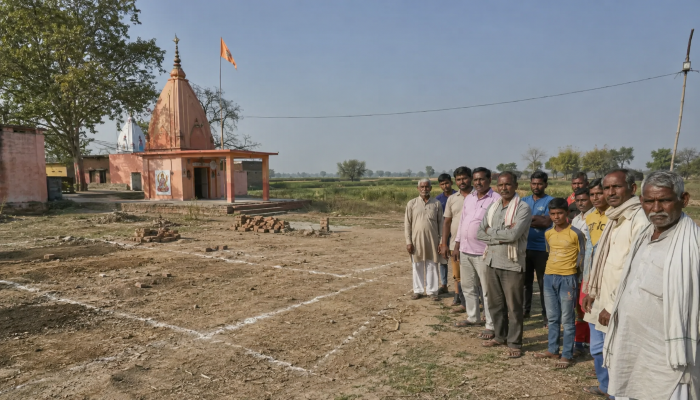
Case Summary
Hindu villagers of Nagariya village, Kotwali police station area, Mainpuri district, Uttar Pradesh, were prevented from constructing a Shiva temple on land reserved for that purpose after a local strongman illegally occupied the plot through fraudulent means. The obstruction of the temple construction caused sufficient distress among the Hindu community that villagers staged a demonstration at the District Magistrate's office. More than one bigha of land on plot numbers 603B and 603 in Badi Nagariya Ward Number 28, Dehat Mainpuri, had been reserved for the construction of a Shiva temple and dharamshala [a rest house for pilgrims and travellers, typically built near Hindu religious sites as an act of community service and devotion]. Rajveer, son of Harnandan Singh, a resident of Purohitana, Mainpuri, illegally occupied plots 636 and 603 by fraudulent means and claimed the land as his own. He used this false claim to prevent Hindu villagers from commencing construction of the temple. Rajveer threatened that if anyone proceeded with temple or any other construction work on the land, the construction would be demolished and the villagers would be killed. Villagers described Rajveer as a land mafia strongman whose primary activity was the illegal seizure of land and homes belonging to poor residents. Villagers submitted a complaint letter to the District Magistrate, signed by temple priest Ramsanehi Lal and multiple residents, including Dilip, Vinod, Brijesh, Vikram Kumar, Abhinav, Banaras, Ajit Raj, Dhaniram, Vipin, Rajesh, and Avadh, demanding appropriate action and the immediate commencement of temple construction. No police action or arrests were confirmed at the time of publication.
Why it is Hate Crime ?
The primary category for this case is "Attack on Hindu religious representations". The sub-category for this case is "Encroachment or illicit takeover of temple land/land near temple". In Hinduism, a temple is the abode of the Deity. The Deity in the Temple is consecrated, thereby, making it a real, breathing entity. Hindus believe that not just the Deity but the temple premises itself are sacred to Hindus since Hindus hold the faith that the entire Temple space is an amalgamation of the divine energy of the deity. Not only the Temple but the Temple premises in its entirety are considered sacred by Hindus. In several cases, the premises of the Temple and/or religious centre are illicitly taken over by institutions belonging to other faiths – like the Waqf board or the Church. Other times, the temple property, land or the property of religious centres are illicitly encroached by non-Hindu groups. Any illicit take over or encroachment is a crime an initio, however, when non-Hindu groups illicitly take over or encroach the sacred land of Hindus, it is an affront to the Hindu community and is therefore classified as a religiously motivated hate crime under this category. Rajveer's encroachment was not directed at generic vacant land. It was directed specifically at land that had been reserved for the construction of a Shiva temple and dharamshala in a Hindu village. The selection of this particular plot as the target of illegal occupation was not incidental. Land reserved for Hindu religious construction carries a devotional significance that extends beyond its material value. Its seizure did not merely deprive the village of a building site. It deprived the Hindu community of Nagariya of the physical space within which their collective worship of Lord Shiva was to be institutionalised and protected. The significance of Lord Shiva to the Hindu community of Nagariya cannot be separated from the severity of what Rajveer's encroachment represented. Shiva is one of the most widely venerated deities in Hinduism, worshipped as the supreme consciousness underlying all existence and the destroyer and transformer within the cosmic cycle of creation, preservation, and dissolution. Shaivism, the tradition of Shiva worship, is one of the oldest and largest devotional traditions within Hinduism, with roots stretching back thousands of years across the Indian subcontinent. For the Hindu villagers of Nagariya, the construction of a Shiva temple was not a building project. It was the formal establishment of their community's living relationship with Lord Shiva, the physical space within which daily puja [devotional worship offered to Hindu deities through rituals involving flowers, incense, lamps, and prayers], seasonal festivals, and the full range of communal Hindu religious life would be conducted. A Shiva temple in a Hindu village is the devotional centre around which the community's religious identity is anchored and expressed across generations. Its obstruction did not merely delay construction. It denied the Hindu community of Nagariya the sacred space within which their collective worship of Lord Shiva was to be permanently housed, leaving their religious life without its institutional foundation. The obstruction of temple construction through fraudulent land claims reflects a deliberate strategy of using legal and administrative mechanisms to prevent the establishment of a Hindu place of worship. By claiming the reserved land as his own and using that false claim to block construction, Rajveer converted the legal framework of land ownership into an instrument of religious suppression. The Hindu community's ability to build its temple was contingent on overcoming a fraudulent legal claim, placing the burden of defending its right to worship on the community rather than on the encroacher. The death threats issued against villagers who attempted to proceed with construction established that the encroachment was backed by a willingness to use lethal violence to prevent Hindu religious activity on the contested land. The threats were not directed at individuals for personal reasons. They were directed at any member of the Hindu community who attempted to build the temple. This collective targeting, in which all Hindu villagers were warned against temple construction under threat of death, demonstrates that the objective was the permanent suppression of the Hindu religious establishment on that land rather than a personal property dispute with specific individuals. Given that this case met the parameters of a religiously motivated hate crime, Rajveer's conduct reflected more than land-grabbing opportunism. By fraudulently seizing land specifically reserved for a Hindu temple, using false ownership claims to obstruct Hindu religious construction, and issuing death threats against any Hindu villager who attempted to build the temple, his actions demonstrated a deliberate campaign to prevent the Hindu community of Nagariya from establishing a place of worship on land set aside for that purpose. The Hindu villagers were targeted specifically because the land they sought to use was for a Hindu temple, and every instrument of obstruction, being fraudulent land claims and death threats, was chosen because it would be most effective in permanently blocking Hindu religious construction. This reflects an underlying hostility toward Hindu religious identity and a complete disregard for Hindus and their faith, warranting inclusion in the tracker.


Case Status
Complaint filed


Perpetrators Details
Perpetrators
Others
Perpetrators Range
One Person
Perpetrators Gender
male
 Sources




