Hindu man abducted, coerced and threatened by members of political party in West Bengal to renounce Hindu organisational ties
 Birbhum district, West Bengal, India
  17 January, 2026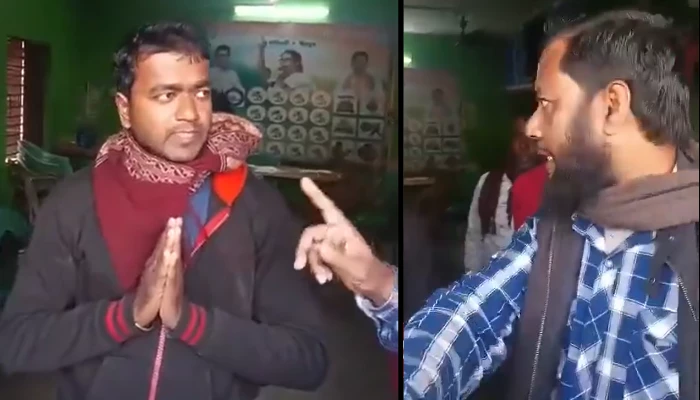
Case Summary
In Angora village under the jurisdiction of Nanur Police Station in Birbhum district, West Bengal, a Hindu man, Rintu Pal, was abducted, threatened, and intimidated by Trinamool Congress Party (TMC) members to discontinue his association with the Rashtriya Swayamsevak Sangh (RSS). As per reports, TMC workers forcibly took Rintu Pal from the locality and brought him to a TMC party office. Inside the premises, he was surrounded and intimidated. He was threatened and pressured to abandon his association with the RSS and to cease all related activities. During the intimidation, Rintu Pal was forced to declare that he would not work for the RSS in the future. The coercion was carried out in a controlled setting within the party office, where the presence of multiple individuals created an environment of fear and pressure. A video of the incident surfaced, showing Rintu Pal inside the TMC office, compelled to make the statement. The video captured the atmosphere of intimidation and the direct pressure he faced to renounce his organisational affiliation. In the video, the young man was seen forced to speak with his hands folded. A man behind the camera was heard asking, “Will you join the RSS-BJP party again in life?” He responded with folded hands, “I will not join RSS or BJP again in life.” He was also made to apologise in front of several people gathered there. The man behind the camera further stated, “It is good that I let you go today. Otherwise, I will hand you over to people, and they will tear you apart and eat you.” The incident drew public attention following the video's circulation. It highlighted the use of coercion and threats to force a Hindu individual to withdraw from his association with a Hindu organisation.
Why it is Hate Crime ?
This case is being added to the tracker under the primary category, "Attack not resulting in death". The subcategory selected is- Attacked for supporting/being part of a perceived Hindu party/org or working for the Hindu community. In several cases, Hindus are attacked specifically or tangentially for their association with parties or organisations perceived to be pro-Hindu and/or for working in favour of the Hindu community. One of the classic cases was the attack against a Bharatiya Janata Party Yuva Morcha (BJYM) worker, Praveen Nettaru. Nettaru was attacked and hacked to death for his association with Hindu organisations and his work for the Hindu community. He was murdered by PFI, a terror organisation that aimed to commit a genocide of Hindus, target Hindu leaders specifically and turn India into an Islamic Nation. In such cases, the immediate trigger for the violence may be non-religious, either according to the perpetrator or the police. However, there are surrounding circumstances from which the conclusion can be reached that the victim was attacked for his association with a Hindu organisation. In a similar case, Rinku Sharma was attacked by radicals. He was a member of Bajrang Dal and regularly worked for the Hindu community. While the police cited a different non-religious trigger for the attack, he was indeed associated with a Hindu organisation, and the family of Rinku Sharma specifically attributed his gruesome murder to his working for Bajrang Dal and raising Jai Shree Ram slogans. Such cases are intrinsically driven by religious hate and would therefore be documented as a hate crime under this category. The other category selected here is- Hate Speech against Hindus. Within this, the subcategory selected is- Violent threats. Violent threats, explicit, implicit or implied, are the most dangerous form of hate speech since it goes beyond discriminatory and prejudicial language to express the intent of causing harm to an individual or a group of people based on their religious identity and faith. There could be several different kinds of threats that are issued to Hindus based on religious animosity. An explicit threat would mean the direct threat of violence towards an individual Hindu, a group of Hindus or Hindus at large. Physical violence, death threats, threats of destruction of property belonging to Hindus and threats of genocide would mean explicit threats against Hindus for their religious identity. Implicit threats may not be a direct threat but implied through the use of symbols of actions – for example, in the Nupur Sharma case, other than explicit threats, there were also implicit threats when Islamists took to the streets to burn and beat her effigies. It implies that they want to do the same to Nupur Sharma, which is considered an implicit threat. Violent threats can be delivered in person, through letters, phone calls, graffiti, or increasingly through social media and other online platforms. It would be important to understand that a threat – explicit or implicit, online or offline – to an individual who happens to be a Hindu does not qualify as a religiously motivated threat. Such a threat, while vile and dangerous, could be owing to non-religious reasons and/or personal animosity. To qualify as a religiously motivated threat, it would need to exhibit an indication that the individual is being targeted for religious reasons and/or owing to his/her religious identity as a Hindu. This case was included in the tracker as it showed that the victim was targeted not for any personal dispute but for his association with a Hindu organisation and the identity he represented. His connection with the RSS made him a visible participant in Hindu community work, which became the basis for the coercion he faced. The pressure exerted on him to abandon this association demonstrated that the objective was to sever his link with a Hindu organisation, indicating hostility towards both his affiliation and his religious identity. Further, the manner in which the coercion was carried out reflected a clear attempt to override his individual agency. He was placed in an environment where he was compelled to publicly renounce his organisational ties, not out of free will but under visible pressure. This created a situation where his right to choose his beliefs and associations was effectively denied. The act conveyed that his continued involvement with a Hindu organisation would not be tolerated, reinforcing the idea that such participation invited consequences. Moreover, the threats issued during the incident carried an explicit element of intimidation. The language used went beyond persuasion and entered the realm of direct harm, indicating what would happen if he did not comply. Such statements were not symbolic or indirect; they conveyed a clear readiness to inflict violence. This transformed the incident from mere coercion into one marked by fear-inducing threats aimed at enforcing submission. Additionally, the public nature of the act amplified its impact. The recording and circulation of the video turned the coercion into a wider message, extending beyond the individual to others who might share similar affiliations. It signalled that those associated with Hindu organisations could be singled out, pressured, and threatened similarly. This broader implication reinforced the pattern of targeting based on organisational and religious identity. This pattern also needs to be situated within the broader context of post-poll violence in West Bengal following the 2021 assembly elections, where individuals associated with the Bharatiya Janata Party and allied organisations were repeatedly singled out and targeted. One of the most prominent cases was that of Avijit Sarkar, a local BJP worker from the Beliaghata constituency in Kolkata. Following the declaration of results in May 2021, he was lynched inside his home by a mob. Prior to his death, he had shared a video showing his house being ransacked by individuals affiliated with the TMC. Reports at the time also indicated that his pet dogs were killed during the attack. This case became emblematic of the wider pattern of targeted violence against BJP workers and supporters in the aftermath of the elections. In multiple such instances, the targeting was not random but directed at individuals identified with specific ideological affiliations, many of which are closely tied to Hindu identity and mobilisation. The overlap between political affiliation and religious identity in these contexts means that coercion aimed at forcing individuals to abandon such associations also carries a dimension of suppressing their Hindu ideological expression. Taken together, the forced abduction, the threats of violence, and the compelled public renunciation of association with a Hindu organisation indicate that the victim was targeted in a manner that goes beyond ordinary political rivalry. The coercion was aimed at erasing his association with a Hindu ideological organisation through intimidation, reflecting a pattern where individuals aligned with such identities are selectively targeted and pressured into compliance.
Victim Details
Total Victim
1
Deceased
0
Gender
- Male 1
- Female 0
- Third Gender 0
- Unknown 0
Caste
- SC/ST 0
- OBC 0
- General 0
- Unknown 1
Age Group
- Minor 0
- Adult 0
- Senior Citizen 0
- Unknown 1


Case Status
Unknown


Perpetrators Details
Perpetrators
State and Establishment
Perpetrators Range
One Person
Perpetrators Gender
male
 Sources




