Hindu community in Bilawal village mobilise against organised conversion gathering operating inside their village
 Charkhi Dadri, Haryana, India
  6 December, 2025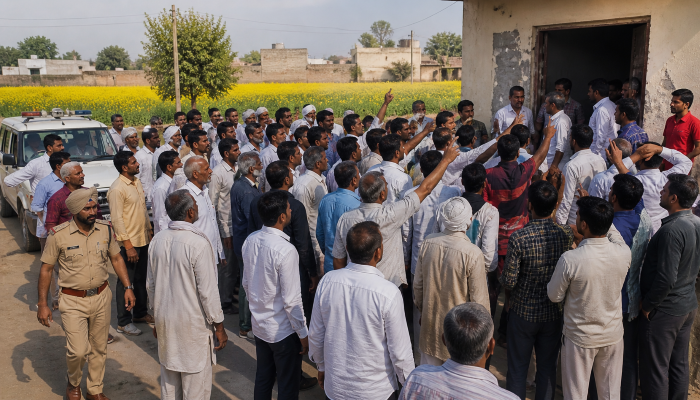
Case Summary
Hindu villagers of Bilawal village, Charkhi Dadri district, Haryana, raised an alarm after discovering that an unauthorised religious gathering aimed at converting Hindu residents was being conducted within their village. A large number of villagers reached the scene upon receiving the information and confronted those conducting the gathering. When villagers asked them to stop, the organisers refused to comply. Sarpanch representative Anil led the community response and called the police. Villagers Manjeet, Krishna, Ravinder, Vikas, Amit, Amandeep, Vijendra and others proceeded to Atela Police Chowki to lodge a formal complaint. Upon receiving information about the incident, Bajrang Dal members also reached Atela Police Chowki and appealed for action. Bajrang Dal District Coordinator Amit Gopalwas, District Co-coordinator Sahil Nawankur, City Coordinator Sahil Dhani Phogat, Gaurav Kaushik, Deepanshu, and Aman were among those present at the chowki demanding legal action. Villagers submitted a written complaint to Atela Chowki police stating that such attempts at conversion were not only legally punishable but also against the social harmony of the village. Investigating officer Sumit of Atela Chowki stated that the matter would be investigated seriously and legal action would be taken as per rules. No arrests were confirmed at the time of publication.
Why it is Hate Crime ?
The primary category for this case is "Predatory Proselytisation". The sub-category for this case is "Proselytisation by grooming, brainwashing, manipulation or subtle indoctrination". The tertiary category for this case is "Pattern of targeting Hindus". Religious brainwashing essentially means the often subtle and forcible indoctrination to induce someone to give up their religious beliefs to accept contrasting regimented ideas. Religious grooming or brainwashing also involves propaganda and manipulation. It involves the systematic effort, driven by religious malice and indoctrination, to persuade “non-believers’ to accept allegiance, command, or doctrine to and of a contrasting faith. Cases of such grooming or brainwashing are far more nuanced than direct threats, coercion, inducement and violence. In such cases, it is often seen that there is repeated, subtle and continual manipulation of the victim to induce disaffection towards their own faith and acceptance of the contrasting faith of the perpetrator. While subtle indoctrination is widely acknowledged as predatory, an element which is often understated in such conversions or the attempts of such conversion is the role of loyalty and trust which might develop between the perpetrator and the victim. Fiduciary relationships are often abused to affect such religious conversion. For example, an educator transmitting religious doctrine of a competing faith to a Hindu student. The Hindu student is likely to accept what the teacher is transmitting owing to existence of the fiduciary relationship. The exploitation of the fiduciary relationship to religiously indoctrinate victims would also be included in this category. Since the underlying animosity towards the victim’s faith forms the basis of predatory proselytization, such cases are considered religiously motivated hate crimes. The conversion gathering in Bilawal village was not a spontaneous or casual religious meeting. It was an organised assembly conducted within a Hindu village with the explicit purpose of converting residents away from Hinduism. The organisers' refusal to stop when confronted by villagers demonstrates that the gathering was not a private or incidental activity but a deliberate and confident operation that its organisers expected to conduct without interference. The location of the gathering within the village itself is a significant religious marker. Rather than operating from an external location, the organisers brought their conversion activity directly into the social space of a Hindu community. This choice of location reflects a calculated assessment that operating within the village would provide direct access to Hindu residents in their own domestic and communal environment, reducing the social distance between the proselytisers and their targets and increasing the likelihood of successful conversion outreach. The organisers' refusal to comply when villagers asked them to stop is a further marker of organised intent. A spontaneous or informal religious gathering would typically dissolve upon community objection. The persistence of the organisers in the face of direct community confrontation establishes that the gathering was backed by an organisational confidence that transcended the immediate social pressure of the village community. This confidence is consistent with a structured proselytisation network that had assessed the risk of community resistance and determined it to be manageable. The pattern of targeting Hindus is established by the broader context of the case. The gathering took place in a Hindu village, provoked an organised Hindu community response, and prompted Bajrang Dal to mobilise at the district level. The scale and speed of the Hindu community's response reflects a recognition that the gathering was part of a wider pattern of conversion activity targeting Hindu communities in the region rather than an isolated incident. Given that this case met the parameters of a religiously motivated hate crime, the perpetrators' conduct reflected more than unauthorised religious assembly. By organising a conversion gathering within a Hindu village, refusing to cease when confronted by Hindu residents, and operating with the confidence of a structured proselytisation network, their actions demonstrated a deliberate effort to penetrate and undermine Hindu communal space for the purpose of converting Hindu residents. The Hindu community of Bilawal village was targeted specifically because they were Hindu, and the choice to conduct the gathering within their village was made because direct community access would be most effective in achieving the conversion objective. This reflects an underlying hostility toward Hindu religious identity that cannot be characterised as anything other than religiously motivated. Given that this case met the parameters of a religiously motivated hate crime, it was added to the hate crime database of the tracker.


Case Status
Complaint filed


Perpetrators Details
Perpetrators
Muslim Extremists
Perpetrators Range
Unknown
Perpetrators Gender
unknown
 Sources




