Revered Hindu symbol “Om” desecrated during protest in Palakkad, Kerala
 Palakkad district, Kerala, India
  21 January, 2026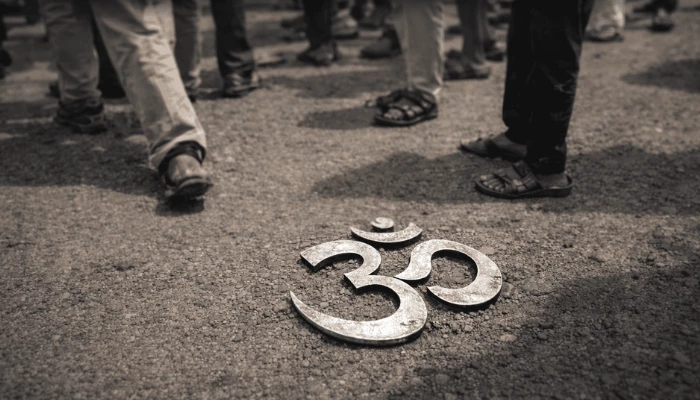
Case Summary
In Palakkad, Kerala, the sacred Hindu religious symbol “Om” was desecrated during a protest in. The protest had been organised by the Students’ Federation of India (SFI), the youth wing of the Communist Party of India (Marxist), and was directed at a school run by an organisation affiliated with the Rashtriya Swayamsevak Sangh. The demonstration followed the death of a student residing in the school hostel, which authorities were investigating as a suspected case of suicide. Police had initiated an inquiry, and officials stated that conclusions would be drawn only after a full investigation into the circumstances surrounding the death. During the course of the protest, participants reached the school premises where the sacred Omkara symbol was installed at the entrance. Visuals that later circulated widely showed the symbol being removed and physically mishandled amid the protest activity. The act took place in full public view and was captured on video, which was subsequently shared across social media platforms. The removal and mistreatment of the Om symbol, which holds deep religious significance in Hinduism, resulted in visible desecration of a sacred emblem placed at the institution. The visuals drew immediate public attention and were widely circulated, triggering reactions from members of the Hindu community who viewed the act as deeply disrespectful towards a revered religious symbol. The incident led to broader public discussion regarding the conduct of protests and the treatment of religious symbols during such demonstrations. Critics questioned the necessity of interfering with a sacred symbol during a protest, particularly when the matter under investigation was unrelated to the religious emblem itself. At the time of reporting, no official response had been issued by the state government regarding the handling of the symbol. It is important to mention here that SFI has always been in the forefront of campus clashes, ideological disputes, and violent misconduct. There are several reports where goons associated with the Students’ Federation of India (SFI), have intervened in Hindu religious practices, opposed or reacted aggressively to the expression of Hindu identity and been linked to disruptions during Hindu festivals. For example, on October 2, 2025, reports emerged of SFI members attacking a Durga Puja idol immersion procession. The incident happened in Delhi's Jawaharlal Nehru University (JNU) campus, where AISA, SFI, and DSF disrupted the procession, hurling wooden blocks and allegedly assaulting a female participant. Similarly, in February 2025, a clash between two student groups, the Students’ Federation of India (SFI) and the Akhil Bharatiya Vidyarthi Parishad (ABVP), erupted at South Asian University (SAU) in New Delhi over food preferences in the university mess. The conflict began when ABVP members requested the mess administration to serve sattvic food, as many students were observing a fast on the occasion of Maha Shivratri and accused leftist goons of trying to “spoil” the religious harmony on campus. Likewise, on 13th January 2024, goons associated with the Students’ Federation of India (SFI) attacked a Hindu man for questioning the tirade of a Communist Party leader, Dipsita Dhar, against the Ram Mandir.
Why it is Hate Crime ?
This case has been added to the tracker under the primary category - Attack on Hindu religious representations. Within this, the subcategory selected is -Desecration of a Hindu religious symbol. Icons and symbols, or a religious representation of a spiritual ideal, are widely revered in Hinduism. Iconography is of vital significance in the Hindu milieu. It helps connect people’s spiritual beliefs with the real world. Iconography within the Hindu faith takes several shapes and forms. Murtis are of most significance to Hindus, to which daily rituals, prayers and offerings are done. Besides the murtis, there are several other symbols which have deep significance in the Hindu faith – the Om and Swastika, for example. Since these Hindu religious symbols hold paramount importance in Hinduism, any desecration of symbols, icons, murtis, religious representations and manifestations, is driven by animosity towards the faith itself, which manifests itself through these murtis, icons and symbols. Therefore, any desecration of these Hindu religious symbols and representations is considered a religiously motivated hate crime under this category. The act of removing and physically mishandling the sacred “Om” (Omkara) symbol during a protest constitutes a clear instance of religiously targeted hostility, rather than incidental damage amid agitation. In Hinduism, Om is not a decorative or peripheral motif but the primordial sound and foundational spiritual symbol, representing the essence of the universe and the divine. Its placement at the entrance of the institution signified sanctity and reverence. The deliberate act of uprooting and desecrating it, especially in full public view, demonstrates a conscious disregard for its religious significance. Crucially, the subject of the protest, a student’s death under investigation, had no connection whatsoever to the Om symbol. The decision to interfere with a sacred emblem unrelated to the grievance indicates that the act was not spontaneous or accidental but a symbolic assertion directed at a Hindu religious marker. When a protest escalates into targeting a specific religious symbol, it reflects an intent to demean and provoke the faith associated with it, rather than merely to express dissent. This incident also aligns with a broader and documented pattern involving the Students’ Federation of India, where confrontations have repeatedly intersected with Hindu religious practices and symbols. Instances such as the disruption of a Durga Puja immersion procession, interference with Maha Shivratri fasting practices, and violence following expressions related to the Ram Mandir point to a recurring trend in which Hindu observances and identity markers become focal points of confrontation. The repetition of such incidents across locations and contexts strengthens the inference that these are not isolated excesses, but part of a consistent pattern of antagonism toward Hindu religious expression. In this context, the desecration of the Om symbol cannot be viewed in isolation. It represents a deliberate act of disrespect toward a sacred Hindu emblem, carried out in a charged environment to assert dominance over a visibly Hindu marker. Such conduct goes beyond protest and enters the realm of religiously motivated intimidation, where the objective effect is to insult the faith, hurt religious sentiments, and signal that Hindu symbols can be targeted without restraint.


Case Status
Unknown


Perpetrators Details
Perpetrators
Others
Perpetrators Range
Unknown
Perpetrators Gender
unknown
 Sources




