Hindu woman targeted for speaking out against anti-Brahmin hate; Ambedkarite man threatens to rape all Hindu women and abuses revered deities on social media
 India
India  3 May, 2026
Case Summary
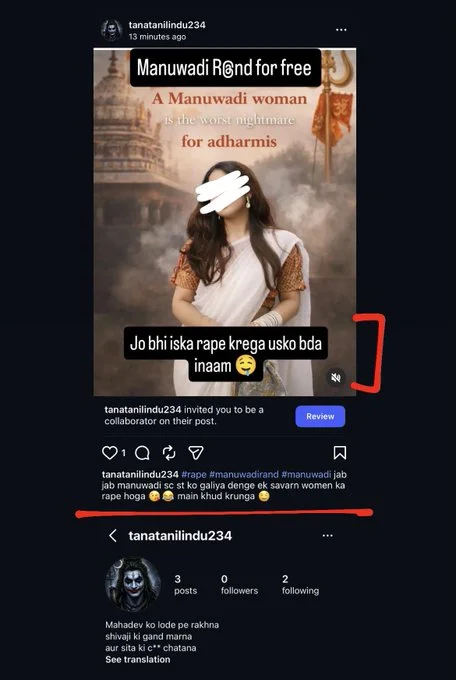
A Hindu woman named Tulip Sharma faced vicious targeting by an Ambedkarite man on social media for speaking out against anti-Brahmin hate. The accused hurled vile abuses at all Hindu women and issued rape threats against them. He also denigrated Hindu deities and revered Hindu kings like Chhatrapati Shivaji Maharaj of the Maratha Empire. According to information available, the accused Ambedkarite handle on social media named "tanatanilindu234" on Instagram made a post issuing abuses and rape threats against Tulip Sharma and all Hindu women. He tagged Tulip Sharma, who is an advocate and a content creator by profession. She speaks about anti-Brahmin and anti-upper-caste hate fuelled by Ambedkarites on social media. The accused posted an image of Tulip and tagged her. In the post, he wrote a derogatory comment about Tulip, calling her a 'Manuvadi R*nd', meaning a Manuvadi prostitute, in this case referring to Hindu women. He also targeted Tulip by saying, "Whoever rapes her will get a big reward". He also wrote a caption saying, "Whenever Scheduled Caste Scheduled Tribe people are abused by Savarnas (upper caste Hindus), then a rape of a Savarna woman would happen. I would do it myself." This screenshot of this post was posted on X by Tulip from her official handle on 4 May 2026. She also posted a screenshot of the accused's Instagram bio, which contained abuses and vulgar remarks towards Lord Shiva, Goddess Sita and revered Hindu king Chhatrapati Shivaji Maharaj of the Maratha empire. On her tweet, Tulip wrote: "This man has publicly sent me a rape threat on Instagram by misusing my image. He declared that every Savarna woman will be r@ped and that he will do it himself. This is the sick mindset of these Ambedkarites. They abuse our gods, issue rape threats to Savarna women, and still roam freely while a Savarna Hindu gets arrested for merely criticising Ambedkar." She further added, "This country has completely failed us, Brahmins. Recently, a 4-year-old Kulkarni Brahmin girl, daughter of a pujari, was raped in Pune. And now this! All because I dared to speak against the atrocities targeting Brahmins. I urge the police, General Category activists, and creators to take immediate cognisance of this. This is extremely triggering." This post by Tulip went viral on X, triggering outrage from Hindu users, who began tagging relevant law enforcement authorities to take action against the accused handle.
Case Images
Why it is Hate Crime ?
This case has been added to the tracker under the primary category- Attack not resulting in death. The subcategory selected is- Attacked for opposing radicals or trying to save victim. In several cases, Hindus are attacked for opposing religiously motivated crimes being committed against a fellow Hindu or simply for voicing an opinion opposing radical elements, who either have in the past or continue to persecute Hindus. In such cases, the initial attack against the victim, against which the Hindu was trying to defend the victim, would also need to be classified as a religiously motivated hate crime. Since the initial crime itself was religiously motivated and the subsequent crime of attempting to save the victim or speaking against the radical elements ends up inviting a violent attack, it would also be classified as a religiously motivated hate crime under this category. Another primary category selected in this case is- Hate Speech against Hindus. The subcategory selected is- Violent Threats. Violent threats, explicit, implicit or implied, is the most dangerous form of hate speech since it goes beyond discriminatory and prejudicial language to express the intent of causing harm to an individual or a group of people based on their religious identity and faith. There could be several different kinds of threats that are issued to Hindus based on religious animosity. An explicit threat would mean the direct threat of violence towards an individual Hindu, a group of Hindus or Hindus at large. Physical violence, death threats, threats of destruction of property belonging to Hindus and threats of genocide would mean explicit threats against Hindus for their religious identity. Implicit threats may not be a direct threat but implied through the use of symbols of actions – for example – in the Nupur Sharma case, other than explicit threats, there were also implicit threats when Islamists took to the streets to burn and beat her effigies. It implies that they want to do the same to Nupur Sharma – thereby is considered an implicit threat. Violent threats can be delivered in person, through letters, phone calls, graffiti, or increasingly through social media and other online platforms. It would be important to understand that a threat – explicit or implicit, online or offline – to an individual who happens to be a Hindu does not qualify as a religiously motivated threat. Such a threat, while vile and dangerous, could be owing to non-religious reasons and/or personal animosity. To qualify as a religiously motivated threat, it would need to exhibit an indication that the individual is being targeted for religious reasons and/or owing to his/her religious identity as a Hindu. Anti-Hindu slurs, mocking faith. The other subcategory selected is- Anti-Hindu slurs, mocking faith. Anti-Hindu slurs and the deliberate mocking of the Hindu faith owing to religious animosity involve the usage of derogatory terms, stereotypes, or offensive references to religious practices, symbols, or figures. One of the common anti-Hindu slurs used against Hindus is “cow-worshipper” and “cow piss drinker”. The intention of using this term is to demean and mock Hindus as a group and their religious beliefs since Hindus consider the cow holy. Additionally, some symbols and the slurs attached to them have a historical context that exacerbates the insult, hate, stereotyping, dehumanisation and oppression against Hindus. Cow worship has been used for centuries to denigrate Hindus, insult their faith and oppress Hindus specifically as a religious group. There has been overwhelming documentation about how cow slaughter has been used to persecute Hindus with cow meat being thrown in temples and places of worship. There has also been overwhelming documentation where cow meat (beef) has been force-fed to Hindus to either forcefully convert them to Islam or denigrate their faith. Apart from cow worship, the Swastika – which holds deep religious significance for the Hindus – has also been misinterpreted and distorted to use as a slur against Hindus. Similarly, the worship of the Shivling has been used by supremacist ideologies and religions to denigrate Hindus owing to religious animosity. Such slurs and denigration stem out of inherent animosity and hate towards Hindus and their faith, therefore, it is categorised as hate speech targeted at Hindus specifically owing to their religious identity. The other subcategory selected is- Mocking/denigrating Hindu leaders. Hate speech is defined as any speech, gesture, conduct, writing, or display that is prejudicial against a specific individual and/or group of people, which is leading to or may lead to violence, prejudicial action or hate against that individual and/or group. Religious leaders are often seen as representatives of the community, especially, the community’s religious faith and beliefs. Mocking or denigrating a religious leader specifically owing to his religious identity and/or the religious rituals he observes can be considered hate speech because the motivating factor of the speech is animosity and/or dislike for what he represents – the religious beliefs and faith of the community. It is important to note that mere insulting words against an individual do not constitute hate speech. It is entirely possible that insulting words are used for an individual, however, the specific speech is not the result of religious hate and/or animosity towards the professed faith of the religious leader, but the individual himself. For the speech to be considered hate speech, the speech itself or the motivating factor behind the speech has to be religious in nature. Such speech which denigrates Hindu religious leaders specifically owing to animosity towards the faith they profess and the community faith they represent will be treated as hate speech under this category. This case exemplifies religiously motivated hate speech, with the Ambedkarite perpetrator targeting Tulip Sharma, a Hindu Brahmin woman and advocate who spoke out against anti-Brahmin hate, while extending vile threats to her and other Hindu women rooted in anti-Hindu animosity. The accused directly targeted Tulip by tagging her image, branding her a "Manuwadi R*nd" (meaning Manuvadi prostitute? a Hindu prostitute), and vowing to personally rape her and all Savarna Hindu women as revenge for perceived caste oppression, while abusing Hindu deities like Lord Shiva and Goddess Sita alongside revered kings such as Chhatrapati Shivaji Maharaj. These coordinated attacks on Tulip, fellow Hindu women, sacred faith symbols, and historical icons form a deliberate pattern aimed at terrorising individual victims like her, dehumanising Hindu women collectively, and eroding the community's religious identity through intimidation and sacrilege. Tulip Sharma faced this vulgar targeting, threats, and abuse simply for speaking out against the anti-Brahmin and anti-Hindu hate propagated by Ambedkarites, transforming her act of courageous advocacy into a direct trigger for religiously motivated retaliation. As a Hindu Brahmin woman and advocate who creates content exposing the Ambedkarite community's pattern of anti-Brahmin hostility and broader assaults on Hindu identity, she became a prime target for their wrath, with the perpetrator tagging her image to brand her a "Manuwadi R*nd" and vowing to rape her personally alongside all Savarna Hindu women. This vicious response reveals the deep religious animosity at play, where opposing Ambedkarite radicalism, rooted in their rejection of Hindu faith, deities, and traditions, provokes immediate hatred towards a Hindu woman, punishing her not for personal faults but for daring to defend her community's dignity against faith-based vilification. Such intimidation seeks to silence voices like Tulip's, ensuring that Hindu women who challenge anti-Hindu narratives suffer dehumanisation and terror, cementing this as a textbook case of religiously fuelled hate crime aimed at her religious and cultural existence. The use of the term "Manuvadi" reveals how Ambedkarites weaponise it to denigrate the Hindu faith and community, often under the pretext of opposing casteism, while actually targeting and abusing Hindu women as a whole, transforming it into a religiously motivated hate crime. When the perpetrator labelled Tulip Sharma and other Hindu women as "Manuwadi R*nd", meaning a Manuvadi prostitute, he explicitly invoked this slur against upper-caste Hindu women like her, but its application extended broadly to all Hindu women, stripping them of dignity based on their religious identity rather than isolated caste issues. Then the fact that he encouraged other men to rape her showcases the depth of hatred that the accused had towards Hindu women and the larger Hindu community in general. This religiously charged abuse and threats showcase deep-seated animosity towards the Hindu community, portraying Tulip and other Hindu women not as individuals but as embodiments of a faith deemed worthy of sexual violence and contempt, thereby constituting a direct assault on Hindu religious and cultural honour. The term "Manuvadi" functions as a loaded slur deployed by anti-Hindu elements to invoke Manusmriti, a Hindu text selectively quoted out of context to depict Hindus as caste-obsessed followers of a supposed oppressive code, despite Manusmriti not being a central or authoritative scripture in mainstream Hinduism like the Vedas, Upanishads, or Gita. Leftist and anti-Hindu Ambedkarite groups routinely apply this label to smear all Hindus as casteists, fostering a divisive narrative that pits communities against each other under the guise of social justice. This tactic erodes Hindu unity by creating false binaries, upper caste oppressors versus others, while collectively targeting Hindus regardless of caste, as evidenced by the broad-brush attack on Tulip Sharma and all Hindu women in this case. The misuse of "Manuvadi" here reveals not genuine reformism but entrenched hostility towards Hindu identity, constituting clear anti-Hindu hate speech designed to demean and isolate the community. The Ambedkarite ideology cloaks itself in the fight against casteism, yet it consistently targets the entire Hindu community, their revered deities, scriptures, and their temples, revealing its core as outright anti-Hindu animosity. The adherents of this ideology paint all 'upper-caste' Hindus as tyrannical oppressors of disadvantaged Dalit sections within Hindu society, but this merely serves as a euphemism to assault Hinduism as a whole, not just specific castes. The slur "Manuvadi R*nd" exemplifies this, lashing out not merely at upper-caste Hindu women like Tulip but at all Hindu women who embrace their faith, imprinting them with a brand of inferiority and hatred. The movement's intent is to discredit Hindu society and faith by labelling it oppressive and tyrannical, falsely portraying Hinduism as inherently discriminatory and reserved only for the privileged upper-caste class. This false narrative persists to delegitimise Hindu faith, dehumanise its followers, and erode their unity, as seen here, where the Ambedkarite perpetrator dehumanised Tulip Sharma and all Hindu women under the euphemism of targeting only "Manuvadi" ones. Furthermore, his rape threats struck at Tulip specifically by misusing her image, while menacing every Hindu woman with sexual violence disguised as vengeance against Savarna women for the supposed oppression of Scheduled Castes and Scheduled Tribes. He boasted he would personally rape them if upper-caste Hindus abused Dalits, showcasing deep-seated religious animosity masked as caste justice, with the goal of inflicting harm on victims like Tulip, instilling terror in Hindu women, and silencing the community. Such violent threats intimidate Hindu followers into submission, marking this as a clear case of religiously motivated hate crime. Furthermore, the perpetrator's abuse of Lord Shiva and Goddess Sita further cements this as religiously motivated hate speech, striking at the heart of Hindu devotion. Lord Shiva, the destroyer and ascetic in the Trimurti, embodies cosmic balance, meditation, and fierce protection for his followers, while Goddess Sita represents ideal womanhood, purity, devotion, and resilience as Rama's consort in the sacred Hindu epic, Ramayana. For millions of Hindus, including Tulip and other Hindu devotees, these deities are living presences invoked daily in prayers, festivals, and life crises; vulgarly denigrating them wounds collective Hindu sentiments profoundly, profanes sacred ideals of dharma and femininity, and provokes outrage. This deliberate sacrilege offends Hindu beliefs at their core, driven purely by animosity towards the Hindu religion, making it a clear example of hate speech. The perpetrator also mocked and abused Chhatrapati Shivaji Maharaj in a derogatory manner, a direct assault revealing religious hatred for Hindu pride and history. Shivaji Maharaj, founder of the Maratha Empire, stands as an eternal symbol of Hindu resistance, having reclaimed swarajya from the Islamic tyranny of the Mughal empire through guerrilla warfare, forts, and navy while upholding Hindu dharma. He fought valiantly for Hindu rights, protected cows and temples, administered justice via Hindu law, and united Hindus across castes, sects, and classes into one formidable force against Islamic invasions, crowning himself in a grand Vedic ceremony to restore Hindu glory. He is revered nationwide by Hindus as a saint-king and embodiment of resilience; his legacy fuels annual festivals like Shivaji Jayanti, towering statues, folk ballads, and a profound sense of communal pride that transcends regions. Abusing him in this context transcends mere personal insult or political disagreement; it deliberately strikes at a unifying icon of Hindu triumph and dharma, wounding the faith's deepest sentiments, inciting fear among Hindu devotees like Tulip, and signalling intent to humiliate an entire religious community. This calculated denigration, paired with attacks on Tulip, other Hindu women, and deities, fulfils every criterion of a religiously motivated hate crime under frameworks like deliberate targeting of religious symbols, provocation of communal outrage, and efforts to suppress Hindu expression through intimidation. Given that this case meets all parameters of a religiously motivated offence, it has been added to the hate crime database of the Hinduphobia Tracker. Disclaimer: The Hinduphobia Tracker records dates of incidents based on when the crime occurs, rather than when it is reported in the media or on social media. In this case, as per the available information, there is no exact date when the accused made these derogatory remarks. Therefore, when Tulip Sharma posted about this on her social media handle on 4 May 2026, that date is selected as the indicative incident date. In this case, although the rape threats were directed at all Hindu women, the attack was specifically launched at Tulip Sharma. Therefore, the victim count is recorded as one (1).
Victim Details
Total Victim
1
Deceased
0
Gender
- Male 0
- Female 1
- Third Gender 0
- Unknown 0
Caste
- SC/ST 0
- OBC 0
- General 1
- Unknown 0
Age Group
- Minor 0
- Adult 1
- Senior Citizen 0
- Unknown 0


Case Status
Unknown


Perpetrators Details
Perpetrators
Others
Perpetrators Range
One Person
Perpetrators Gender
male
 Sources




