Hindu religious procession attacked near mosque in Bihar, devotees stone-pelted over DJ music by Muslims
 Mothihari, Bihar, India
  3 May, 2026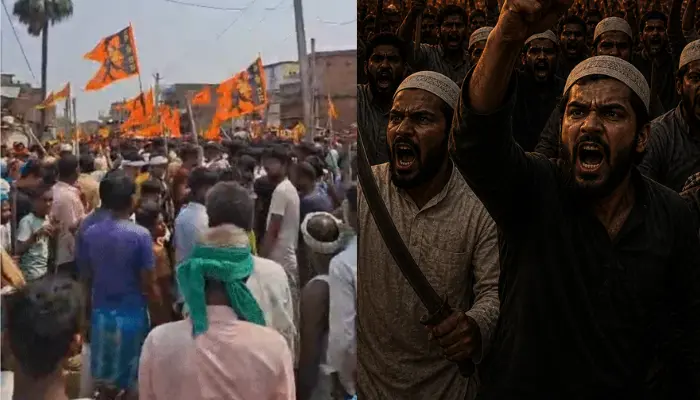
Case Summary
In Bihar’s Motihari district, a Hindu religious procession, a Kalash Yatra, was attacked by Muslims for passing through a mosque while playing Hindu religious songs on a DJ. This led to a violent communal clash between Hindus and Muslims, which involved stone pelting. According to reports, this occurred in Bhandaar village on 4 May 2026. The Kalash Yatra was taken out in connection with a Mahayagna (sacred fire ritual) in the village. Hindu women participants walked with pots on their heads during the Kalash Yatra, while the Hindu men added grandeur to the procession with DJs and bands playing Hindu religious songs. The procession departed from Bhandaar and headed towards Belwa Ghat. When the procession approached a mosque, with music being played on the DJ, this angered the members of the Muslim community. They blocked the road in protest. Meanwhile, some members of the Muslim community objected to the designated route of the procession. This further escalated as Muslims began attacking Hindus, leading to confrontation between the two sides, and stone-pelting and lathi-charge ensued. A heated exchange between the people present at the scene escalated further, turning the situation into a violent riot between Hindus and Muslims. Upon receiving information about the incident, local police immediately arrived at the scene and began efforts to control the situation. Recognising the gravity of the situation, the district administration also swung into action. District Magistrate Saurabh Jorwal and Superintendent of Police Swaran Prabhat arrived at the scene with a heavy police force. Officials brought the situation under control by convincing both Hindus and Muslims. As a precaution, an additional police force was deployed in the area. Police continuously camped in the village and kept an eye on the situation. The administration tried to maintain peace by establishing dialogue between the Hindu and Muslim communities. The district administration appealed to the people not to pay heed to rumours and maintain peace. Regarding this violence, the police claimed that a meeting had been held before the procession to maintain peace between the Hindu and Muslim communities. The police further claimed that it was agreed that DJ music would not be played when the procession passed by the mosque on its way to Belwa Ghat, to avoid any untoward incidents. The administration also issued necessary guidelines regarding this. However, when the procession approached the mosque, some participants refused to turn off the DJ. This led to violence and a communal attack from the Muslims. Furthermore, the police claimed that in 1990–1991, both Hindus and Muslims had agreed that no procession would be taken along this route. This time, at an administrative meeting, it was decided that unmarried girls participating in the Kalash Yatra would travel along the said route past the mosque, while a separate route was designated for DJs. However, during the procession, an attempt was made to change the route of the DJ and take it through the same mosque, which led to a tense situation between the two communities. Seeing the situation, the police acted swiftly, shut down the DJ and calmed both sides. After this, the participants of the Kalash Yatra were sent for Jalbhojhi in turn, and the situation gradually returned to normal. District Magistrate Saurabh Jorwal said, “There was a brief dispute during the Kalash Yatra. Upon receiving information, we immediately reached the scene. After reaching there, we spoke with both parties. After convincing them, the Yatra proceeded peacefully along the designated route, in accordance with the pre-arranged agreement.” Superintendent of Police Swaran Prabhat said, “During the Kalash Yatra, some anti-social elements made an unsuccessful attempt to disrupt it. However, the presence of the police administration at the spot and the prompt intervention of senior officers brought the situation under control quickly. I personally accompanied the District Magistrate to the scene and monitored the situation.” There was no loss of life or property during the entire incident. After convincing both parties, the Kalash Yatra proceeded peacefully along the pre-determined route. The puja rituals continued smoothly. As per the police, videography had been conducted to identify the anti-social elements involved in the incident. Strict action would be taken against them. At the time of writing this report, the situation was completely under control, and an adequate police force had been deployed as a precaution until further notice.
Why it is Hate Crime ?
The primary category selected in this case is- Attack not resulting in death. The subcategory selected is- Attack on Hindu religious procession. The outward celebration and display of religious symbols in an intrinsic part of Hinduism. Religious processions on various festivals are age-old traditions and a way to manifest faith and form a part of the religious practices of Hindus. On several occasions, such religious processions come under attack by non-Hindu mobs, in a manifestation of their animosity towards Hinduism and their practices. The reasons cited for such violent attacks are many and range from crossing a non-Hindu resident-dominated area to playing loud music, crossing from an area where there is a religious structure of another faith etc. The violent attacks are triggered by the outward display of religiosity by Hindus. The attacks are mainly a manifestation of religious supremacist doctrine which believes that idolatry, essentially the Hindu faith, is one that deserves to be annihilated since the very tenets of Hinduism, its practices and traditions are considered a sin in those doctrines. Since these attacks emanate from intrinsic and doctrinal animosity towards Hindus and Hinduism, it is considered a religiously motivated hate crime under this category. The other subcategory selected in this case is- Attack against Hindu devotees. Hindu devotees are a few of the easiest targets of religiously motivated hate crimes because during the festival/procession/puja etc, for non-Hindus it is easy to profile their victims on the basis of religion. Hindu devotees come under attack on several occasions by individual non-Hindus or mobs of non-Hindus owing to their animosity against Hinduism, its symbols and tradition/practices. There are several instances of Hindu devotees being attacked while they worship in temples or temporary religious structures, during religious processions, doing bhajan/kirtan/puja in their own homes, in the residential society etc. These attacks are perpetrated by non-Hindus primarily because of their animosity towards Hindus and their faith. In some cases, the trigger for the violence may be non-religious, however, there are two elements that make these hate crimes. First, the Hindus who come under attack are attacked violently while indulging in religious activity. Whether they are in a place of worship or not is immaterial to the crime. When individuals are attacked while indulging in religious practices, the attack in itself is a hindrance to their freedom to practice religion and therefore constitutes a hate crime. Secondly, religious supremacist doctrines and ideologies deem religious practices of Hindus to be offensive ab initio since they are considered “sinful” by these ideologies, worthy to be annihilated by force or coercion. Driven by these religious supremacist ideologies and doctrines, the attacks against Hindu devotees stem from intrinsic animosity towards Hinduism. In some cases, the trigger for the violence may be non-religious, however, it develops into a religiously motivated crime during the course of the violence. Since these attacks stem from animosity towards Hindus and Hinduism, they are considered religiously motivated hate crimes under this category. The other subcategory selected is- Attacked for crossing 'Muslim area'. One of the reasons that Hindus get attacked unprovoked specifically by Islamists is for crossing ‘Muslim areas’. Essentially, Muslim mobs often attack Hindus crossing or present in certain areas which have a majority Muslim population. It has often been cited as one of the reasons to blame Hindus for attacks against themselves, signalling that Hindus displaying religious symbols, taking our religious processions or crossing any area which is dominated by Muslim residents is a provocation in and of itself. These areas are mostly ghettoized areas where mobs mobilize quickly to attack Hindus for a variety of reasons like playing music during a religious procession, crossing a mosque, wearing a tilak or any other religious symbol in a Muslim-dominated area, praying at a local temple in that area etc. There have been cases where the few local Hindus of that area have been attacked on their way to the Temple for prayers as well, simply because the area is considered a Muslim-dominated area. Several times, it is entirely possible that the immediate trigger for the violence against Hindus was non-religious in nature, however, the violence became religiously motivated in nature because the area was Muslim dominated and the residents on the whole harboured animosity towards Hindus, evidenced from the actions of the mob, the slogans, and the nature of the attack. Such crimes are motivated by the religious identity of the victims and are therefore classified as hate crimes under this category. The other subcategory selected is- Communal Clash/Attack. Communal clash is a form of collective violence that involves clashes between groups belonging to different religious identities. For a communal clash between Hindus and non-Hindus to qualify as a religiously motivated hate crime, the trigger of the violence itself would have to be anti-Hindu in essence. For example, if there is a Hindu religious procession that comes under attack from a non-Hindu mob and after the initial attack, Hindus retaliate in self-defence, leading to a communal clash between the two religious communities. While at a later stage, both communities are involved in the clash/violence, the initial trigger of the violence was by the non-Hindu mob against the Hindus and therefore, it could safely be termed as an anti-Hindu violence. Further, the trigger would also have to be religiously motivated. In the cited example, the attack by the non-Hindu mob was against religious processions and therefore, can be concluded to be religiously motivated. In some cases, the trigger may be non-religious, however, it develops into religious violence against Hindus at a later stage. In such cases too, the foundational animosity towards Hindus becomes the motivating factor of the crime and therefore, it would be classified as a religiously motivated hate crime against Hindus under this category. Another primary category selected is- Restriction/Ban on Hindu practices. The subcategory selected is- Restriction on expression of Hindu identity. An example of the state-affected prejudicial and targeted orders against the Hindu community would be a government denying the right of a Hindu or a group of Hindus to hold a religious procession owing to the animosity of non-Hindu groups. Denial of the religious right of the Hindus to assuage the non-Hindu group which harbours animosity to a point where it could lead to violence against Hindus is not only a failure of law and order but is a prejudicial order against Hindus, denying them their fundamental rights to express their religious identity. An example of a hate crime against Hindus by a non-Hindu would be a non-Hindu institution forcing its Hindu employees to abandon religious symbols that a Hindu would wear as an expression of faith owing to inherent prejudice against the faith professed by the victim or a non-Hindu group of people restricting a Hindu group from constructing a place of worship simply because the demography of the area in which the temple is being built is dominated by non-Hindus. Such actions are driven by religious animosity and/or prejudice against Hindus and their faith and would therefore be categorized as a hate crime. The other subcategory selected is- Administration restricting religious practice. In several cases, it is seen that the administration/state disallows a religious practice owing to prejudicial orders and concerns, targeted specifically against the Hindu community. Such restriction/prohibition would be considered documented as a hate crime because the orders are often a result of pressure by groups that harbour animosity towards Hinduism and Hindus. Often, the restriction by the authorities is driven by bias, hostility, or prejudice against the specific community being stopped from holding a religious practice, by pressure groups that harbour animosity towards Hindus, intrinsic to their faith. Since practices are intrinsic to the faith of the Hindus, such prejudicial restriction is considered a curtailing of the fundamental rights of the Hindu community. In several cases, for example, the authorities ban a Hindu religious practice due to pressure from groups opposed to the religion. In other instances the prohibition is selectively enforced against one religious group (Hindus) while others are allowed to proceed. There are still other cases where the authorities preemptively restrict a religious practice by Hindus because those who hold animosity towards Hindus may get “provoked” leading to them being violent, thereby assuaging the sentiments of those who hold animosity towards Hindus by curtailing the religious rights of Hindus. Such acts and orders are prejudiced, indicating discriminatory motives owing to the capitulation to groups that harbour animosity towards Hindus and therefore, would be categorized as a religiously motivated hate crime since the original pressure leading to the order itself is a result of hatred/bias/prejudice/religious hate against Hindus. This case is a clear example of a religiously motivated hate crime, as a Hindu religious procession was attacked and Hindu devotees were assaulted by Muslims for playing DJ music while passing through a mosque. This makes this incident a clear case of a religiously motivated hate crime. Even the fact that the police had aimed to restrict the Hindu religious procession by restricting the use of a DJ through the procession route showcases institutionalised bias against Hinduism and the Hindu community, making it a clear case of a religiously motivated offence. Firstly, the targeted attack on the Hindu procession unequivocally demonstrates profound religious animosity from the Muslim perpetrators. A Hindu procession embodies sacred faith, fervent devotion, and communal unity, core pillars of Hindu religious life, making it a blatant symbol of Hindu identity. Launching a violent assault solely because the procession featured DJ music with Hindu devotional songs exposes not just intolerance, but a visceral hatred for Hinduism itself: the perpetrators weaponised something as innocuous as religious music to justify their aggression. This was not a random act of violence; it was a calculated strike at Hindu sentiments, triggered exclusively by the sound of Hindu bhajans, underscoring the perpetrators' anti-Hindu bigotry and framing this as a textbook hate crime rooted in anti-Hindu animosity. Attacking Hindu devotees during their sacred religious procession starkly exposes the perpetrators' deep-seated religious animosity toward Hinduism. These devotees were immersed in a profound act of public worship, chanting mantras, honouring deities, and affirming communal bonds, when they were brutally assaulted, transforming a moment of devotion into one of terror. This was no mere law-and-order skirmish; it was a deliberate assault on Hindus boldly expressing their faith, aimed at humiliating and silencing their religious identity and expression in broad daylight. By attacking Hindu devotees mid-procession, the attackers signalled not just personal hatred, but systemic hostility toward Hinduism itself, elevating this from isolated violence to a brazenly religiously motivated hate crime. The fact that the procession passed by a mosque, and for that reason, it was attacked, also points towards a hate crime. When a religious procession is violently targeted simply because it moved through an area near a place of worship, it reflects an attempt to control public space on religious lines. Muslims often consider areas near mosques, dargahs, or places where their community is in the majority as "Muslim areas" or "Muslim ghettos". This reveals a disturbing sense of Islamic supremacy held by the Muslim attackers, who viewed the area near the mosque as an exclusive zone where non-Muslims, particularly Hindus, were unwelcome. This sense of entitlement and superiority reflects deep-seated prejudice and an attempt to assert religious dominance over public spaces. The assault on the Hindu victims was motivated by this supremacist ideology, with Muslims in the area looking down upon Hindus and believing they had the right to control who could move freely in "their area". Such an act illustrates a dangerous mindset rooted in exclusion, intolerance, and religious animosity, making this case an ideal example of a crime motivated by anti-Hindu hatred. Overall, this incident exemplifies a communal attack on Hindus and a full-blown communal clash fueled by profound religious animosity, as the Hindu devotees faced brutal violence simply for publicly expressing their faith through devotional songs on a DJ during a Kalash Yatra passing a mosque route. What began as a peaceful religious procession swiftly escalated into savage aggression from Muslim perpetrators, revealing how their deep hostility erupts at the mere sight of Hindu worship in shared public spaces. This disproportionate brutality far exceeded any legitimate grievance over the route or music volume; if those were genuine concerns, the response would have involved calm negotiation, police mediation, or any other non-violent recourse, not physical violence against unarmed Hindu devotees. Instead, the Muslim attackers' choice to unleash physical harm on Hindus mid-procession underscores a deliberate intent to target and suppress Hindu identity, treating sacred expressions like the Kalash procession and bhajans as provocations warranting bloodshed. By prioritising violence over restraint, they exposed not situational frustration but visceral hatred for Hinduism itself, transforming a routine religious event into a calculated assault that wounds Hindu sentiments, shatters public peace, widens religious fault lines, and signals permission for further anti-Hindu aggression. This pattern elevates the episode beyond a local skirmish into a quintessential hate crime, where the victims' Hindu faith was the sole trigger for communal carnage. The earlier restrictions from the 1990s and 1991, which prohibited Hindu processions from passing through the route simply because a mosque stood there, reveal deep religious animosity through blatant unequal treatment of Hindu religious practices. Public roads serve as civic spaces open to all communities for peaceful movement, yet Hindus were singled out and forced to alter their sacred yatras, effectively ceding public access to one religion's sensitivities. This selective barrier not only curtailed Hindu devotees' rights to express their faith publicly but also signalled that Hindu religious identity must bow to Muslim presence, fostering a climate where one community's worship trumps another's. Such targeted historical curbs demonstrate entrenched bias from local authorities and the Muslim community, portraying Hindu processions as inherently disruptive threats warranting exclusion. The current incident amplifies this animosity, as the administration once again swiftly restricted the Hindu procession by stopping the DJ near the mosque, prioritising one religion's comfort over Hindu devotional rights. Devotional music plays a central role in these processions, creating an immersive religious atmosphere of bhajans, rhythms, and collective fervour that uplifts devotees' spirits and publicly proclaims their faith. By mandating silence at the mosque's proximity, officials effectively policed Hindu worship as provocative noise, while ignoring similar expressions from other faiths. This knee-jerk intervention tells Hindu devotees their sacred sounds are offensive and expendable, exposing administrative complicity in religious discrimination that diminishes Hinduism's public voice. When Hindu processions face repeated demands to adjust, reduce volume, or silence practices under the guise of public order, while other religious expressions like daily azaan calls proceed unchecked, it underscores profound animosity through one-sided enforcement. Hindu celebrations, often vibrant with music and processions during festivals like Ram Navami or Ganesh Chaturthi, become flashpoints for curbs, yet mosques broadcast prayers five times daily without equivalent restrictions on decibels or timing. This disparity communicates to Hindus that their religious customs must yield disproportionately, breeding resentment and highlighting a systemic bias where Hindu faith bears the burden of "harmony." Such patterns erode equal religious footing, framing Hinduism as the aggressor in shared spaces. The stark contrast between rare Hindu processions with DJ music and the unrestricted daily loudspeaker azaan further exposes this religious animosity as discriminatory double standards. Hindu events occur annually or sporadically, yet trigger immediate halts, while azaan echoes through neighbourhoods multiple times each day without negotiation or volume controls. This selective scrutiny strengthens the case for viewing the violence as a hate crime, rooted in hostility toward Hindu expression, as it reveals not impartial governance but favouritism that emboldens aggression against Hindus while shielding other communities. Ultimately, it signals to Hindu devotees that their infrequent joys invite interference, perpetuating cycles of animosity. Given that this case meets multiple parameters of a hate crime, it is added to the hate crime database of the Hinduphobia Tracker.


Case Status
Unknown


Perpetrators Details
Perpetrators
Muslim Extremists
Perpetrators Range
Unknown
Perpetrators Gender
unknown
 Sources




