Hindu tribal communities in Uttarakhand targeted by organised Christian conversion network
 Uttarakhand, India
  29 April, 2026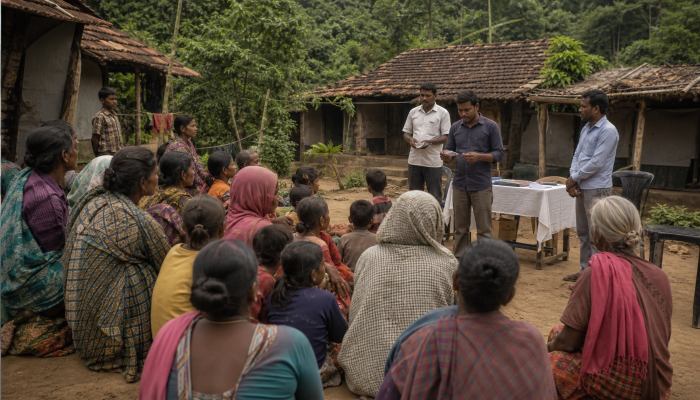
Case Summary
Hindu tribal communities in Khatima and the surrounding border areas of Uttarakhand faced sustained predatory proselytisation by Christian missionaries operating across multiple tribal-majority villages in the region. Poor and vulnerable Hindu families in areas including Khetalsanda, Kham Pachauriya, Ganna Centre Halwari, Saina, Badi Baguliya, 22 Pul, and Bhudakishni were identified as targets of an organised conversion campaign. Vishwa Hindu Parishad [VHP] and Bajrang Dal workers documented that Christian missionaries employed two primary methods to convert Hindu tribal communities. The first was financial inducement, in which poor Hindu families were offered money as a direct incentive to convert. The second was the Changai Sabha [faith healing gathering in which participants are falsely promised miraculous cures for illness through religious intervention], in which missionaries falsely presented themselves as capable of curing diseases through religious means, exploiting the medical vulnerability and limited healthcare access of tribal Hindu communities to draw them toward conversion. VHP and Bajrang Dal workers submitted a memorandum to the Chief Minister of Uttarakhand through the Sub-Divisional Magistrate, demanding immediate and strict legal action against those conducting illegal conversions in the region. Block Minister Pradeep Thakur issued a clear warning that if the administration failed to stop the conversion activity, VHP and Bajrang Dal would be compelled to launch an intense protest. Khatima Tehsildar Veerendra Sajwan stated that if the conversion of any Scheduled Caste [SC] or Scheduled Tribe [ST] individual was fully established, their reserved status could be revoked under applicable law.
Why it is Hate Crime ?
The primary category for this case is "Predatory Proselytisation". The sub-category for this case is "Conversion/attempts to convert by inducement". Predatory Proselytisation is not just limited to threat, harassment, force and violence, but it also has contours of stealth. In several cases, the Hindu victim is exploited to convert, with non-Hindus taking advantage of their poverty. In such cases, the Hindu victim who is suffering financially is offered monetary benefits, including lucrative offers for jobs, health treatment, education, etc, to induce the victim into changing his/her religion. In such cases, the religious identity of the victim and the aim to disenfranchise him from his faith form the heart of the crime. Also, taking advantage of and exploiting an individual’s economic vulnerabilities is widely acknowledged as exploitation, forms of which are often penalised by law. Such cases therefore are considered religiously motivated hate crimes since the victim’s religious identity forms the very heart of the crime itself. Another sub-category for this case is "Proselytisation by grooming, brainwashing, manipulation and subtle indoctrination". Within this, the tertiary category selected is- Pattern of targeting Hindus. Religious brainwashing essentially means the often subtle and forcible indoctrination to induce someone to give up their religious beliefs to accept contrasting regimented ideas. Religious grooming or brainwashing also involves propaganda and manipulation. It involves the systematic effort, driven by religious malice and indoctrination, to persuade “non-believers’ to accept allegiance, command, or doctrine to and of a contrasting faith. Cases of such grooming or brainwashing are far more nuanced than direct threats, coercion, inducement and violence. In such cases, it is often seen that there is repeated, subtle and continual manipulation of the victim to induce disaffection towards their own faith and acceptance of the contrasting faith of the perpetrator. While subtle indoctrination is widely acknowledged as predatory, an element which is often understated in such conversions or the attempts of such conversion is the role of loyalty and trust which might develop between the perpetrator and the victim. Fiduciary relationships are often abused to affect such religious conversion. For example, an educator transmitting religious doctrine of a competing faith to a Hindu student. The Hindu student is likely to accept what the teacher is transmitting owing to existence of the fiduciary relationship. The exploitation of the fiduciary relationship to religiously indoctrinate victims would also be included in this category. Since the underlying animosity towards the victim’s faith forms the basis of predatory proselytization, such cases are considered religiously motivated hate crimes. Christian missionaries operating in the tribal-majority villages around Khatima selected their targets with deliberate precision. Poor Hindu tribal families, living in conditions of economic vulnerability and limited access to healthcare, were identified as the most susceptible population for conversion. The selection was not random. It was calculated. The missionaries' operational focus on tribal-majority villages in a border region of Uttarakhand reflects an awareness that tribal Hindu communities in such areas represent a structurally vulnerable population with reduced institutional protection and greater susceptibility to material and medical inducements. The financial inducement methodology was a direct exploitation of economic desperation. Offering money to poor Hindu families as an incentive to abandon their faith is not evangelism. It is the commodification of religious identity, in which Hindu devotional life is assigned a monetary value and offered as a transaction. The targeting of families in conditions of poverty establishes that the missionaries assessed economic vulnerability as a gateway to religious conversion, and that the conversion objective was deliberately pursued through the exploitation of that vulnerability rather than through genuine spiritual engagement. The Changai Sabha methodology carried a distinct and more insidious form of exploitation. Hindu tribal communities in border areas of Uttarakhand have limited access to medical care. The missionaries' false promise of miraculous healing through religious intervention was directed precisely at this condition. Families with sick members, facing medical uncertainty and limited healthcare options, were drawn to gatherings where their desperation was instrumentalised as a conversion tool. The deliberate targeting of the medically vulnerable within an already economically vulnerable community reflects a layered exploitation strategy, in which physical suffering was used as a lever to displace Hindu religious identity. The multi-village operational scale of the conversion campaign across Khetalsanda, Kham Pachauriya, Ganna Centre Halwari, Saina, Badi Baguliya, 22 Pul, and Bhudakishni establishes that this was not a localised or spontaneous activity but an organised, resourced network operating systematically across a defined geographic area. The consistent methodology across multiple villages, combining financial inducements with faith-healing deception, indicates coordinated direction rather than independent proselytisation. The pattern of targeting Hindu tribal communities specifically, in a border region where tribal populations are historically vulnerable to conversion pressure, is a documented and directional form of anti-Hindu predatory proselytisation. Given that this case met the parameters of a religiously motivated hate crime, the perpetrators' conduct reflected more than unsolicited religious outreach. By systematically targeting poor and medically vulnerable Hindu tribal families across multiple villages in Khatima's border region, deploying financial inducements to commodify their faith, and exploiting their medical desperation through false promises of miraculous healing, their actions demonstrated a calculated and sustained campaign to strip Hindu tribal communities of their religious identity through the deliberate exploitation of their most acute vulnerabilities. The Hindu tribal families of Khatima were targeted specifically because they were Hindu, and every instrument of conversion, being financial inducement and faith healing deception, was chosen because it would be most effective against Hindu communities in conditions of poverty and medical vulnerability. This reflects an underlying hostility toward Hindu religious identity that cannot be characterised as anything other than religiously motivated. Given that this case met the parameters of a religiously motivated hate crime, it was added to the hate crime database of the tracker. Disclaimer: The Hinduphobia Tracker records incident dates based on when the crime occurred, not when it was reported or published. The exact date on which the conversion activity began was not confirmed in the source, as the campaign had been ongoing for an unspecified period across multiple tribal villages. 30 April 2026 has been used as the primary incident date. This was recorded for documentation purposes only.


Case Status
Complaint filed


Perpetrators Details
Perpetrators
Christian Extremists
Perpetrators Range
Unknown
Perpetrators Gender
unknown
 Sources




