Hindu community targeted; Indian politician spreads false anti-Hindu rhetoric, glorifies Islamic tyrant ruler who committed mass atrocities against Hindus
 Lucknow, Uttar Pradesh, India
  29 April, 2026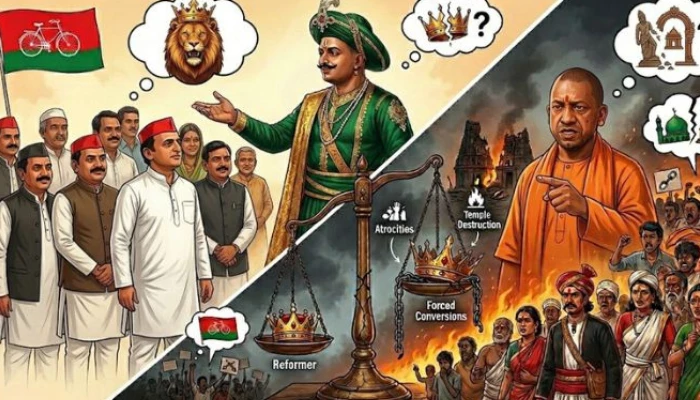
Case Summary
In Lucknow, Uttar Pradesh, during a special session of the Uttar Pradesh Legislative Assembly on 30 April 2026, Samajwadi Party Member of Parliament Toofani Saroj deliberately hurt the sentiments of the Hindu community. He made a statement that distorted history, spread anti-Hindu gender atrocity narratives and glorified Tipu Sultan, an anti-Hindu Islamic tyrant. While participating in a debate in the House, he said, “Tipu Sultan gave women the right to cover their breasts. There was a law against covering breasts. This hasn’t been the case since ancient times. You should check it out.” Following this statement, the remarks circulated widely on social media and triggered public controversy. The comment drew reactions due to its reference to historical practices and its portrayal of Tipu Sultan as just and as one who granted women the right to cover their upper bodies. The statement emerged in the context of a broader discussion in the legislative assembly, where historical narratives and social issues featured during the debate. He falsely claimed a supposed law prohibiting women from covering their breasts, and its attribution to ancient Indian society, which became the focal point of the controversy. Subsequently, discussions arose around the historical concept of “Mulakkaram” (breast tax), referenced in connection with the statement. This term historically referred to a form of gender-based tax rather than a literal tax on breasts, and its interpretation remained subject to debate among historians.
Why it is Hate Crime ?
This case has been added to the tracker under the primary category of - Hate speech against Hindus. The sub-category selected here is- Anti-Hindu subversion and prejudice. Hate speech is defined as any speech, gesture, conduct, writing, or display that is prejudicial against a specific individual and/or group of people, which leads to or may lead to violence, prejudicial action or hate against that individual and/or group. Media plays a specific and overarching role in perpetuating prejudicial attitudes towards a community owing to unfair, untrue coverage and/or misrepresentation/misinterpretation, selective coverage and/or omission of facts of/about issues affecting a specific religious group. This type of bias can dehumanise the victim group, making it easier for others to justify harmful actions against them, which aligns with the objectives of hate speech laws aimed at preventing such harm. It is often observed that the media takes a prejudicial stand against the Hindu community, driven by their need to shield the aggressor community, which happens to be a numeric minority; however, that is the one perpetrating violence against Hindus. For example, the media is often quick to contextualise religiously motivated crimes against Hindus, omit or misrepresent facts that point towards religiously motivated hate crimes, justify and/or downplay religiously motivated hate crimes, or present fake news to stereotype Hindus. Such media bias leads to the denial of persecution and is often used to dehumanise Hindus, leading to justification for violence against them. For example, the media covered several fake allegations of Hindus targeting Muslims and forcing them to chant Jai Shree Ram. Most of these cases were proved false and fabricated after police investigation. These fake news reports were subsequently never retracted or clarified. Such fake news led to the justification of violence and dehumanisation of Hindus based on the argument that since Hindus targeted Muslims and forced them to chant Jai Shree Ram, the dehumanisation of Hindus and violence against them was par for the course and merely a retaliation. Such media bias leads to prejudicial portrayals of Hindus and offers a justification for violence against them and, therefore, is considered hate speech under this category. This case has been added to the tracker because a sitting Member of Parliament, Toofani Saroj, made a statement in a legislative forum that distorted historical facts and projected a narrative that maligned Hindu society and its traditions. By claiming that Tipu Sultan “gave women the right to cover their breasts,” he presented a misleading account that falsely suggested that Hindu society had prohibited women from covering themselves. Primarily, on the face of it, the claims made by the SP leader, Toofani Saroj, were factually incorrect. There is no evidence of any such law barring Hindu women from covering their breasts. In regions like Kerala, given the climate and long-standing customs, women across communities did not traditionally wear upper garments. This was a cultural practice rooted in the extreme weather of Kerala, not a system of gender oppression. Even historical accounts such as those of the 17th-century Dutch traveller William van Nieuhoff recorded that Queen Umayamma of Travancore herself followed similar attire. By erasing this context and attributing a fabricated “grant of rights” to Tipu Sultan, the statement constructed a false binary where Hindu traditions were portrayed as regressive and misogynistic and an anti-Hindu ruler was glorified as a reformer. Furthermore, the remarks deliberately conflated separate historical issues to push a misleading anti-Hindu narrative. The reference to “Mulakkaram” or breast tax was presented in a manner that implied systemic humiliation of Hindu women by their own society, whereas historical evidence indicates it was a form of taxation linked to social and economic structures in Kerala, not a literal imposition on women’s bodily autonomy. Such anti-Hindu rhetoric creates a negative stereotype portraying Hindus as barbaric oppressors of their own women, reinforcing the trope of Sanatan Dharma as inherently misogynistic and regressive. This distortion vilifies Hindu traditions and fuels communal prejudice by erasing Islamic atrocities under Tipu Sultan while amplifying fabricated Hindu guilt. Notably, the struggle of Nadar women during the Channar Rebellion (1813–1859) was a distinct social movement concerning dress rights, where Tipu Sultan had no role. Linking this later development to Tipu Sultan’s rule and portraying it as his reform blurred timelines and facts. Such conflation is not a minor error; it reshapes public understanding by inserting an anti-Hindu interpretation into historical discourse. Moreover, the assertion that such practices were uniquely oppressive to Hindu society ignored the broader anthropological reality that attire customs varied widely across regions and communities, including in parts of Africa and the Indian subcontinent, where similar traditions existed without being framed as oppression. By isolating one cultural practice and recasting it as evidence of systemic injustice, the statement reinforced a pattern of selectively targeting Hindu traditions for criticism while overlooking comparable practices elsewhere. This selective framing contributed to a narrative that portrayed Hindu society as inherently regressive, thereby undermining its cultural legitimacy. In addition, glorifying Tipu Sultan as a progressive liberator of women exemplifies anti-Hindu rhetoric in this context, as it deliberately whitewashes his well-documented campaigns of violence, coercion, and religious persecution against Hindu communities in Kodagu, Malabar, and parts of Karnataka. Historical records, including those from his court chronicler Mir Hussain Kirmani, detail large-scale temple destructions, forced conversions of Hindus, village burnings, abductions of Hindu women and children, and the enslavement of thousands of Hindu civilians explicitly targeted for their faith. Kodava and Nair communities preserve vivid oral and written memories of these atrocities, such as Tipu Sultan's orders to raze over 8,000 temples and impose jizya-like poll taxes on non-Muslims, framing Hindus as subjugated inferiors. This selective portrayal, crediting Tipu with "granting" Hindu women the right to cover their breasts against a fabricated ancient "law", showcases the accused Toofani Saroj's anti-Hindu animosity by inverting victimhood: it erases Islamic tyranny while fabricating Hindu misogyny via the distorted "Mulakkaram" narrative. By reframing a figure synonymous with Hindu suffering as a supposed feminist icon, Saroj diminishes generational trauma inflicted on Hindu society, advances a supremacist view that Muslim rulers "civilised" barbaric Hindus, and incites communal division. Such anti-Hindu historic revisionism demonstrates deep-seated prejudice against the Hindu community and their historical experience of religious persecution, legitimising past violence while perpetuating stereotypes of Hindus as regressive oppressors unworthy of empathy. The cumulative effect of these statements was not merely academic distortion but a public misrepresentation delivered from a position of authority. When an elected representative presents inaccurate history in a legislative setting, it lends credibility to that narrative and amplifies its impact. By mischaracterising Hindu customs, glorifying an anti-Hindu historical figure, and conflating unrelated events, the remarks contributed to the erosion of historical accuracy and fostered a perception that demeaned the Hindu community, its traditions and identity. Therefore, it is being documented in the Hinduphobia Tracker's hate crime database.


Case Status
Unknown


Perpetrators Details
Perpetrators
Others
Perpetrators Range
One Person
Perpetrators Gender
male
 Sources




