Hindu youth threatened with death as Muslim group raises Pakistan Zindabad slogans in Bareilly
 Bareilly, Uttar Pradesh, India
  2 May, 2026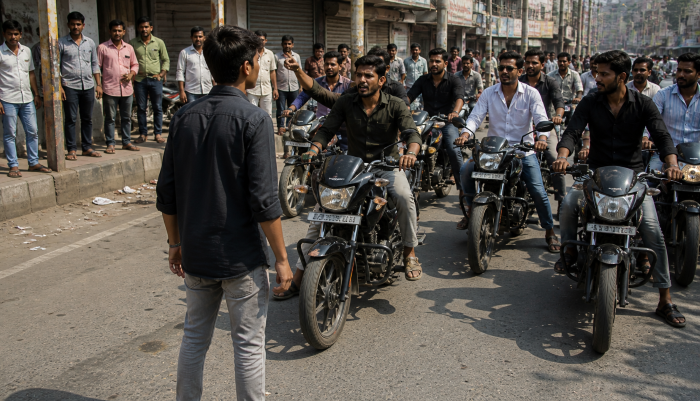
Case Summary
A Hindu youth named Vikas was physically assaulted and threatened with death in Sadar Bazar Cantt, Bareilly, Uttar Pradesh, after he objected to a group of Muslim youths raising Pakistan Zindabad slogans openly on a public road. The incident occurred at approximately 12:30pm on a 3rd May 2026. Vikas had gone to the market for work when eight to ten youths arrived on four to five motorcycles near Madari ki Pulia, having come from a cricket match. The group began raising Pakistan Zindabad slogans openly in front of bystanders. Vikas, who was present at the scene, objected to the conduct. In response, Imran, Kasif, and others from the group physically assaulted him, abused him, and issued explicit death threats. The accused then left the scene while continuing to issue threats. A video of the sloganeering was recorded and went viral on social media within hours. The sound of Pakistan Zindabad slogans was clearly audible in the footage. Hindu organisations demanded immediate action upon seeing the video. The incident was particularly alarming given that Bareilly had experienced communal riots just months prior. On the complaint of Vikas, Cantt police registered an FIR [First Information Report] against Imran, Kasif, and a third unidentified individual. Some individuals were taken into custody by late evening. The accused had fled their homes fearing arrest. Cantt Inspector Sanjay Dhir confirmed that a report had been registered and that legal action against the accused would follow. Police were also using the viral video to identify additional individuals present during the incident.
Why it is Hate Crime ?
The primary category here for this case is "Hate speech against Hindus". The sub-category for this case is "Violent threats". Violent threats, explicit, implicit or implied, is the most dangerous form of hate speech since it goes beyond discriminatory and prejudicial language to express the intent of causing harm to an individual or a group of people based on their religious identity and faith. There could be several different kinds of threats that are issued to Hindus based on religious animosity. An explicit threat would mean the direct threat of violence towards an individual Hindu, a group of Hindus or Hindus at large. Physical violence, death threats, threats of destruction of property belonging to Hindus and threats of genocide would mean explicit threats against Hindus for their religious identity. Implicit threats may not be a direct threat but implied through the use of symbols of actions – for example – in the Nupur Sharma case, other than explicit threats, there were also implicit threats when Islamists took to the streets to burn and beat her effigies. It implies that they want to do the same to Nupur Sharma – thereby is considered an implicit threat. Violent threats can be delivered in person, through letters, phone calls, graffiti, or increasingly through social media and other online platforms. It would be important to understand that a threat – explicit or implicit, online or offline – to an individual who happens to be a Hindu does not qualify as a religiously motivated threat. Such a threat, while vile and dangerous, could be owing to non-religious reasons and/or personal animosity. To qualify as a religiously motivated threat, it would need to exhibit an indication that the individual is being targeted for religious reasons and/or owing to his/her religious identity as a Hindu. The other category selected here is- Attack not resulting in death, and within this, the subcategory selected is- Attacked for opposing radicals or trying to save victim. In several cases, Hindus are attacked for opposing religiously motivated crimes being committed against a fellow Hindu or simply for voicing an opinion opposing radical elements, who either have in the past or continue to persecute Hindus. In such cases, the initial attack against the victim, against which the Hindu was trying to defend the victim, would also need to be classified as a religiously motivated hate crime. Since the initial crime itself was religiously motivated and the subsequent crime of attempting to save the victim or speaking against the radical elements ends up inviting a violent attack, it would also be classified as a religiously motivated hate crime under this category. The attack on Vikas was a direct consequence of his objection to public sloganeering of "Pakistan Zindabad" in a shared civic space. The slogans were not raised in a private setting. They were raised openly on a public road in Sadar Cantt, Bareilly, in front of bystanders, by a group of eight to ten individuals who arrived together and acted in concert. The slogan itself, and, moreover, the public and deliberate character of the sloganeering, establish that it was intended to provoke Hindus. The context of the sloganeering is a critical religious marker in this case. Slogans of Pakistan Zindabad were raised. It may be said that the slogan of Pakistan Zindabad can be considered anti-India and pro-Pakistan, but not anti-Hindu. However, raising slogans such as Pakistan Zindabad does not only show pro-Pakistan sentiments, but also anti-Hindu sentiments. It is pertinent to note that Muslim extremists harbour specific animosity towards Hindus and their faith and also view India as a Hindu collectivity. The very basis of the partition of India was that the Muslims believed that Islam was a nation unto itself, which could not survive with a Hindu collectivity like India. Further, Muslims often believe in transnational unity - or the Ummah - which is a belief that all Muslims across the world are a nation unto themselves and therefore, loyalty as far as the nation-state is concerned lies with the Muslim collectivity and not with a Hindu collectivity like India. This would also mean that the slogan Pakistan Zindabad is about hailing a Muslim collectivity and an expression of transnational loyalty and anti-Hindu sentiments. For that reason, any slogan which expresses transnational loyalty, faith in the Ummah, is automatically a slogan against Hindus and the Hindu collectivity. Moreover, Bareilly had experienced communal riots just months before this incident. The city's communal atmosphere was already heightened. The raising of Pakistan Zindabad slogans in this specific environment was not a politically neutral act. It was a provocation calibrated to exploit existing communal tensions and to assert a hostile presence in a space where Hindu residents lived and worked. The choice of Sadar Cantt, a central and visible public location, amplified the provocative intent. The violent response to Vikas's objection establishes that the sloganeering was backed by a willingness to use force against any Hindu who challenged it. Vikas did not initiate a confrontation. He objected to the anti-India and, by extension, anti-Hindu conduct that was taking place in his presence in a public space. The group's response was immediate and coordinated: physical assault, verbal abuse, and explicit death threats. The speed and coordination of the response demonstrates that the group had come prepared to defend their sloganeering by force if challenged. The death threats were not a spontaneous reaction but a deliberate instrument of intimidation directed at a Hindu individual who had asserted his right to object to anti-Hindu provocation in a public space. It was as if the perpetrators wanted to give out a message not only to Vikas but to Hindus as a community, that any resistance or objection would be met with violence and fear, thereby discouraging others from speaking out against such conduct. The use of such slogans also reflects an expression of transnational loyalty, reinforcing a message that those who do not align with it, particularly Hindus who object, can be intimidated into silence. In conclusion, the conduct of the perpetrators went beyond a simple public order issue. By openly raising Pakistan Zindabad slogans in a communally sensitive Hindu-majority area, attacking a Hindu youth who objected, and issuing death threats to silence opposition, their actions showed a clear attempt to intimidate the Hindu community. The sequence of events indicates that the violence was used to enforce silence and discourage resistance. Vikas was not randomly targeted. He was attacked because he objected to conduct that carried hostile implications in a shared public space. This reflects a clear pattern where intimidation and violence were used against a Hindu individual for asserting his right to object. Taken together, these elements show that the incident was driven by identity-based hostility. The actions were not incidental but part of a deliberate effort to suppress dissent through fear. As such, the case meets the criteria of a religiously motivated hate crime and has been added to the tracker. Disclaimer: The exact number of individuals who participated in the sloganeering and assault has not been confirmed beyond a range of eight to ten, as stated in the source. For documentation purposes, the perpetrator count has been recorded as ten. This was recorded for documentation purposes only.
Victim Details
Total Victim
1
Deceased
0
Gender
- Male 1
- Female 0
- Third Gender 0
- Unknown 0
Caste
- SC/ST 0
- OBC 0
- General 0
- Unknown 1
Age Group
- Minor 0
- Adult 1
- Senior Citizen 0
- Unknown 0


Case Status
Complaint registered


Perpetrators Details
Perpetrators
Muslim Extremists
Perpetrators Range
From 5 to 10
Perpetrators Gender
male
 Sources




