Hindu festival mocked as "poop festival" in viral video by American YouTuber
 Erode, Tamil Nadu, India
  22 October, 2025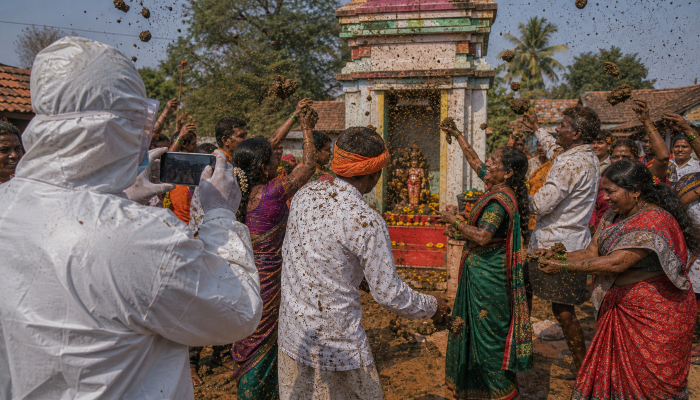
Case Summary
The Gorehabba festival, a centuries-old post-Diwali Hindu ritual celebrated in Gumatapura village on the Karnataka-Tamil Nadu border, was filmed and mocked by American YouTuber Tyler Oliveira in October 2025. He posted a disparaging video on 23 October 2025 under the title "I Survived India's Poop-Throwing Festival." The post was accompanied by the caption: "Happy Diwali! Yes, I went to India's poop-throwing festival. It was the shittiest experience of my life. I will never go back. Please pray that I survive." The Gorehabba festival is an annual post-Diwali ritual celebrated in Gumatapura village and the surrounding areas of Karnataka and Andhra Pradesh. It honours Beereshwara Swamy [a Hindu deity venerated in the region, held in local tradition to have been born from cow dung, with the festival serving as an act of communal devotion, purification, and agricultural gratitude]. As part of the ritual, villagers throw sun-dried cow dung at one another in a symbolic act of purification and prosperity. The cow and its by-products hold sacred significance in Hinduism, with cow dung regarded not as waste but as a purifying substance used in Hindu rituals and devotional practices across the country. Oliveira filmed himself wearing a hazmat suit and goggles while participating in the festival, framing the sacred ritual throughout as a spectacle of disgust for a Western audience. He posted a follow-up video in which he said, "They're going to kill me!" while covered in dung. The video went viral, accumulating millions of views across YouTube and X, with Hindu devotees and Indian users widely condemning the portrayal as a deliberate denigration of their religious tradition. When Hindu and Indian users criticised the video and reported it for violating community standards, Oliveira responded dismissively, stating "It isn't racist to film a poop-throwing festival" and questioning whether a critical article had been "written by an Indian." On 27 October he posted a sarcastic apology on X reading "I'm sorry India." On 6 November 2025, Oliveira announced he would not release the planned full documentary at the festival, claiming doxxing and threats directed at himself and his family. In his announcement, he described his visit to the festival as "the worst decision of his life" and stated he could not defeat "the combined power of 1.5 billion Indians." No legal or institutional action against Oliveira was confirmed in the source material.
Why it is Hate Crime ?
The primary category for the case is "Hate speech against Hindus". The sub-category for this case is "Anti-Hindu slurs, mocking faith". Anti-Hindu slurs and the deliberate mocking of the Hindu faith owing to religious animosity involve the usage of derogatory terms, stereotypes, or offensive references to religious practices, symbols, or figures. One of the common anti-Hindu slurs used against Hindus is “cow-worshipper” and “cow piss drinker”. The intention of using this term is to demean and mock Hindus as a group and their religious beliefs since Hindus consider the cow holy. Additionally, some symbols and the slurs attached to them have a historical context that exacerbates the insult, hate, stereotyping, dehumanisation and oppression against Hindus. Cow worship has been used for centuries to denigrate Hindus, insult their faith and oppress Hindus specifically as a religious group. There has been overwhelming documentation about how cow slaughter has been used to persecute Hindus with cow meat being thrown in temples and places of worship. There has also been overwhelming documentation where cow meat (beef) has been force-fed to Hindus to either forcefully convert them to Islam or denigrate their faith. Apart from cow worship, the Swastika – which holds deep religious significance for the Hindus – has also been misinterpreted and distorted to use as a slur against Hindus. Similarly, the worship of the Shivling has been used by supremacist ideologies and religions to denigrate Hindus owing to religious animosity. Such slurs and denigration stem out of inherent animosity and hate towards Hindus and their faith, therefore, it is categorised as hate speech targeted at Hindus specifically owing to their religious identity. Oliveira's conduct at the Gorehabba festival was not that of a documentarian who failed to understand what he was filming. It was that of a content creator who understood precisely what he was filming and chose to present it in the most denigrating frame available to him. The title "I Survived India's Poop-Throwing Festival" was not an accident of phrasing. It was a deliberate editorial choice that stripped a sacred Hindu ritual of its devotional identity and replaced it with the language of disgust and survival spectacle. It is also important to note that Oliveira’s presence at the festival was entirely voluntary. There was no compulsion or obligation for him to attend or participate. He chose to travel to the location, engage with the ritual, and document it. This makes the subsequent framing more significant. Having willingly participated, the decision to portray the ritual in a derogatory manner reflects a conscious editorial stance rather than a reaction driven by unfamiliarity or compulsion. The religious significance of the Gorehabba festival is neither obscure nor difficult to ascertain. It honours Beereshwara Swamy and is rooted in Hindu devotional practice around the sacred status of the cow and its by-products. In Hinduism, cow dung is not waste. It is a purifying substance with ritual use in a wide range of Hindu ceremonies and devotional practices. For a Hindu devotee, the act of throwing cow dung at the Gorehabba festival is an expression of faith, community, and agricultural reverence. Oliveira's choice to film himself in a hazmat suit reduced this act of Hindu devotion to a biohazard. The hazmat suit was not a practical form of protection. It was a visual statement about how he assessed the ritual and the people participating in it. Oliveira's responses to Hindu criticism confirmed that the denigration was conscious rather than inadvertent. When challenged, he did not express regret for misrepresenting the festival's significance. He defended the title, questioned his critics' nationality, and issued a sarcastic apology. Each response reinforced the original mockery rather than retracting it. His statement that "it isn't racist to film a poop-throwing festival" is particularly revealing: it demonstrates that he was aware the framing was being experienced as an attack on Hindu identity and chose to maintain it regardless. The monetisation dimension of the conduct is a further religious marker. Oliveira did not merely mock a Hindu ritual in a private context. He packaged the mockery as content, distributed it to a mass Western audience, and earned from the resulting engagement. The viral reach of the video across YouTube and X meant that the denigration of the Gorehabba festival was amplified to millions of viewers who received no context for the ritual's religious significance. The commercial incentive aligned directly with the degree of mockery: the more effectively Oliveira framed Hindu devotional practice as disgusting and absurd, the greater the engagement and the greater the revenue. Given that this case met the parameters of a religiously motivated hate crime, Oliveira's conduct reflected more than cultural insensitivity or poor editorial judgment. By deliberately framing a sacred Hindu ritual as a spectacle of filth for mass Western consumption, defending that framing when challenged by Hindu devotees, and monetising the resulting denigration, his actions demonstrated a calculated exploitation of Hindu religious practice for personal gain at the direct expense of Hindu dignity. The Gorehabba festival and its Hindu participants were targeted specifically because their devotional practices could be made to appear absurd to a Western audience unfamiliar with their religious significance. Such conduct reflects a conscious disregard for the religious significance of the practice and the faith it represents, warranting its inclusion in the tracker as a religiously motivated hate incident.


Case Status
Unknown


Perpetrators Details
Perpetrators
Christian Extremists
Perpetrators Range
One Person
Perpetrators Gender
male
 Sources




