Hindu villagers in West Bengal threatened with arson and bloodshed for being Hindu by elected local representative
 North 24 Parganas district, West Bengal, India
  1 May, 2026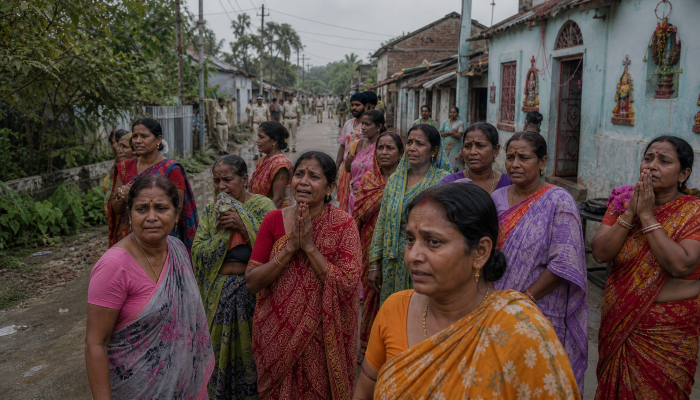
Case Summary
Hindu villagers in Falta, South 24 Parganas district, West Bengal, were subjected to death threats and threats of arson by a local Trinamool Congress [TMC] leader. The villagers, all Hindu, stated that they were being targeted specifically because of their Hindu identity. TMC panchayat head Israfil Chonkdar threatened local Hindu women that if they voted for the Bharatiya Janata Party [BJP], they would be persecuted. The threats included explicit warnings that if TMC won the election, their homes would be burned and there would be bloodshed. One local woman stated that the threats were directed at them on account of their being Hindu rather than on account of any political affiliation. An atmosphere of fear was reported across the affected villages. Concerned villagers took to the streets and demanded immediate intervention from the local administration. The Election Commission directed re-voting at 15 polling stations in Magrahat West and Diamond Harbour in South 24 Parganas district following complaints of irregularities during the second phase of voting. Police forces were deployed in the area following the protests. The local administration stated that an investigation had been initiated and that necessary steps would be taken to ensure residents' security.
Why it is Hate Crime ?
The primary category for this case is "Hate speech against Hindus". The sub-category here is "Violent threats". Violent threats, explicit, implicit or implied, is the most dangerous form of hate speech since it goes beyond discriminatory and prejudicial language to express the intent of causing harm to an individual or a group of people based on their religious identity and faith. There could be several different kinds of threats that are issued to Hindus based on religious animosity. An explicit threat would mean the direct threat of violence towards an individual Hindu, a group of Hindus or Hindus at large. Physical violence, death threats, threats of destruction of property belonging to Hindus and threats of genocide would mean explicit threats against Hindus for their religious identity. Implicit threats may not be a direct threat but implied through the use of symbols of actions – for example – in the Nupur Sharma case, other than explicit threats, there were also implicit threats when Islamists took to the streets to burn and beat her effigies. It implies that they want to do the same to Nupur Sharma – thereby is considered an implicit threat. Violent threats can be delivered in person, through letters, phone calls, graffiti, or increasingly through social media and other online platforms. It would be important to understand that a threat – explicit or implicit, online or offline – to an individual who happens to be a Hindu does not qualify as a religiously motivated threat. Such a threat, while vile and dangerous, could be owing to non-religious reasons and/or personal animosity. To qualify as a religiously motivated threat, it would need to exhibit an indication that the individual is being targeted for religious reasons and/or owing to his/her religious identity as a Hindu. Israfil Chonkdar's threats were not political warnings directed at opposing voters in general. They were explicitly directed at Hindu villagers on the basis of their Hindu identity. The villagers themselves made this distinction clearly, stating that they had no party affiliation and that their Hindu identity was the reason they were being targeted. This self-identification as targets of religious rather than political persecution is a significant marker. It establishes that the Hindu community in these villages experienced the threats as communally directed rather than electorally motivated. The content of the threats reflected a familiarity with what would cause the greatest fear among a Hindu population. The threat to burn homes and cause bloodshed invoked a specific historical terror for Hindu communities in West Bengal, where communal violence targeting Hindu populations has a documented history spanning decades. The threat was not abstract. It was calibrated to resonate with a community that has lived with the memory and reality of anti-Hindu communal violence in the region. The choice of these specific threats over others indicates an awareness of their psychological effect on a Hindu audience. The institutional position of Israfil Chonkdar as a TMC panchayat head amplified the severity of the threats. A panchayat head exercises direct administrative authority over village-level governance, including access to resources, dispute resolution, and local security. Threats issued by a person in this position carry the implicit weight of institutional power. Hindu villagers receiving threats from their own local administrative head faced not merely personal intimidation but the prospect of institutional retaliation. The power differential between the perpetrator and the victims made the threats considerably more coercive than they would have been from a private individual. The threats issued by Israfil Chonkdar did not occur in a political vacuum. Trinamool Congress has a documented record of institutional indifference toward anti-Hindu violence in West Bengal, with Hindu communities across the state reporting consistent failure by TMC-administered local bodies to act on complaints of communal targeting. The pattern of TMC-affiliated local leaders either participating in or enabling anti-Hindu conduct has been raised by Hindu organisations, opposition parties, and affected communities across multiple districts. That a TMC panchayat head felt sufficiently emboldened to threaten Hindu villagers openly, by name of their religious identity, and without apparent concern for institutional consequence, reflects the broader environment of impunity that this pattern has produced. The threats were not an aberration. They were consistent with a documented political culture in which Hindu minority interests within TMC-administered areas have been structurally subordinated, and in which Hindu communities have learned that complaints of communal targeting are unlikely to produce protective action from the local administration. This political environment is itself a religious marker: it established the conditions under which Israfil Chonkdar assessed that threatening Hindu villagers carried no meaningful risk. The collective nature of the targeting further establishes the case's religious character. The threats were not directed at a specific individual for a specific act but at Hindu villagers as a group, on account of their shared religious identity. This collective targeting is consistent with communal hate speech directed at a religious community rather than personal or political dispute. Given that this case met the parameters of a religiously motivated hate crime, Israfil Chonkdar's conduct reflected more than electoral intimidation. By threatening Hindu villagers with arson and bloodshed explicitly on account of their Hindu identity, and deploying the institutional authority of his position as panchayat head to amplify those threats, his actions demonstrated a deliberate effort to terrorise a Hindu community into submission through the invocation of communal violence. The Hindu villagers of Falta were targeted specifically because they were Hindu, and the threats were chosen because they would be most effective against a Hindu community with living memory of communal violence in West Bengal. This reflects an underlying hostility toward Hindu religious identity that cannot be characterised as anything other than religiously motivated. Given that this case met the parameters of a religiously motivated hate crime, it was added to the hate crime database of the tracker. Disclaimer: The Hinduphobia Tracker records incident dates based on when the crime occurred rather than when it was reported or published. The exact date on which the threats were issued was not confirmed in the source. 2 May 2025 has been used as the primary incident date, derived from the source's publication date. This was recorded for documentation purposes only.


Case Status
Complaint filed


Perpetrators Details
Perpetrators
Muslim Extremists
Perpetrators Range
One Person
Perpetrators Gender
male
 Sources




