Hindu religious symbols insulted, and Hindu sage disrespected during protest rally in Chitrakoot, Uttar Pradesh
 Chitrakoot, Uttar Pradesh, India
  28 April, 2026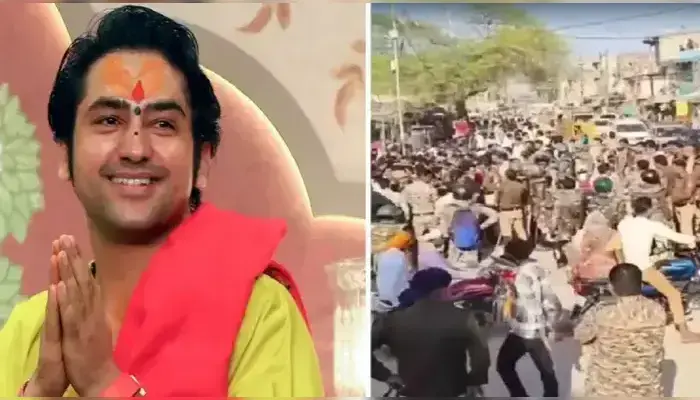
Case Summary
In Chitrakoot, Uttar Pradesh, Hindu religious symbols were insulted, and a Hindu sage was disrespected by a group of individuals led by Panchayat member, Meera Bharti, and BSP leader, Rohit Patel. The incident took place on April 29, 2026, in the Dhanush intersection area of Chitrakoot, Uttar Pradesh, where a group of individuals led by Meera Bharti, a District Panchayat member and BSP (Bahujan Samaj Party) leader, Rohit Patel, along with others, carried out a public act of protest that escalated into a targeted religious insult. During the demonstration, the perpetrators burned an effigy of Dhirendra Krishna Shastri, the head priest of Baba Bageshwar Dham, and garlanded it with shoes. The situation was further aggravated by the use of derogatory language and the insult of Hindu symbols. Following the incident, activists from the Vishwa Hindu Parishad submitted a formal petition at the Karvi Kotwali police station, demanding strict legal action against the accused. They argued that such acts contribute to social disharmony and embolden further hostility against Hindu beliefs and figures. The organisation also issued a warning of protests in case of administrative inaction, highlighting the potential for escalation if grievances are not addressed. The police acknowledged the complaint and initiated an investigation, stating that appropriate legal action will be taken based on findings.
Why it is Hate Crime ?
The primary category for this case is "Hate speech against Hindus". The sub-category for the case is "Anti-Hindu slurs, mocking faith". Anti-Hindu slurs and the deliberate mocking of the Hindu faith owing to religious animosity involve the usage of derogatory terms, stereotypes, or offensive references to religious practices, symbols, or figures. One of the common anti-Hindu slurs used against Hindus is “cow-worshipper” and “cow piss drinker”. The intention of using this term is to demean and mock Hindus as a group and their religious beliefs since Hindus consider the cow holy. Additionally, some symbols and the slurs attached to them have a historical context that exacerbates the insult, hate, stereotyping, dehumanisation and oppression against Hindus. Cow worship has been used for centuries to denigrate Hindus, insult their faith and oppress Hindus specifically as a religious group. There has been overwhelming documentation about how cow slaughter has been used to persecute Hindus with cow meat being thrown in temples and places of worship. There has also been overwhelming documentation where cow meat (beef) has been force-fed to Hindus to either forcefully convert them to Islam or denigrate their faith. Apart from cow worship, the Swastika – which holds deep religious significance for the Hindus – has also been misinterpreted and distorted to use as a slur against Hindus. Similarly, the worship of the Shivling has been used by supremacist ideologies and religions to denigrate Hindus owing to religious animosity. Such slurs and denigration stem out of inherent animosity and hate towards Hindus and their faith, therefore, it is categorised as hate speech targeted at Hindus specifically owing to their religious identity. The other sub-category selected is - Mocking/denigrating Hindu leaders. Hate speech is defined as any speech, gesture, conduct, writing, or display that is prejudicial against a specific individual and/or group of people, which is leading to or may lead to violence, prejudicial action or hate against that individual and/or group. Religious leaders are often seen as representatives of the community, especially, the community’s religious faith and beliefs. Mocking or denigrating a religious leader specifically owing to his religious identity and/or the religious rituals he observes can be considered hate speech because the motivating factor of the speech is animosity and/or dislike for what he represents – the religious beliefs and faith of the community. It is important to note that mere insulting words against an individual do not constitute hate speech. It is entirely possible that insulting words are used for an individual, however, the specific speech is not the result of religious hate and/or animosity towards the professed faith of the religious leader, but the individual himself. For the speech to be considered hate speech, the speech itself or the motivating factor behind the speech has to be religious in nature. Such speech which denigrates Hindu religious leaders specifically owing to animosity towards the faith they profess and the community faith they represent will be treated as hate speech under this category. The case has been added to the tracker because a group of individuals led by Meera Bharti, along with BSP leader Rohit Patel and others, staged a protest that escalated into the public desecration of Hindu-associated figures and symbols. During the demonstration, an effigy of Dhirendra Krishna Shastri, the head priest of Baba Bageshwar Dham, was burned and garlanded with shoes, accompanied by the use of derogatory language and insult to Hindu symbols. The targeting of Dhirendra Krishna Shastri, who was a prominent Hindu religious preacher associated with Baba Bageshwar Dham and widely followed for his discourses rooted in Sanatan traditions, Shastri represents not merely an individual but a visible symbol of contemporary Hindu religious identity. The act of creating and burning his effigy, combined with the deliberate choice to garland it with shoes, carries deep cultural connotations in the Indian context, where such gestures are widely understood as forms of extreme insult and social degradation. This indicates that the protest moved beyond disagreement or criticism and took the form of symbolic humiliation. Moreover, the method of protest demonstrates intentionality in provoking religious offence. Effigy burning in itself can be a form of political expression, but the addition of shoe garlanding and the use of abusive language transforms the act into one that is explicitly demeaning. By targeting a Hindu religious leader in this manner, the perpetrators effectively extended the insult to the broader community that reveres him. This reflects a pattern where religious figures are singled out not just for opposition but for degradation, thereby reinforcing hostility towards the faith they represent. In this context, the act can be interpreted as anti-Hindu in nature, as it employs culturally loaded symbols of humiliation directed at a figure of religious significance. In addition to the targeting of Dhirendra Krishna Shastri, the incident also involved the insult of Hindu religious symbols. While the specific symbols were not exhaustively detailed, the fact that they were subjected to derogatory treatment and language further strengthens the assessment that the act was not limited to an individual but extended to the religious framework itself. Religious symbols function as sacred representations within Hinduism, and their desecration or ridicule is perceived as an attack on the collective beliefs and identity of adherents. Such actions contribute to an atmosphere where disrespect towards Hindu practices and symbols is normalised, thereby deepening communal sensitivities and tensions. Taken together, the incident reflects a convergence of actions that go beyond protest into the realm of targeted religious insult. The deliberate humiliation of a Hindu religious leader, combined with the desecration of Hindu symbols and the use of derogatory language, indicates an element of hostility directed at the religious identity itself. This pattern of conduct, especially when carried out in a public and performative manner, underscores the broader implications for social harmony and justifies the classification of the case as a hate incident involving anti-Hindu elements.
Victim Details
Total Victim
1
Deceased
0
Gender
- Male 1
- Female 0
- Third Gender 1
- Unknown -1
Caste
- SC/ST 0
- OBC 0
- General 1
- Unknown 0
Age Group
- Minor 0
- Adult 1
- Senior Citizen 0
- Unknown 0


Case Status
Complaint filed


Perpetrators Details
Perpetrators
Others
Perpetrators Range
From 2 To 5
Perpetrators Gender
both
 Sources




