Hindu Dalit community targeted through organised gatherings for Christian conversion through coercion
 Bahraich, Uttar Pradesh, India
  1 May, 2026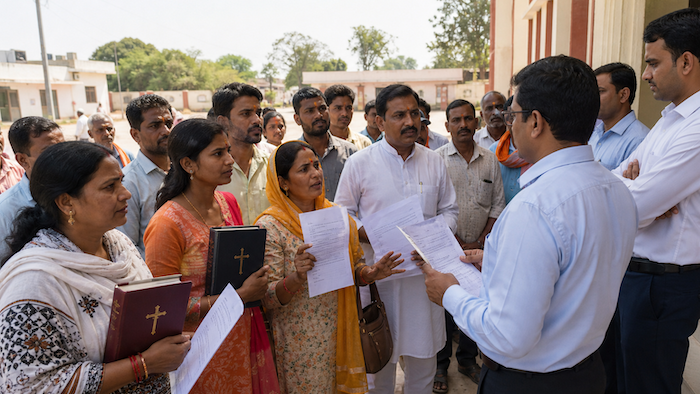
Case Summary
Hindu residents in Bahraich, Uttar Pradesh, raised concerns over ongoing efforts to convert them through organised activities. The issue came to light through a public protest at the district headquarters. The developments reflected sustained targeting of Hindu communities. The events took place in Bahraich, Uttar Pradesh, where Hindu residents were being approached through organised gatherings linked to a church operating in the region. At a church run by Santosh Jaiswal in Pandeypurwa, Bhagwanpur Square, Tehsil Mahsi, Hindu individuals were invited regularly to attend prayer and healing sessions. These sessions were conducted frequently, with large numbers of Hindu residents attending on Sundays and others being called daily. The activities were presented as solutions to illness and personal problems. During these gatherings, claims were made that diseases and suffering could be cured through participation in the sessions. Hindu residents were encouraged to attend repeatedly, creating sustained engagement with the organisers. The gatherings involved practices described as exorcism and prayer meetings, conducted in a structured manner over an extended period. Christian missionaries operating in the district were described as maintaining a network of agents across villages, especially in areas with significant Scheduled Caste and Scheduled Tribe populations. These agents facilitated contact with Hindu residents and encouraged participation in the sessions. Terminology associated with Hindu traditions was used within these activities, including referring to religious figures using familiar Hindu terms, creating continuity with the participants’ existing beliefs. The activities had been ongoing for several years, with references indicating that such operations had continued for up to ten years. Multiple cases had been registered against Santosh Jaiswal in relation to these activities, though details of outcomes were not specified. Hindu residents continued to be invited and engaged through these organised efforts. On 2nd May 2026, members of the Rashtradharak Dal organised a protest at the Collectorate in Bahraich. A delegation gathered and expressed opposition to the continued efforts to convert Hindu residents. They highlighted the continuation of such activities despite previous cases and raised concerns about the methods used to attract and influence Hindu participants. During the protest, a memorandum addressed to the Chief Minister was submitted to the Deputy Tehsildar. The memorandum outlined concerns regarding the ongoing activities and sought intervention. Representatives present at the protest included Karan Singh, along with several other individuals who participated in the delegation. The matter remained under administrative consideration following the submission of the memorandum.
Why it is Hate Crime ?
This case has been added to the tracker under the primary category - Predatory proselytisation. Within this, the subcategory selected is - Proselytisation by grooming, brainwashing, manipulation or subtle indoctrination. Under this, the tertiary category selected - Pattern of targeting Hindus. Religious brainwashing essentially means the often subtle and forcible indoctrination to induce someone to give up their religious beliefs to accept contrasting regimented ideas. Religious grooming or brainwashing also involves propaganda and manipulation. It involves the systematic effort, driven by religious malice and indoctrination, to persuade “non-believers’ to accept allegiance, command, or doctrine to and of a contrasting faith. Cases of such grooming or brainwashing are far more nuanced than direct threats, coercion, inducement and violence. In such cases, it is often seen that there is repeated, subtle and continual manipulation of the victim to induce disaffection towards their own faith and acceptance of the contrasting faith of the perpetrator. While subtle indoctrination is widely acknowledged as predatory, an element which is often understated in such conversions or the attempts of such conversion is the role of loyalty and trust which might develop between the perpetrator and the victim. Fiduciary relationships are often abused to affect such religious conversion. For example, an educator transmitting religious doctrine of a competing faith to a Hindu student. The Hindu student is likely to accept what the teacher is transmitting owing to existence of the fiduciary relationship. The exploitation of the fiduciary relationship to religiously indoctrinate victims would also be included in this category. Since the underlying animosity towards the victim’s faith forms the basis of predatory proselytization, such cases are considered religiously motivated hate crimes. The other sub-category selected for this case is - Conversion/ attempts to convert by inducement. Predatory Proselytisation is not just limited to threat, harassment, force and violence, but it also has contours of stealth. In several cases, the Hindu victim is exploited to convert, with non-Hindus taking advantage of their poverty. In such cases, the Hindu victim who is suffering financially is offered monetary benefits, including lucrative offers for jobs, health treatment, education, etc, to induce the victim into changing his/her religion. In such cases, the religious identity of the victim and the aim to disenfranchise him from his faith form the heart of the crime. Also, taking advantage of and exploiting an individual’s economic vulnerabilities is widely acknowledged as exploitation, forms of which are often penalised by law. Such cases therefore are considered religiously motivated hate crimes since the victim’s religious identity forms the very heart of the crime itself. This case qualified as a religiously motivated hate crime because Hindu individuals were systematically engaged through structured Christian religious activities designed to influence their faith. The perpetrators organised repeated gatherings framed as healing sessions and prayer meetings, drawing Hindu participants into prolonged exposure to a different religious framework. These acts were not incidental, they were sustained and patterned. The deliberate use of religious settings and inducements demonstrated that the Hindu identity of the victims was central to the actions carried out. The first religious marker was the use of grooming, sustained engagement, and indoctrination through repeated religious gatherings. Hindu victims were invited over extended periods to prayer meetings and exorcism sessions, where participation was encouraged through promises of relief and intervention. For Hindu individuals, such practices hold deep spiritual and cultural significance, particularly when linked to illness or personal hardship. The perpetrators chose these methods deliberately, using repeated exposure to gradually influence belief systems rather than direct confrontation. This reveals a calculated approach, where sustained engagement was used as a tool to weaken existing religious identity and replace it over time, demonstrating clear intent to alter the Hindu victim’s faith through structured influence. The second religious marker was the identifiable pattern of targeting Hindu individuals, particularly those from Scheduled Caste and Scheduled Tribe communities. The activities were concentrated in areas where these communities formed a significant portion of the population. For Hindu SC/ST individuals, existing social and economic vulnerabilities can increase dependence on external support systems, especially in matters of health and livelihood. The perpetrators exploited this context by positioning themselves as providers of solutions, embedding religious messaging within that support. This was not random outreach. The choice of location and demographic reflects a deliberate selection of Hindu victims who were more susceptible to sustained engagement. This demonstrates intent to target Hindu identity within a vulnerable segment, where resistance could be lower and influence more effective. The third religious marker was the use of inducement through promises of curing illness and resolving personal suffering. Hindu victims were drawn into these gatherings with assurances that participation would lead to healing and relief from ongoing problems. Health and wellbeing hold deep personal and spiritual importance, and linking these to religious participation created a strong incentive to engage. The perpetrators deliberately tied material and emotional relief to exposure to a different faith system, ensuring continued participation and abandoning Hindu faith. This reveals a clear strategy, where inducement was used as a mechanism to initiate and maintain engagement, demonstrating intent to influence and ultimately alter the religious identity of Hindu participants. This incident was not isolated but formed part of a recurring pattern where Hindu individuals, particularly from Scheduled Caste and Scheduled Tribe communities, were drawn into sustained religious engagement through inducements and repeated exposure. In this case, Hindu participants were invited to structured gatherings such as prayer meetings and healing sessions, where assurances of curing illness and resolving personal hardship were used to maintain continued involvement. The approach relied on prolonged interaction, emotional influence, and the leveraging of vulnerability linked to health and socio economic conditions. These actions reflected a targeted process in which the Hindu identity of the individuals was central, with religious engagement structured in a way that gradually encouraged departure from their existing faith. Given that this case met the parameters of a religiously motivated hate crime, it was added to the hate crime database of the tracker. Disclaimer: The exact date of the incident was not specified in the available sources. No details were provided regarding when the initial contact or activities began, or the duration over which they occurred. The tracker records incident dates based on when the act took place rather than when it was reported. In the absence of a confirmed timeline, 2nd May 2026, the article’s publication date, was used as the indicative incident date. This date was recorded for documentation purposes only.


Case Status
Complaint filed


Perpetrators Details
Perpetrators
Christian Extremists
Perpetrators Range
One Person
Perpetrators Gender
male
 Sources




