Hindu family confined in their own home for three weeks as Muslim neighbours seize land and block access in Bangladesh
 Kurigram District, Bangladesh
  8 April, 2026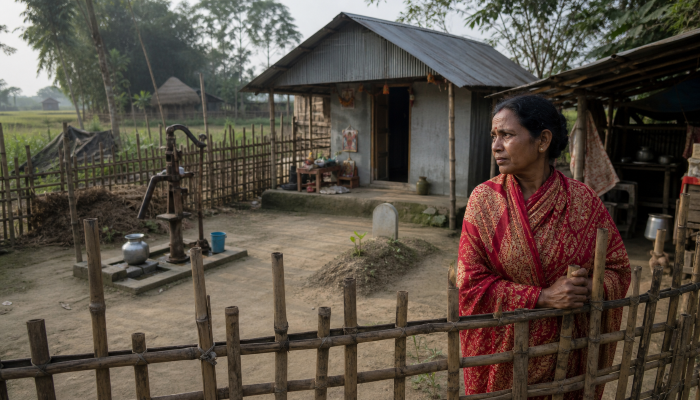
Case Summary
A Hindu family in Nowdabas village, Phulbari upazila, Kurigram district, northern Bangladesh, was confined within their own home for over three weeks after Muslim neighbours erected bamboo fencing around their homestead. The family of Lal Bahadur Rabidas had lived on the property for over 40 years. A group of individuals, including Jabbarul Haque, Jasim Uddin, and Shahidul Islam, had long sought to seize the land. On 9 April, all access routes to the family's home were blocked through the construction of bamboo barriers, restricting the family's movement entirely. The fencing enclosed the family's tube well, latrine, kitchen, and the grave of a family member, effectively cutting them off from basic necessities. On 14 April, the perpetrators entered the property, vandalised parts of the home, and dug up sections of the yard to plant vegetable seeds, an act of physical occupation intended to establish control over the land. Arati Rani, wife of Lal Bahadur Rabidas, stated that the family was effectively imprisoned in their own home and could barely carry out daily activities. Local residents Zainal Abedin and Dulu Mia called for immediate intervention. Union Parishad member Mominul Islam confirmed that several mediation meetings involving community leaders had been held but no resolution had been reached. Officer-in-Charge of Phulbari Police Station, Mahmud Hasan Naim, confirmed receipt of a complaint and stated that the matter would be investigated and necessary legal action taken. No arrests were confirmed at the time of publication.
Why it is Hate Crime ?
The primary category for this case is "Attack not resulting in death". The sub-category for this case is "Attack for Hindu identity". In several cases, Hindus are attacked merely for their Hindu identity without any perceived provocation. A classic example of this category of religiously motivated hate crime is a murder in 2016. 7 ISIS terrorists were convicted for shooting a school principal in Kanpur because they got ‘triggered’ seeing the Kalava on his wrist and tilak that he had put. In this, the Hindu victim had offered no provocation except for his Hindu religious identity. The motivation for the murder was purely religious, driven by religious supremacy. Such cases where Hindus are targeted merely for their religious identity would be documented as a hate crime under this category. Another sub-category for this case is "Attacked to induce migration from non-Hindu dominated area". There have been cases where the Hindus living in an area, often with a majority dwelling belonging to non-Hindus or those harbouring animosity towards the Hindu faith, the Hindu residents experience threats and violence. The violence is employed with the aim of making the Hindus leave the area and relocate, so the area could be turned into an exclusive ghetto for adherents of the non-Hindu faith or those who harbor animosity towards the Hindu faith. In several cases, the aim of exodus is explicit. However, in several cases, the demand for exodus of Hindu residents is not explicit, however, violence by non-Hindu residents leaves the Hindu residents no option but to leave the area, thereby, turning the area into an exclusive ghetto of non-Hindu residents. In such cases, there are instances violence against the Hindu residents explicitly. For example, in the Hauz Qazi case of 2019, the Muslim residents claimed that mob violence against the Hindu residents had been triggered by a parking dispute. However, the violence did turn religious with a temple being desecrated and was directed specifically against the Hindu residents. The Hindu residents of the area were clear that the violence was religiously motivated and one of the motives was to affect an exodus of the Hindu residents. In such cases, even though the perpetrators have not explicitly expressed the aim of affecting exodus, the given circumstances and violence and precedent point to the intention of exodus and therefore would be categorized under this sub-category. Such crimes are religiously motivated and therefore are hate crimes. The perpetrators in this case conducted a sustained and organised campaign against a Hindu family that had lived on their land for over 40 years. The targeting was not random. In Bangladesh's Kurigram district, Hindu minority families represent a structurally vulnerable population with limited recourse against organised land seizure campaigns. The selection of the Rabidas family as targets reflected an assessment that their minority status made successful dispossession achievable. The construction of bamboo barriers around the homestead on 9 April was a calculated act of physical domination. The fencing was not placed arbitrarily but positioned to enclose the family's tube well, latrine, kitchen, and the grave of a family member. Each of these elements is essential to daily survival and dignified living. The deliberate enclosure of a family grave carries additional significance — in Hindu tradition, the care and preservation of ancestral remains is a sacred duty, and the desecration or denial of access to a burial site constitutes a direct assault on the family's religious and ancestral identity. The perpetrators' choice to include the grave within the fencing demonstrates an awareness of the religious and emotional significance of that act. The escalation on 14 April further established the intent behind the campaign. The perpetrators entered the property, vandalised the home, and dug up sections of the yard to plant vegetable seeds. The planting of seeds was not a casual act of trespass but a deliberate assertion of ownership over Hindu-held land, a physical performance of possession designed to establish a visible claim. Combined with the continued confinement of the family, this act was intended to make the family's continued residence psychologically and practically unsustainable. The sustained nature of the campaign, spanning over three weeks without resolution despite mediation attempts, reflects an organised effort to exhaust the family's capacity to resist. The failure of multiple mediation meetings to produce any outcome further indicates that the perpetrators operated with confidence that institutional mechanisms would not effectively protect a Hindu minority family. This confidence is itself a marker of the structural vulnerability that makes Hindu families in Bangladesh disproportionately susceptible to land seizure campaigns of this kind. The geographic context of this case is itself a religious marker. Bangladesh's Hindu population has faced systematic dispossession, displacement, and violence since Partition, a pattern that accelerated following the 1971 war and has continued through successive cycles of communal violence, land seizure, and forced migration. Hindu families in rural Bangladesh represent one of the most structurally vulnerable religious minority populations in South Asia, with limited access to legal protection, disproportionate exposure to land grabbing, and a well-documented history of being targeted precisely because their minority status reduces the institutional cost of targeting them. The Rabidas family's 40-year tenure on their land did not protect them. It made them a target. The perpetrators' confidence in conducting a sustained, open, and organised campaign of confinement and dispossession against a Hindu family, in full view of local administration and community leaders, and without facing arrest or legal consequences at the time of publication, reflects the broader environment of impunity within which anti-Hindu targeting operates in Bangladesh. This case did not occur in isolation. It occurred within a documented national pattern of Hindu minority dispossession that has been acknowledged by human rights organisations, diaspora bodies, and international observers. That pattern is not incidental to this case. It is the condition that made this case possible. Given that this case met the parameters of a religiously motivated hate crime, the perpetrators' conduct reflected more than a property dispute. By systematically confining a Hindu family within their own home, enclosing their ancestral grave, vandalising their property, and physically occupying their land over a sustained period, their actions demonstrated a deliberate campaign to strip a Hindu family of their home, their dignity, and their ancestral connection to the land. The Rabidas family was targeted specifically because they were Hindu, and every instrument of coercion, being physical confinement, denial of basic necessities, desecration of ancestral remains, and property occupation, was chosen because it would be most effective against a Hindu minority family in their specific condition. This reflects an underlying hostility toward Hindu religious identity that cannot be characterised as anything other than religiously motivated. Given that this case met the parameters of a religiously motivated hate crime, it was added to the hate crime database of the tracker. Disclaimer: The exact number of individuals who participated in the land seizure and confinement campaign has not been confirmed beyond the three named perpetrators as stated in the source. For documentation purposes, the perpetrator count has been recorded as three. This was recorded for documentation purposes only.
Victim Details
Total Victim
3
Deceased
0
Gender
- Male 1
- Female 2
- Third Gender 0
- Unknown 0
Caste
- SC/ST 0
- OBC 0
- General 0
- Unknown 3
Age Group
- Minor 0
- Adult 3
- Senior Citizen 0
- Unknown 0


Case Status
Complaint filed


Perpetrators Details
Perpetrators
Christian Extremists
Perpetrators Range
From 2 To 5
Perpetrators Gender
male
 Sources




