Hindu woman found hanging at Muslim boyfriend's home in Raipur after being forced to convert and sustained physical abuse
 Raigarh, Chhattisgarh, India
  18 April, 2026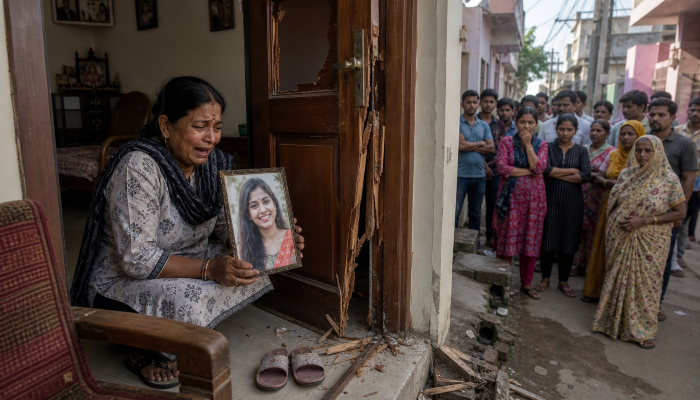
Case Summary
A 19-year-old Hindu woman named Kavita Das was found hanging inside the home of her Muslim boyfriend Mahfuz Khan in the Santoshi Nagar area of Raipur, Chhattisgarh, on the morning of 20 April 2026. Her family stated that Mahfuz Khan and his family had subjected Kavita to sustained pressure to convert to Islam, follow Muslim customs, and abandon the worship of Hindu deities. Under this sustained pressure, Kavita had changed her name to Joya and had distanced herself from Hindu religious activities before her death. As per details, Kavita Das went to Mahfuz Khan's home late on 19 April 2026. At around 2:30am, an altercation broke out between them over an unspecified matter, following which Kavita went into another room. The following morning, Mahfuz Khan found her hanging and informed the police. Police arrived at the scene, conducted a panchnama, and sent the body for post-mortem examination. The body was subsequently handed over to the family. Kavita's family stated that Mahfuz Khan and his family had continuously pressured their daughter to convert to Islam, adopt Muslim customs, and stop worshipping Hindu deities. Under this pressure, Kavita had changed her name to Joya and distanced herself from Hindu religious activities. The family stated that the sustained mental stress caused by the conversion pressure and name change was the direct cause of her suicide. They demanded strict action against Mahfuz Khan and his family. A video of a physical altercation between Kavita and Mahfuz went viral on social media. Police registered a case against Mahfuz Khan for abetment of suicide and took him into custody. Police stated that the case was not merely a love relationship dispute but involved dimensions of mental pressure and coercive pressure. The investigation was stated to be underway at the time of publication, with police examining the viral video and other evidence.
Why it is Hate Crime ?
The primary category for this case is "Crimes against women in relationships and other sexual crimes". The sub-category for this case is "Brainwashed and/or groomed". The tertiary category for this case is "Family/Friends of deceased victim says she was brainwashed/groomed". In our database, we have not added incidents where women have converted to another religion of their free will and no allegations of forced/involuntary conversion have been made. However, there are certain cases of conversion where the consent itself is a result of the brainwashing or grooming of a minor by the non-Hindu perpetrator trying to victimise a woman for her Hindu religious identity. The phenomenon of grooming points to non-Hindu perpetrators identifying their Hindu victims’ vulnerabilities and exploiting them over months and sometimes years, to extract the supposed ‘consent’ in order to convert their religion. In most cases of grooming, the victims are minors or the grooming started when the victim was a minor. In other cases of grooming, the non-Hindu perpetrator brainwashes and grooms a minor victim to extract their trust and then proceeds to rape them repeatedly with the intent of converting them to their faith. It is pertinent to understand here that when the victim is a minor, the ‘consent’ to convert or enter into a romantic relationship with an adult itself is redundant – addressed by POCSO. While every case of conversion of a minor and incidents of establishing a physical relationship with a minor by an adult is a crime, for the purpose of this database, a case would be considered a hate crime only if there is a distinct religious angle to the grooming. For example, in the UK, if a Hindu minor is targeted by Pakistani grooming gangs, it would be considered a hate crime because the victims are specifically targeted owing to their non-Muslim religious identity with the perpetrators being Muslim. In other cases, if a Hindu minor is brainwashed into entering a physical relationship with the non-Hindu adult perpetrator and the family alleges grooming/brainwashing of the minor to convert her religion, it would form a part of this database. If the victim is a Hindu adult, the case would form a part of this database only if the victim herself says that she was brainwashed/groomed to convert her religion. However, if the victim is deceased (murdered or otherwise), the case would form a part of this database if her family/friends provided testimony that the victim was brainwashed/groomed to convert her religion. Since these crimes have a distinct religious angle where the victim is being targeted owing to her Hindu religious identity, these cases are considered a hate crime. Another sub-category for this case is "Suicide for being forced to or pressured to convert". When Hindu women are in a relationship with a non-Hindu men, there are cases where the woman faces pressure/threats/violence to convert and change her religious identity by the non-Hindu man. Such relationships may be consensual with the religious identity of the non-Hindu man known to the victim. Somewhere along the relationship, the non-Hindu man starts pressurizing the Hindu woman to convert. In some of these cases, unable to bear the pressure/threat/violence being mounted by the non-Hindu partner to convert, the Hindu woman commits suicide. In such cases, often, threats are also given to the family members of the Hindu woman. Since such cases are driven by specific religious motivations and against the religious identity of the victim, leading to the woman committing suicide, these cases are categorized as a hate crime. The sustained pressure directed at Kavita Das to convert to Islam, abandon Hindu worship, and change her name to Joya reveals the religious character of Mahfuz Khan's conduct toward her. The conversion pressure was not incidental to the relationship. It was central to it. Mahfuz Khan and his family did not merely pressure Kavita to adopt certain personal habits or relationship expectations. They specifically targeted her Hindu religious identity, demanding that she abandon the worship of Hindu deities, adopt Muslim customs, and replace her Hindu name with a Muslim one. Each of these demands was directed at a specific dimension of her Hindu identity rather than at her as an individual. The name change from Kavita to Joya is particularly significant as a religious marker. A Hindu woman's name is not merely a label. It is often a direct expression of her family's devotional connection to Hindu deities and her own Hindu identity. The replacement of a Hindu name with a Muslim name in the context of sustained conversion pressure constitutes a deliberate act of religious identity erasure. That Kavita complied with this demand reflects the degree of psychological control Mahfuz Khan had established over her rather than any genuine religious conviction on her part. The compliance was the product of sustained mental pressure, not voluntary religious transformation. The abandonment of Hindu worship by Kavita during the relationship is the most measurable outcome of the sustained psychological manipulation she was subjected to. A Hindu woman who stops worshipping Hindu deities, changes her name to a Muslim name, and adopts Muslim customs under the sustained pressure of her Muslim boyfriend and his family has not made a free religious choice. She has been psychologically coerced into the progressive replacement of her Hindu identity. The family's recognition of this process, confirmed in their statements to police and media, establishes that those closest to Kavita understood her changed behaviour as the product of manipulation rather than conviction. The physical assault that accompanied the conversion pressure further established the coercive character of the relationship. While the source does not confirm that the physical violence was triggered specifically by Kavita's resistance to conversion demands, the simultaneous presence of sustained physical assault and sustained conversion pressure within the same relationship reflects a pattern of total control over the victim in which her physical safety and her religious identity were both subject to the perpetrator's dominance. The livestreaming of physical assaults on Instagram represents a further and distinct dimension of this control, in which Kavita's humiliation was made public as a demonstration of the perpetrator's power over her. The police's own characterisation of the case as involving dimensions of mental pressure and conversion pressure beyond a simple love relationship dispute reflects official recognition that the religious dimension of the conduct was a substantive feature of the case rather than a peripheral allegation. The registration of a case for abetment of suicide confirms that the sustained mental pressure Kavita was subjected to was understood as a direct contributing cause of her death. Given that this case met the parameters of a religiously motivated hate crime, the conduct directed at Kavita Das reflected more than the breakdown of a romantic relationship. By subjecting a Hindu woman to sustained pressure to abandon Hindu worship, change her Hindu name to a Muslim name, and adopt Muslim customs, and by maintaining this pressure through physical assault and psychological coercion until it produced her death, the perpetrator demonstrated a deliberate campaign to strip a Hindu woman of her religious identity through sustained manipulation and control. Kavita Das was targeted specifically because she was Hindu, and the conversion demands directed at her were chosen because they would be most effective in separating a Hindu woman from her faith and her identity. This reflects an underlying hostility toward Hindu religious identity that cannot be characterised as anything other than religiously motivated. Given that this case met the parameters of a religiously motivated hate crime, it was added to the hate crime database of the tracker. Disclaimer: The Hinduphobia Tracker records incident dates based on when the crime occurred rather than when it was reported or published. The exact date on which the sustained conversion pressure and harassment began was not confirmed in the source. 19 April 2026 has been used as the primary incident date, reflecting the confirmed date of the fatal incident. This was recorded for documentation purposes only.
Victim Details
Total Victim
1
Deceased
1
Gender
- Male 0
- Female 1
- Third Gender 0
- Unknown 0
Caste
- SC/ST 0
- OBC 0
- General 0
- Unknown 1
Age Group
- Minor 0
- Adult 1
- Senior Citizen 0
- Unknown 0


Case Status
Complaint filed


Perpetrators Details
Perpetrators
Muslim Extremists
Perpetrators Range
One Person
Perpetrators Gender
male
 Sources




