Hindu physician's pharmacy attacked and looted in broad daylight in Bangladesh by a Muslim man
 Noakhali District, Bangladesh
  25 April, 2026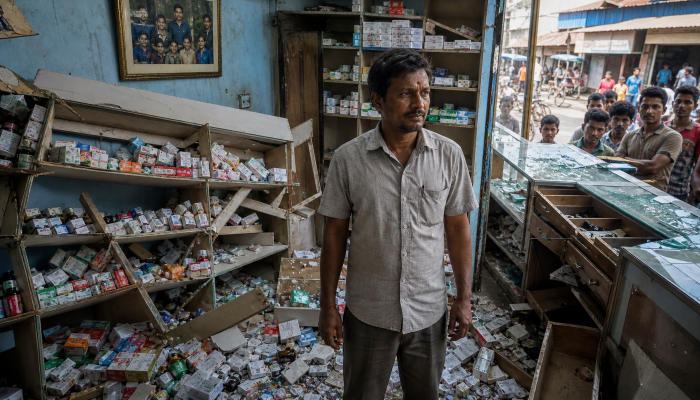
Case Summary
A Hindu rural physician named Utpal Chandra Majumdar had his pharmacy, Rubel Pharmacy, attacked in broad daylight at Ochkhali Puratan Bazar in Hatiya, Noakhali district, Bangladesh by a Muslim man named Abdul Aziz and his two sons, who arrived with local weapons, vandalised the shop, and took cash. Abdul Aziz used a false claim of having received a court verdict in his favour as the pretext for the attack, which was in reality a land grab attempt against a Hindu family that had lived peacefully on the same land for over a hundred years. Three individuals were detained by police. This incident cannot be viewed in isolation, but in continuity with the escalating hostility faced by Hindus in Bangladesh, particularly since the ouster of Sheikh Hasina’s government, which has been followed by repeated and targeted acts of violence against the Hindu minority. The onslaught of violence against Hindus in Bangladesh unfolded in three distinct phases: first, following the ouster of Sheikh Hasina’s government in August 2024; second, after the death of Sharif Osman Bin Hadi in December 2025; and third, in the immediate aftermath of the 13th National Parliamentary Election 2026. The fresh wave of anti-Hindu violence that followed the 13th National Parliamentary Election 2026 in Bangladesh reinforced a recurring pattern of post-poll violence targeting Hindu minorities. Within days of the announcement of results, Hindu families in districts such as Noakhali, Rangpur, Nilphamari, Sylhet, Thakurgaon, and Dinajpur reported coordinated attacks involving arson, looting, assault, and vandalism of temples and homes. In several instances, Hindu homes were selectively targeted, looted, and families were threatened with displacement. This electoral violence unfolded against the broader backdrop of sustained anti-Hindu hostility that had persisted since the ouster of the Sheikh Hasina government in August 2024. During that period, multiple reports documented attacks on Hindu homes, temples, and religious institutions, alongside intimidation campaigns, arson, and mob assaults targeting minority neighbourhoods. The Hinduphobia tracker has recorded 336 such incidents against the Hindu minority, underscoring the scale and persistence of anti-Hindu violence during this period. A further escalation occurred following the death of Sharif Osman Bin Hadi, a Muslim political activist and student leader known for his anti-Hindu and anti-India rhetoric. Hadi had been involved in political unrest after the fall of the Hasina government and was killed in Dhaka on 18 December 2025 during clashes. In the aftermath of his death, Hindu communities were blamed and subsequently targeted in retaliatory violence. Hindu homes were selectively set ablaze in multiple localities, forcing families to flee and leaving many displaced. The attacks appeared patterned rather than sporadic, with Muslim mobs focusing on Hindu neighbourhoods, properties, and religious symbols. Among the victims was Dipu Chandra Das, who was lynched to death and his body was set ablaze by a Muslim mob over false blasphemy allegations. The Hinduphobia tracker documented 51 incidents of anti-Hindu violence in the period following Hadi’s death alone. Such incidents underscore the vulnerability of the Hindu minority amid rising communal hostility and the weaponisation of religious accusations. Reports further indicated that posters and written materials calling for the extermination of Hindus were displayed in public spaces, signalling an alarming normalisation of genocidal rhetoric. When combined with acts of arson, vandalism, assault, and targeted intimidation, these developments suggest a coordinated environment of hostility aimed at terrorising the Hindu community and reinforcing majoritarian dominance. Utpal Chandra Majumdar and his ancestors had lived and worked on the land in Ochkhali for over a century. Abdul Aziz, a resident of Ward 3 of Hatiya Municipality and son of the late Kausar Ahmed, recently claimed ownership of the land. A court case between the two parties was ongoing when Abdul Aziz arrived on 26 April 2026 with his two sons, Ahmed Ullah Meraj and Mohammad Ullah Didar, and a group of associates armed with local weapons. He falsely claimed to have received a court verdict in his favour and used this as the pretext to launch an attack on the pharmacy with the stated objective of seizing the property. The attackers vandalised the pharmacy and took cash from the premises. Local residents intervened and attempted to bring the situation under control. Police arrived and detained Abdul Aziz and his two sons for questioning. Utpal Chandra Majumdar, who had been in India for medical purposes and had returned to his shop that morning, described the attack and asked whether he would be denied justice because he was Hindu. Ochkhali Puratan Bazar Market Committee president Master Faruk condemned the attack, stating that the family had been peacefully occupying the land for a long time and that any ownership claim had to be proven through the court rather than through daylight violence against a member of the Hindu community. Hatiya police station officer-in-charge [OC] Kobir Hossain confirmed that the incident appeared to have arisen from a land dispute and that three individuals had been detained for questioning, with further legal action to follow upon receipt of a written complaint.
Why it is Hate Crime ?
The primary category for this case is "Attack not resulting in death". The sub-category here is Attacked for Hindu identity". In several cases, Hindus are attacked merely for their Hindu identity without any perceived provocation. A classic example of this category of religiously motivated hate crime is a murder in 2016. 7 ISIS terrorists were convicted for shooting a school principal in Kanpur because they got ‘triggered’ seeing the Kalava on his wrist and tilak that he had put. In this, the Hindu victim had offered no provocation except for his Hindu religious identity. The motivation for the murder was purely religious, driven by religious supremacy. Such cases where Hindus are targeted merely for their religious identity would be documented as a hate crime under this category. Another sub-category for this case is "Attack to induce migration from non-Hindu dominated areas". There have been cases where the Hindus living in an area, often with a majority dwelling belonging to non-Hindus or those harbouring animosity towards the Hindu faith, the Hindu residents experience threats and violence. The violence is employed with the aim of making the Hindus leave the area and relocate, so the area could be turned into an exclusive ghetto for adherents of the non-Hindu faith or those who harbor animosity towards the Hindu faith. In several cases, the aim of exodus is explicit. However, in several cases, the demand for exodus of Hindu residents is not explicit, however, violence by non-Hindu residents leaves the Hindu residents no option but to leave the area, thereby, turning the area into an exclusive ghetto of non-Hindu residents. In such cases, there are instances violence against the Hindu residents explicitly. For example, in the Hauz Qazi case of 2019, the Muslim residents claimed that mob violence against the Hindu residents had been triggered by a parking dispute. However, the violence did turn religious with a temple being desecrated and was directed specifically against the Hindu residents. The Hindu residents of the area were clear that the violence was religiously motivated and one of the motives was to affect an exodus of the Hindu residents. In such cases, even though the perpetrators have not explicitly expressed the aim of affecting exodus, the given circumstances and violence and precedent point to the intention of exodus and therefore would be categorized under this sub-category. Such crimes are religiously motivated and therefore are hate crimes. This case bears multiple indicators of religiously motivated targeting that align with the broader, well documented pattern of anti Hindu violence in Bangladesh. At the core of the incident is a land grab attempt against a Hindu family that had been residing on the same property for over a century. The use of fabricated legal claims by the accused to justify a violent takeover is not an isolated tactic. In numerous cases across Bangladesh, Hindu owned land and businesses have been systematically targeted through coercion, intimidation, and outright violence, often under the cover of disputes or false legal assertions. The fact that the victim was a Hindu and that his long standing ownership was disregarded in favour of forceful encroachment reflects a pattern where Hindu property rights are deliberately undermined. The nature of the attack itself further reinforces this assessment. The accused did not pursue legal remedies through the ongoing court case but instead arrived with armed associates, vandalised the pharmacy, and looted cash in broad daylight. Such actions demonstrate a calculated use of violence to dispossess a Hindu individual of his livelihood. This mirrors several documented instances where Hindu economic assets, shops, homes, and land are selectively targeted to weaken the community’s financial stability and force displacement. Importantly, this incident cannot be viewed in isolation but must be situated within the wider context of escalating anti Hindu hostility in Bangladesh, particularly following the political upheaval after the ouster of Sheikh Hasina’s government, the violence after the death of Sharif Osman Bin Hadi, and the aftermath of the 13th National Parliamentary Election 2026. These phases have been marked by repeated, patterned attacks on Hindu homes, temples, and businesses, often involving arson, looting, and mob violence. The selective targeting of Hindu individuals and their properties during these periods indicates that such acts are not random criminal occurrences but part of a sustained environment of hostility where Hindus are treated as vulnerable targets. The recurrence of similar methods, including intimidation, fabricated accusations, and violent dispossession, establishes continuity between this case and previously documented incidents. Additionally, the victim’s own question about whether he would be denied justice because of his religious identity reflects an underlying reality faced by many Hindus in Bangladesh, where fear of bias, lack of protection, and systemic vulnerability are recurring concerns. This perception is not unfounded, given the scale and frequency of attacks recorded against the Hindu minority. Taken together, the deliberate targeting of a Hindu-owned property, the use of violence to enforce a land grab, and the broader context of sustained anti-Hindu aggression indicate that this incident is not merely a property dispute but part of a pattern of religiously motivated hostility aimed at dispossessing and intimidating the Hindu community.
Victim Details
Total Victim
1
Deceased
0
Gender
- Male 1
- Female 0
- Third Gender 0
- Unknown 0
Caste
- SC/ST 0
- OBC 0
- General 0
- Unknown 1
Age Group
- Minor 0
- Adult 1
- Senior Citizen 0
- Unknown 0


Case Status
Arrested


Perpetrators Details
Perpetrators
Muslim Extremists
Perpetrators Range
From 2 To 5
Perpetrators Gender
male
 Sources




