Hindus targeted, Hindu Gods branded 'demonic' by organised Christian missionary network to induce conversions in Chhattisgarh
 Chhattisgarh, India
  17 April, 2026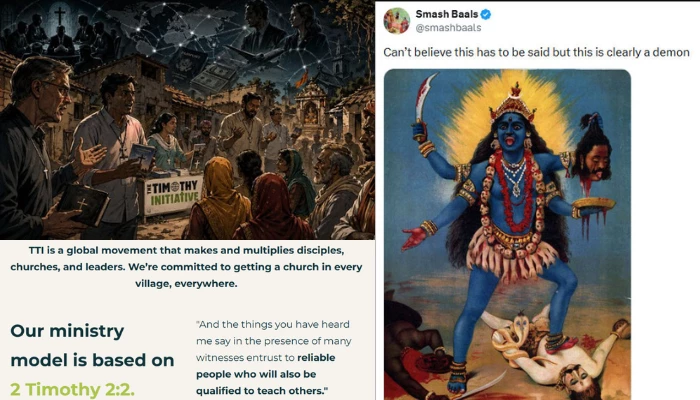
Case Summary
Hindus were converted in large numbers by an evangelical non-profit Christian organisation by inducing Hindus to convert and denigrating Hinduism in Naxal-affected areas and villages of Chhattisgarh. A detailed investigation report of internal training manuals of The Timothy Initiative (TTI) revealed a structured strategy aimed at targeting Hindu communities for conversion. An investigation report published on 30th April 2026 detailed the functioning, internal structure, and operational strategies of an organisation named The Timothy Initiative (TTI). It revealed 10 structured manuals used for missionary training and outreach aimed at converting Hindus in every village. TTI was described as a global Christian organisation focused on “church planting”, with the stated objective of establishing a church in every village. Its official material and internal documentation indicated that its core mission centred on creating, multiplying, and sustaining churches by training local leaders who would further expand the network. This expansion model relied on measurable outcomes, particularly the number of churches established and leaders trained across regions. The organisation operated through a structured training system comprising ten manuals designed to guide missionaries at different stages of engagement. The first nine manuals did not explicitly reference specific religions and primarily focused on theological training, leadership building, and organisational methods. However, the tenth manual was specifically designed for “church planting leaders” and contained detailed instructions on engaging with non-Christian communities, particularly Hindus. The book clearly explained that the “ultimate goal of a Hindu” was liberation from the cycle of karma and rebirth, and it presented Hindu scriptures as a long, layered tradition centred on the Vedas, Upanishads, and Bhagavad Gita. It gave an overview of Hindu traditions and religious texts, including references to the Vedas, the Upanishads, and the Bhagavad Gita. This introductory section outlined key aspects of Hindu belief systems, philosophies, and practices. However, this descriptive portion was followed by a section titled “Apologetic Responses and Witnessing Suggestions”, which shifted the focus from understanding Hinduism to actively responding to and engaging with it. Chapter 3 of the book, titled World Religions and Cults, asked the church planters to examine religions against the “standard of Scriptures”. The book offered suggestions for apologetic responses and witnessing in the context of coercing Hindus to convert to Christianity. It was essential to understand how TTI had spoken about Hinduism, posing it as the main target. The section on Hinduism in the book was not written as an academic survey or a neutral theological comparison. It was written as a practical guide for engaging Hindus and advancing missionary work among them. The manual explicitly presented Hindu communities, especially villages with a dominant Hindu population, as areas of missionary engagement and outreach. It characterised these regions as “mission territory” and outlined structured approaches for entering such areas and initiating interaction with local populations. It provided detailed strategies for addressing and countering core Hindu beliefs, including karma, reincarnation, and the concept of multiple deities. The manual suggested that missionaries should reinterpret these beliefs in ways that would make Christian teachings appear more compelling and accessible. For instance, it recommended presenting Jesus as an “avatar” to create familiarity and relatability among Hindus. The structure of the text mattered, as it did not just explain what Hindus believed, but also how missionaries should answer them. In simple terms, Hindu communities were treated as mission territory and Hindu belief as a field to be worked upon through argument, persuasion, and carefully designed outreach. It was not just theology but a conversion playbook. The text further instructed missionaries to contrast Hindu philosophical concepts with Christian theology. Karma was described as a system that bound individuals without offering forgiveness, while Christian doctrine was presented as providing redemption and liberation. Similarly, the Hindu understanding of sin as ignorance was reframed as moral disobedience requiring divine intervention and correction. As per the report, the most problematic aspect of the book was the way it demonised Hindu beliefs and Gods. The book read, “Understand that most Hindu villages are possessed by evil spirits, or a Hindu god that watches over them.” It then added, “Missiologists call this a territorial spirit. The spirit that has power for that particular village only.” The instruction that followed was direct: “When you enter into the village, pray for protection and power from the Holy Spirit to remove any sort of disruptions that the evil spirits may attempt.” In addition to ideological and engagement strategies, the manual provided operational guidance for conducting missionary work in environments where open religious activity might face resistance. It advised missionaries to avoid carrying visible religious materials, such as Bibles, and to avoid overt methods, such as screening religious films. Instead, it encouraged memorisation of scriptures and reliance on oral communication to continue outreach discreetly without attracting attention. The incident came to light when the Enforcement Directorate conducted raids at several locations of The Timothy Initiative on 18th and 19th April 2026. According to the investigation agency, in just six months, TTI withdrew ₹95 crore using foreign bank debit cards across different states, including ₹6.5 crore in Naxal-affected Jharkhand. While doing so, TTI bypassed FCRA regulations. Notably, this organisation was not registered under FCRA. According to the investigation, foreign debit cards linked to a United States-based bank were used to withdraw substantial amounts of cash from ATMs across multiple Indian states between November 2025 and April 2026. These withdrawals were described as systematic and organised in nature. During the searches, authorities seized 25 foreign debit cards, approximately ₹40 lakh in cash, and multiple digital devices and documents believed to be linked to the organisation's financial operations. A Christian man, identified as Micah Mark, was intercepted at Kempegowda International Airport in Bengaluru while in possession of several foreign debit cards. The ED noted that a significant portion of the withdrawn funds, approximately ₹6.5 crore, had been extracted from regions in Chhattisgarh, including the Naxal-affected regions of Bastar and Dhamtari. The agency further stated that the pattern of withdrawals indicated a coordinated network rather than isolated transactions. The funds were reportedly utilised for activities related to TTI’s operations in India, including religious outreach and conversion efforts. Additionally, the ED observed that records of these financial transactions were maintained through an online billing and accounting platform allegedly controlled by foreign entities. This indicated that the financial inflows, withdrawals, and expenditures were centrally monitored and coordinated. The investigation thus brought both the financial mechanisms and operational strategies of TTI under scrutiny, including its training manuals, structured outreach model, and activities carried out across various regions in India.
Why it is Hate Crime ?
This case has been added to the tracker under the primary category of Predatory Proselytisation. Within it, the sub-category selected is- Conversion/ attempts to convert by inducement. Predatory Proselytisation is not just limited to threat, harassment, force and violence, but it also has contours of stealth. In several cases, the Hindu victim is exploited to convert, with non-Hindus taking advantage of their poverty. In such cases, the Hindu victim who is suffering financially is offered monetary benefits, including lucrative offers for jobs, health treatment, education, etc, to induce the victim into changing his/her religion. In such cases, the religious identity of the victim and the aim to disenfranchise him from his faith form the heart of the crime. Also, taking advantage of and exploiting an individual’s economic vulnerabilities is widely acknowledged as exploitation, forms of which are often penalised by law. Such cases, therefore, are considered religiously motivated hate crimes since the victim’s religious identity forms the very heart of the crime itself. Another sub-category selected for this case is "Attempting to convert/ converting by denigrating Hinduism". In several cases, Hindus are converted, or an attempt is made to convert Hindus by denigrating their faith, Hinduism. In such cases, the Hindus associate with the non-Hindu perpetrators often by choice and then the attempt to convert them by insulting their faith, showing the faith down, etc., begins. An example of this would be a non-Hindu gathering where the Hindus are attending the gathering of their own free will. However, once they attend the gathering, there is an explicit attempt to convert them by abusing their faith and hailing the faith of the perpetrator. The denigration of the Hindu faith is often based on misrepresentation of the Hindu faith, its doctrine and scriptures and insult to espoused traditions, if not blatant lies about Hindu beliefs and ways. Such conversions or attempts at conversions are driven by animosity towards the Hindu faith and are therefore documented as religiously motivated hate crimes. The other selected sub-category is Predatory Proselytisation. Within it, the sub-category selected is- Proselytisation by grooming, brainwashing, manipulation or subtle indoctrination. The tertiary category selected within it is - Pattern of targeting Hindus, Conversion of minors. Religious brainwashing essentially means the often subtle and forcible indoctrination to induce someone to give up their religious beliefs to accept contrasting, regimented ideas. Religious grooming or brainwashing also involves propaganda and manipulation. It involves the systematic effort, driven by religious malice and indoctrination, to persuade “non-believers’ to accept allegiance, command, or doctrine to and of a contrasting faith. Cases of such grooming or brainwashing are far more nuanced than direct threats, coercion, inducement and violence. In such cases, it is often seen that there is repeated, subtle and continual manipulation of the victim to induce disaffection towards their own faith and acceptance of the contrasting faith of the perpetrator. While subtle indoctrination is widely acknowledged as predatory, an element which is often understated in such conversions or the attempts of such conversion is the role of loyalty and trust which might develop between the perpetrator and the victim. Fiduciary relationships are often abused to affect such religious conversion. For example, an educator transmitting religious doctrine of a competing faith to a Hindu student. The Hindu student is likely to accept what the teacher is transmitting owing to the existence of the fiduciary relationship. The exploitation of the fiduciary relationship to religiously indoctrinate victims would also be included in this category. Since the underlying animosity towards the victim’s faith forms the basis of predatory proselytisation, such cases are considered religiously motivated hate crimes. This case was added to the tracker because a structured and organised system was used to target Hindus for conversion through a mix of inducement, denigration of their faith, and sustained psychological conditioning. The actions were not isolated acts of preaching. They reflected a carefully designed model that identified Hindu communities as targets and worked systematically to alter their belief systems. Firstly, the trigger lay clearly in the religious identity of the victims. The manuals and outreach model were not generic or universal. They were specifically tailored for Hindus. Entire sections were dedicated to understanding Hindu beliefs only so they could be challenged and replaced. Hindu villages were described as “mission territory”, which showed that the focus was not coexistence but intervention. The targeting was deliberate and religion-specific. Secondly, the method adopted was layered and strategic. The manuals did not promote open debate or equal exchange of ideas. Instead, they trained individuals on how to persuade, influence, and gradually shift beliefs. Concepts like karma, rebirth, and multiple deities were not simply discussed; they were reframed in a way that made Hinduism appear inadequate. At the same time, Christian ideas were presented as solutions. This was not education. It was guided persuasion designed to produce a fixed outcome. Further, there was a clear element of denigration. Hindu beliefs were not treated with neutrality or respect. The text described Hindu villages as being under “evil spirits” and positioned Hindu gods in negative spiritual terms. This was not an incidental word choice. Instead, it framed Hindu villages not merely as places where people held different beliefs, but as spiritually hostile spaces under dark influence. Notably, “evil spirits” and “a Hindu God” were placed in the same frame, which clearly stated that, for them, Hindu Gods were “demonic”. The village was thus portrayed as being under supernatural control that the missionary must confront before meaningful work could begin. They referred to Hindu Gods as demonic and even posted images of Maa Kali as “clearly demonic”. Such a portrayal went beyond theological disagreement. It created fear, doubt, and inferiority around Hindu identity. When a person’s faith is first weakened through such narratives, the ground is prepared for conversion. Additionally, the strategy relied heavily on subtle indoctrination. Missionaries were trained not to appear overt or confrontational. They were advised to avoid visible religious symbols and instead build trust through conversation and presence. This showed a conscious attempt to operate under the surface. The process was gradual, first understanding the individual, then influencing thoughts, and finally encouraging a break from existing beliefs. This kind of slow and repeated engagement is a classic form of conditioning rather than free choice. The financial trail strengthened this pattern. Large amounts of money were routed and withdrawn in a systematic manner across regions. Such a scale indicated that the outreach was not casual or voluntary. It was backed by organised funding, enabling a sustained presence and influence. When financial strength supported ideological outreach, it created a power imbalance. The individual on the receiving end was not engaging on equal footing. Moreover, the choice of regions and communities mattered. Withdrawals and activities were linked to areas that were economically and socially vulnerable, including Naxal-affected regions. These are places where people often struggled with limited resources and access. In such conditions, even indirect benefits, support systems, or attention from organised groups could act as an inducement. The vulnerability of the population made the outreach more effective and more coercive in impact, even if not openly forceful. The intent became even clearer from the structure of the manuals themselves. They did not just teach belief; they taught method. They explained how to approach Hindus, how to respond to their faith, how to replace their worldview, and how to do so without attracting resistance. This was not a spontaneous religious expression. It was a planned conversion framework. The impact of such actions went beyond individual choices. It affected the collective confidence of Hindu communities in their own beliefs. When faith was repeatedly described as flawed, evil, or inferior, it created internal conflict. Over time, this weakened cultural continuity and identity. The harm, therefore, was not only personal but also social. Finally, the continuity and organisation of these efforts showed that this was not a one-time occurrence, but a carefully thought-out pattern. The use of manuals, trained personnel, financial systems, and targeted outreach reflected a long-term campaign. It was sustained, methodical, and directed at a specific religious group. Taken together, the deliberate targeting of Hindus, the use of inducement and psychological conditioning, the denigration of their faith, and the backing of organised funding established clear intent and significant impact. This was not simple religious propagation. It was a structured attempt to alter religious identity through influence, imbalance, and sustained pressure.


Case Status
Complaint filed


Perpetrators Details
Perpetrators
Christian Extremists
Perpetrators Range
Unknown
Perpetrators Gender
unknown
 Sources




