Hindu woman raped, forced to wear burqa, visit dargah and recite kalma by Muslim man posing as Hindu; justifies the act by calling it 'sawaab'
 Indore, Madhya Pradesh, India
  30 April, 2023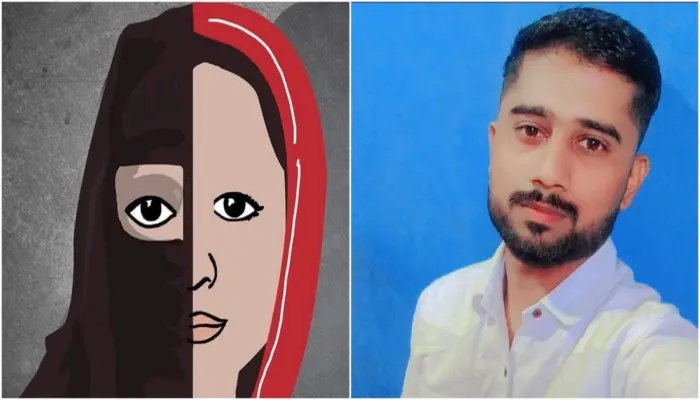
Case Summary
In the Lasudia area of Indore, Madhya Pradesh, a 23-year-old Hindu woman was subjected to prolonged sexual exploitation and coercion for religious conversion by a Muslim man named Sohail Khan, who pretended to be Hindu. The accused also took her to a dargah where she was forced to wear a burqa and convert to Islam by reciting the kalma (the Islamic declaration of faith). Furthermore, the accused also justified his crime by calling it "sawaab" (a religiously meritorious deed). According to reports, the accused initially contacted the victim through Instagram using the false Hindu identity of “Lucky” and gradually gained her trust. He first met her in the 56 Dukaan area and, under the pretext of offering her a job, took her to a room in Tilak Nagar, where he administered intoxicants to render her unconscious and raped her. He recorded the act and subsequently used the footage to blackmail her, threatening to circulate it on social media. Using blackmail, he subjected her to prolonged and repeated sexual exploitation. Furthermore, the accused had a relationship with her on the pretext of marriage and then married another woman. The victim also revealed that the accused took her to Ajmer to visit a dargah in March 2024, where he forced her to wear a burqa and made her recite the Kalma, subjecting her to Islamic practices against her will. Furthermore, he told her that engaging in sexual acts with him would bring “sawaab” (a religiously meritorious deed) and declared that she had become “pure.” The victim was also taken to an individual identified as Naushad Baba in Chandan Nagar, where she was physically assaulted and subjected to supposed occult rituals. According to TI Surendra Singh Raghuvanshi, the woman had been in contact with Sohail for three years since 2023. As of the date of writing this report, the Police had registered a case against the accused under relevant sections pertaining to rape and related offences and initiated further investigation into the involvement of additional individuals.
Why it is Hate Crime ?
This case has been added to the tracker under the primary category - Crimes against women in relationships and other sexual crimes. Within this, the subcategory selected is - Man pretends to be Hindu. Under this, the tertiary category selected is- Name changed When a non-Hindu man pretends to be a Hindu to deceive a Hindu woman into a relationship, the act is seen as triggered by malafide intentions. In some cases, the woman eventually accepts the man’s original religious identity and converts after the man’s identity is revealed. These cases could be argued as cases of religious brainwashing and a result of the pressure a woman feels after getting into a relationship with a man. The woman, it can be argued, also changed her religious identity because of the stigma she believes she might face if she chooses to walk out of a deceptive relationship. However, for the purpose of documenting hate crimes, the cases in this subcategory are limited to those where there is explicit violence aimed at religious conversion against the wishes of the victim (force-feeding beef, blackmailing with intimate videos, rape on refusal to convert, etc), or if the woman herself complains of the man’s religious deception. In such cases, it is established that the deception of the non-Hindu man had a specific aim of religious conversion or targeting of the victim due to her Hindu religious identity, therefore, making it a religiously motivated hate crime. The other sub-category selected for this case is - Brainwashed and/or groomed, with the tertiary category being - Rape and sexual assault/harassment. In our database, we have not added incidents where women have converted to another religion of their free will and no allegations of forced/involuntary conversion have been made. However, there are certain cases of conversion where the consent itself is a result of the brainwashing or grooming of a minor by the non-Hindu perpetrator trying to victimise a woman for her Hindu religious identity. The phenomenon of grooming points to non-Hindu perpetrators identifying their Hindu victims’ vulnerabilities and exploiting them over months and sometimes years, to extract the supposed ‘consent’ in order to convert their religion. In most cases of grooming, the victims are minors or the grooming started when the victim was a minor. In other cases of grooming, the non-Hindu perpetrator brainwashes and grooms a minor victim to extract their trust and then proceeds to rape them repeatedly with the intent of converting them to their faith. It is pertinent to understand here that when the victim is a minor, the ‘consent’ to convert or enter into a romantic relationship with an adult itself is redundant – addressed by POCSO. While every case of conversion of a minor and incidents of establishing a physical relationship with a minor by an adult is a crime, for the purpose of this database, a case would be considered a hate crime only if there is a distinct religious angle to the grooming. For example, in the UK, if a Hindu minor is targeted by Pakistani grooming gangs, it would be considered a hate crime because the victims are specifically targeted owing to their non-Muslim religious identity with the perpetrators being Muslim. In other cases, if a Hindu minor is brainwashed into entering a physical relationship with the non-Hindu adult perpetrator and the family alleges grooming/brainwashing of the minor to convert her religion, it would form a part of this database. If the victim is a Hindu adult, the case would form a part of this database only if the victim herself says that she was brainwashed/groomed to convert her religion. However, if the victim is deceased (murdered or otherwise), the case would form a part of this database if her family/friends provided testimony that the victim was brainwashed/groomed to convert her religion. Since these crimes have a distinct religious angle where the victim is being targeted owing to her Hindu religious identity, these cases are considered a hate crime. The other sub-category selected here is - Forced conversion before marriage, with the tertiary category being - Forced to follow non-Hindu religious practices, Forced to wear hijab, and Forced to visit mosque. In such cases, a non-Hindu man is in a relationship with a Hindu woman when the pressure to convert her religion begins to manifest. In such cases, typically, two patterns emerge. First, when the relationship is consensual, and the religious identity of the perpetrator is known to the Hindu woman in the relationship, however, at some point during the relationship, the non-Hindu man starts to force the victim to convert her religion and give up her Hindu religious identity. The second is when the woman gets into a marriage with the man pretending to share her faith. Later, when the truth is revealed, the man starts pressuring the woman to convert her religion and give up her religious identity. In both the situations, the methods used to force the victim to convert her religion often revolve around force-feeding beef, forcing her to wear hijab, forcing her to read the Kalma or even pressurizing the victim to do ‘Nikah’, which is marriage under Islamic law, with a prerequisite being conversion to Islam. Cases where a Hindu woman consensually converts to Islam in a relationship will be left out of the hate crime database, even though it could be argued in several cases that the conversion was a result of religious brainwashing. The other primary category selected here is - Hate speech against Hindus. Within it, the sub-category selected is - Anti-Hindu slurs, mocking faith. Anti-Hindu slurs and the deliberate mocking of the Hindu faith owing to religious animosity involve the usage of derogatory terms, stereotypes, or offensive references to religious practices, symbols, or figures. One of the common anti-Hindu slurs used against Hindus is “cow-worshipper” and “cow piss drinker”. The intention of using this term is to demean and mock Hindus as a group and their religious beliefs since Hindus consider the cow holy. Additionally, some symbols and the slurs attached to them have a historical context that exacerbates the insult, hate, stereotyping, dehumanisation and oppression against Hindus. Cow worship has been used for centuries to denigrate Hindus, insult their faith and oppress Hindus specifically as a religious group. There has been overwhelming documentation about how cow slaughter has been used to persecute Hindus with cow meat being thrown in temples and places of worship. There has also been overwhelming documentation where cow meat (beef) has been force-fed to Hindus to either forcefully convert them to Islam or denigrate their faith. Apart from cow worship, the Swastika – which holds deep religious significance for the Hindus – has also been misinterpreted and distorted to use as a slur against Hindus. Similarly, the worship of the Shivling has been used by supremacist ideologies and religions to denigrate Hindus owing to religious animosity. Such slurs and denigration stem out of inherent animosity and hate towards Hindus and their faith, therefore, it is categorised as hate speech targeted at Hindus specifically owing to their religious identity. This case has been added to the tracker because a Hindu woman was deliberately targeted, deceived, subjected to sustained sexual exploitation and religious coercion by a Muslim man who concealed his identity by presenting himself as a Hindu. Firstly, the accused deliberately concealed his religious identity to initiate and sustain a relationship with a Hindu woman. This itself is a clear manifestation of bias and malicious intent towards the victim's religion. By concealing his true identity, he exploited her trust, targeting her under false pretences. This indicates a premeditated intent to manipulate her based on her religious background. In cases like these, the tactic of adopting a false Hindu identity to manipulate and "ensnare" a Hindu individual is not just an act of personal betrayal but can also be interpreted as an expression of disdain or disregard for Hinduism and its customs that reflects a deeper animosity towards Hindus and their beliefs. In such instances, identity concealment was not just a deceptive tactic for personal reasons but a calculated strategy rooted in religious profiling and targeting. The accused knew that the victim, being Hindu, would likely refuse his advances if she knew his real identity, and he circumvented this by lying, which directly pointed to a religiously driven intent. Secondly, the subsequent drugging, sexual assault and blackmail further entrenched the coercive control exercised over her. The recording of intimate videos and repeated threats of exposure created psychological captivity, ensuring compliance through fear and shame. By threatening her, he silenced the victim and severed her ability to seek support within her own community, thereby isolating her from her Hindu social and familial networks. These exploitations were not random acts of crime; rather, they functioned as religiously motivated tools aimed at humiliating and dominating a Hindu woman because of her faith. The target was not the victim as an individual, but her Hindu identity. In such cases, sexual violence, blackmail and threats serve a dual purpose: physical subjugation and religious humiliation. The intention was to break the victim down, emotionally, physically, and spiritually, so that she could be converted. This was not random violence; it was systematic, targeted, and rooted in religious animosity. Thirdly, she was forcibly taken to a Dargah in Ajmer by the accused, where she was forced to wear a burqa and recite the Kalma, in an effort to convert her to Islam. These actions went beyond personal domination and constituted an assault on her religious autonomy. By forcibly imposing Islamic rituals like wearing a burqa and reciting the kalma, the accused violated her religious autonomy and demonstrated deep-seated hatred towards Hinduism. Such actions were not mere persuasion but a systematic assault on her faith, aimed at breaking her spiritual ties and reprogramming her beliefs, constituting religiously motivated persecution. Fourth, the act of forcibly taking her to a dargah demonstrates that the perpetrator intended to gradually immerse her in Islamic religious practices and environment, with the aim of eroding her Hindu faith and severing her emotional and spiritual ties to her own religious identity. This was not an isolated or incidental act; it was part of a calculated process to shift her worldview toward Islam while undermining the Hindu beliefs she had grown up with. Equally revealing is the imposition of the burqa, which symbolises an attempt to externally mark her as belonging to an Islamic way of life, a lifestyle fundamentally alien to her Hindu background. By forcing her into this religiously coded attire, the perpetrator sought to reshape her public identity in accordance with his own religious framework, further marginalising her original faith. Together, these actions clearly expose the religiously motivated core of the crime: the exploitation and manipulation were not merely sexual or personal, but were systematically directed at dismantling her Hindu identity and replacing it with an alien religious framework, underscoring this as a religiously aggravated offence rooted in anti‑Hindu animus. Fifth, the accused lured the Hindu woman under the false promise of marriage. In Islam, marriage to a non-Muslim partner is prohibited, which is why she was pressured for religious conversion. Pressuring a Hindu individual to discard her religious faith and embrace another was a direct attack on her religious identity and dignity. It was not a matter of personal choice; it was coercion rooted in hostility towards the victim's Hindu identity. Such an attempt reflects religious animosity because the act was not simply about personal differences but about erasing the victim’s Hindu faith, making it a religiously motivated crime. Sixth, the accused justified the sexual acts by describing them as bringing “sawaab” (a religiously meritorious deed) and declared that she had become “pure.” Such statements reflect the use of religious narratives to legitimise and rationalise abuse and rape, framing the exploitation of a Hindu woman as a virtuous act. This introduces a clear dimension of religious dehumanisation, where the victim’s identity is not only disregarded but symbolically overridden. By openly stating that such acts were virtuous in his religious view, he not only justified horrific violence against a Hindu woman but also spread the dangerous idea that exploiting women of a Hindu faith is an acceptable, even commendable, religious act. This is not only hate speech but also glorification of religiously driven sexual violence under the guise of religious duty. His speech denies the individual dignity and safety of Hindu women and mocks the community’s suffering, reducing religious identity to a justification for abuse. The use of religious terminology to endorse crimes also attempts to lend moral authority to acts of violence, thereby spreading communal hatred. Thus, this case constitutes a religiously motivated hate crime. This is not an isolated incident where the Muslim perpetrator tried to justify his crimes by calling them "sawaab", as the Hinduphobia Tracker has documented similar patterns in earlier cases. In the Bhopal grooming and conversion gang case, led by Farhan Khan in Bhopal, the accused explicitly justified the sexual exploitation of Hindu girls by describing such acts as “sawaab” (a religiously meritorious deed). The use of the same terminology in both instances indicates a recurring pattern where sexual violence against Hindu women is framed and rationalised through religious language. This continuity demonstrates that such justifications are not incidental but form part of a broader pattern of religious and ideological conditioning, where abuse is normalised and even valorised under the guise of religious virtue, reinforcing the targeting of Hindu women on the basis of their identity. Such actions stem from inherent hostility towards the victim's professed faith since Abrahamic faiths believe that any non-adherent to the faith is subject to being dehumanised till they convert. Such acts were not merely personal crimes; they were rooted in a desire to dominate and erase the religious identity of the victim. Since such predatory actions stem from doctrinal animosity towards the Hindu faith and its adherents, this case is being documented as a religiously motivated hate crime. Therefore, this case is being added to the Hate Crime database of the Hinduphobia Tracker. Disclaimer: The Hinduphobia Tracker records the incident based on when the victim’s ordeal began, not when it was reported by the media. However, it is important to clarify that none of the media sources covering this case has specified the exact date when the victim's ordeal began, though it is mentioned that the victim was in contact with the accused for three years. Thus, to document this case, we have used an indicative date, 1 May 2023, as a placeholder to represent the beginning of her suffering. While media coverage of the incident emerged on 1 May 2026.
Victim Details
Total Victim
1
Deceased
0
Gender
- Male 0
- Female 1
- Third Gender 0
- Unknown 0
Caste
- SC/ST 0
- OBC 0
- General 0
- Unknown 1
Age Group
- Minor 0
- Adult 1
- Senior Citizen 0
- Unknown 0


Case Status
Complaint registered


Perpetrators Details
Perpetrators
Muslim Extremists
Perpetrators Range
One Person
Perpetrators Gender
male
 Sources




