Revered Hindu deities denigrated on social media by a man from Balrampur, Uttar Pradesh
 Balrampur, Uttar Pradesh, India
  28 April, 2026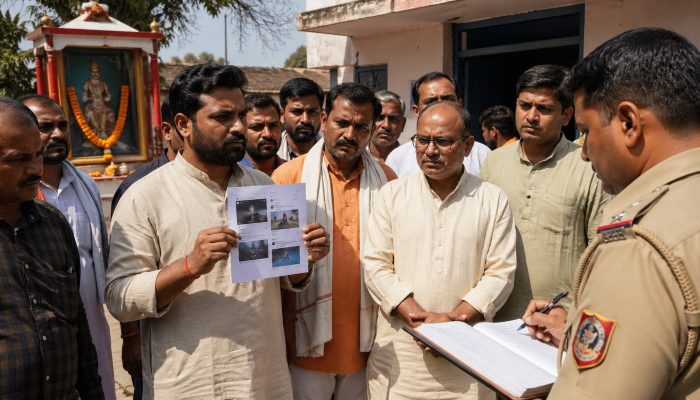
Case Summary
In the Rehra police station area of Balrampur, Uttar Pradesh, Hindu sentiments were outraged by a man named Abhishek Kumar Verma, who made derogatory remarks about the Hindu community and revered Hindu deities, particularly Lord Parshuram. The incident came to light after a complaint was filed against the accused under various sections of the law. It stated that he had been continuously spreading inflammatory and objectionable content on social media. On 29 April 2026, Hindu activists from Rehra Bazaar Block, Mukesh Chaturvedi, Shyam Sundar Tiwari, Ravi Pathak, and Abhay Shukla, stated that Abhishek Kumar Verma, a resident of Majra Durgapurwa in Badhiya Farid Khan village, posted indecent comments targeting Hindu society and Hindu gods and goddesses. The accused's post went viral, igniting widespread outrage. The complaint of Hindu activists highlighted the accused's specific derogatory remarks about Lord Parashuram, which deeply wounded the religious sentiments of the Hindu community. The activists described it as a deliberate attempt to incite animosity and disrupt social harmony. Inspector-in-Charge Durgesh Kumar Singh confirmed that, due to the gravity of the offence, a case has been registered under relevant sections of the Indian Penal Code (IPC) and the Information Technology (IT) Act. At the time of reporting, investigations are underway, with further legal action to follow based on evidence. Efforts to arrest the accused have been intensified.
Why it is Hate Crime ?
The primary category for this case is "Hate speech against Hindus". The sub-category for the case is "Anti-Hindu slurs, mocking faith". Anti-Hindu slurs and the deliberate mocking of the Hindu faith owing to religious animosity involve the usage of derogatory terms, stereotypes, or offensive references to religious practices, symbols, or figures. One of the common anti-Hindu slurs used against Hindus is “cow-worshipper” and “cow piss drinker”. The intention of using this term is to demean and mock Hindus as a group and their religious beliefs since Hindus consider the cow holy. Additionally, some symbols and the slurs attached to them have a historical context that exacerbates the insult, hate, stereotyping, dehumanisation and oppression against Hindus. Cow worship has been used for centuries to denigrate Hindus, insult their faith and oppress Hindus specifically as a religious group. There has been overwhelming documentation about how cow slaughter has been used to persecute Hindus with cow meat being thrown in temples and places of worship. There has also been overwhelming documentation where cow meat (beef) has been force-fed to Hindus to either forcefully convert them to Islam or denigrate their faith. Apart from cow worship, the Swastika – which holds deep religious significance for the Hindus – has also been misinterpreted and distorted to use as a slur against Hindus. Similarly, the worship of the Shivling has been used by supremacist ideologies and religions to denigrate Hindus owing to religious animosity. Such slurs and denigration stem out of inherent animosity and hate towards Hindus and their faith, therefore, it is categorised as hate speech targeted at Hindus specifically owing to their religious identity. In this case, a man named Abhishek Kumar Verma from Balrampur district, Uttar Pradesh, conducted a sustained and deliberate campaign of offensive social media posts targeting Hindu gods and goddesses and the broader Hindu community, with posts specifically insulting Lord Parshuram. The act was not a single impulsive act. The source confirms he had been persistently publishing inflammatory and offensive content over an extended period, indicating a calculated and ongoing assault on Hindu religious identity through the most publicly visible platform available to him. The sustained nature of the posting is what distinguishes this case from a single offensive remark. Abhishek Kumar Verma was not reacting to a specific event or a personal grievance. He was persistently and repeatedly publishing offensive content targeting the Hindu faith and Hindu deities across an extended period, with each post deepening the cumulative harm to Hindu religious sentiments across the community. A perpetrator who returns repeatedly to publish offensive content against the same religious community is a perpetrator whose hostility toward that community is settled and deliberate rather than momentary. The specific targeting of Lord Parshuram amplifies the religious gravity of the case. Lord Parshuram is not a peripheral figure within the Hindu tradition. As one of the ten avatars of Lord Vishnu, he occupies a position of profound theological significance, and within the Brahmin community, he is revered as a divine ancestor and protector whose honour is inseparable from the community's own religious identity. An insult directed at Lord Parshuram is therefore not merely an offensive remark about a historical or mythological figure. It is a targeted attack on the devotional identity of every Hindu who reveres him, chosen deliberately because it would cause the deepest possible religious injury to the community most closely associated with him. The accused's abuse of other Hindu deities, in addition to Lord Parshuram, reveals his deep-seated religious animosity towards the Hindu community. Hindu deities are highly revered by devotees, and they embody sacred ideals of dharma, justice, and protection of the faithful, forming the spiritual core of Hindu devotion and identity. Abusing them constitutes a direct affront to these revered sentiments, inflicting profound emotional harm on Hindu devotees and the community at large. This pattern elevates the incident to a clear case of religiously motivated hate speech designed to provoke division and pain. The choice of social media as the vehicle for the campaign ensured that the harm extended far beyond the perpetrator's immediate locality. By publishing the content on social media rather than expressing it privately, Abhishek Kumar Verma ensured that the insults reached Hindu people across the district and beyond, multiplying the communal harm of each post through the mechanism of viral spread. The rapid circulation of the content and the widespread outrage it triggered confirms that the harm was as extensive as the platform was designed to produce. Given that this case met the parameters of a religiously motivated hate speech, it was added to the hate crime database of the tracker. Disclaimer: The Hinduphobia Tracker records incident dates based on when the crime occurs, rather than when it is reported by the media. In this case, since the media reports do not specify the exact date on which the accused made the derogatory remarks, the date on which the complaint was filed, 29 April 2026, has been selected as the indicative incident date for documentation purposes only.


Case Status
Complaint registered


Perpetrators Details
Perpetrators
Others
Perpetrators Range
One Person
Perpetrators Gender
male
 Sources




