Hindu woman deceived into a relationship by a Muslim government employee, forced to convert to Islam and wear burqa
 Barwani, Madhya Pradesh, India
  28 April, 2023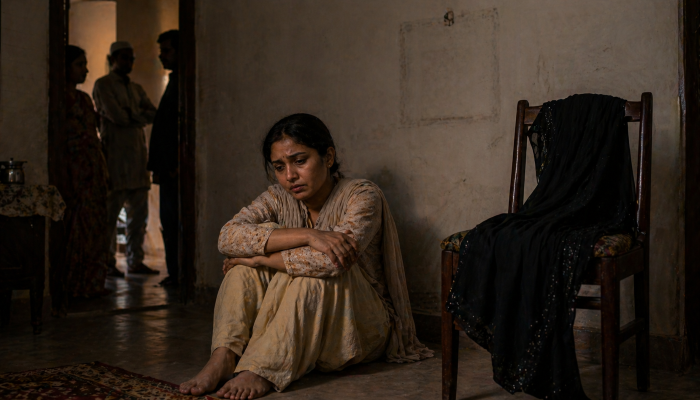
Case Summary
A Hindu woman in Barwani, Madhya Pradesh was deceived into a relationship by a Muslim government employee named Aman Khan, also known as Kittoo, who used false promises of marriage to exploit her sexually over an extended period beginning in 2023, caused her to undergo two abortions without her informed consent by secretly administering medication, and after marriage subjected her to sustained pressure to wear a burqa and convert to Islam. A case was registered against Aman Khan, his parents, his aunt, and other relatives under rape, non-consensual abortion, criminal intimidation, and Madhya Pradesh Religious Freedom Act provisions. The victim had known Aman Khan since 2023. He used false promises of marriage to establish a sexual relationship with her. During this period, she became pregnant twice. Both times, Aman Khan secretly administered medication to her without her knowledge or consent, causing forced abortions. The victim was unaware of what was being done to her until after the fact. Following the marriage, Aman Khan and his family subjected the Hindu woman to sustained pressure to wear a burqa and convert to Islam. When she resisted, she was tortured and threatened. Hindu organisations learned of the case, arrived at Kotwali police station, and staged a protest demanding action. Following the demonstration, police registered a case against Aman Khan, his parents, his aunt, and other relatives. Kotwali Station House Officer [TI] Baljit Singh Bisen confirmed that a case had been registered under section 376 [rape], section 313 [abortion without consent], section 506 [criminal intimidation], and provisions of the Madhya Pradesh Dharmic Swatantrya Adhiniyam [Madhya Pradesh Religious Freedom Act] on the basis of the victim's statement and evidence. The investigation was assigned to Sub-Inspector Suresh Muvel. Aman Khan was currently employed as an Assistant Grade 3 on a compassionate appointment in Agar Malwa district. All accused were being searched for as of the source date.
Why it is Hate Crime ?
The primary category for this case is "Crimes against women in relationships and other sexual crimes". The sub-category here is "Forced conversion after marriage". The tertiary category here is "Forced to wear Hijab". In such cases, a non-Hindu man marries a Hindu woman, and the force/pressure to convert to any Abrahamic faith, like Islam, begins after marriage. In such cases, typically, two patterns emerge. First, when the relationship is consensual, and the religious identity of the perpetrator is known to the Hindu woman in the relationship. The marriage could be under the Special Marriages Act, where neither parties are required to convert their religion for the marriage to be considered legitimate. While the victim in such cases enters matrimony assuming that religious identity is not a barrier, the non-Hindu man starts to pressure the woman to convert her religion after marriage. The second is when the woman gets into a marriage with the man, pretending to share her faith. Later, when the truth is revealed, the man starts pressuring the woman to convert her religion and give up her religious identity. In both situations, there is the application of force by the perpetrator, including the denial of the woman’s religious rights. Some of the means by which the woman is forced/pressured to convert include force-feeding beef, being forced to read the Kalma, being forced to wear a hijab, forced to undergo Halala, etc. There are several instances where, after marriage, the woman voluntarily converts to Islam. Such cases are often argued to be a result of religious brainwashing; however, for the purpose of documenting religiously motivated hate crimes, in the absence of the victim complaining of forced conversion, such cases do not form a part of the database. Another sub-category for the case is "Brainwashed and/or groomed". The tertiary category is "Rape and sexual assault/harassment". In several cases, a Hindu woman and/or minor is sexually harassed and/or assaulted with a religious motive. For example, in a case in Kausambi, UP, a Hindu girl was raped by non-Hindu perpetrators. During the assault, the victim pleaded to 'spare her in the name of Bhagwan'. The perpetrators then asked her to plead in the name of Allah. This clearly indicates a religious motive for the crime and evidences the religious animosity the perpetrators harbored against the victim owing to her religious identity. Such cases would be added to this tertiary category since the religious animosity makes the crime a hate crime. One other sub-category for the case is "Assault or threat upon refusal to convert". When Hindu women are in a relationship with non-Hindu men, there are cases where the woman faces threats or assault after she refuses to convert and change her religious identity owing to pressure/force by the non-Hindu man. Such relationships may be consensual with the religious identity of the non-Hindu man known to the victim. Somewhere along the relationship, the non-Hindu man starts pressurizing the Hindu woman to convert to Islam and upon her refusal, assaults or threatens the victim. Such cases are driven by specific religious motivations and against the religious identity of the victim and are therefore qualified as hate crimes. Cases where the Hindu woman converts to Islam and does not file a complaint about the force or threat, are not considered a part of the hate tracker, even though, it may be argued that the woman was brainwashed or threatened to convert to Islam. In this case, a Muslim government employee used sustained false promises of marriage to draw a Hindu woman into a sexual relationship and, after marriage, subjected her to sustained pressure to wear a burqa and convert to Islam, resorting to torture and criminal intimidation when she refused. The false marriage promise as the entry point into exploitation is the most revealing element of this case. Aman Khan did not approach the Hindu woman as a Muslim man seeking a relationship. He approached her as someone who intended to marry her, sustaining that promise over an extended period from 2023 while simultaneously exploiting her sexually and ensuring that the prospect of marriage kept her emotionally bound to him. The marriage promise was not a genuine intention. It was the instrument through which her consent to the relationship was manufactured and maintained, and through which her resistance to his subsequent demands was progressively eroded. A Hindu woman who believes she is in a committed relationship moving toward marriage is one whose guard is lowered, whose trust is at its highest, and whose vulnerability to exploitation is at its greatest. Aman Khan understood this and deliberately exploited it. The post-marriage imposition of the burqa and conversion pressure reveals the true objective of the relationship. Once the marriage had been solemnised and the Hindu woman was within his household, Aman Khan and his family moved from the manufactured intimacy of the pre-marriage relationship to open coercion. The demand to wear a burqa and convert to Islam, backed by torture and criminal intimidation when she refused, confirms that the entire pre-marriage relationship had been structured around gaining access to a Hindu woman and placing her in a position from which religious transformation could be most effectively imposed. The burqa demand is particularly significant. It is the most visible and comprehensive instrument of Islamic identity imposition available within a domestic context, designed to erase every visible marker of the Hindu woman's identity and replace it with an Islamic one from the moment she steps outside the home. The involvement of Aman Khan's entire family in the coercion confirms the institutional character of the targeting. A family that collectively applies torture and criminal intimidation to compel a Hindu woman to convert to Islam is not a family reacting to a personal domestic conflict. It is a family that understood from the outset that the marriage had been entered into with the objective of the Hindu woman's conversion, and that collectively enforced that objective when she refused. It is important to mention here that the forced abortions in this case form a critical part of the pattern of exploitation and control exercised by the accused and become particularly significant when viewed alongside the subsequent coercion after marriage, where the victim was pressured to adopt religious practices and convert. The sequence suggests that the concealment, exploitation, and forced abortions were not isolated acts, but part of a broader pattern in which control over the victim’s body and autonomy was maintained until a stage where religious imposition could be enforced more directly. Given that this case met the parameters of a religiously motivated hate crime, every element of what Aman Khan did, the false marriage promise, the sustained sexual exploitation, the two secret abortions, the post-marriage conversion pressure, the burqa demand, and the torture upon refusal, was chosen because it would be most effective in drawing a Hindu woman into a position of total vulnerability and then exploiting that vulnerability to compel her religious transformation. She was targeted because she was Hindu, and the entire structure of the relationship was built around the objective of erasing that identity. All the perpetrator's actions stemmed from inherent hostility towards the victim's professed faith since Abrahamic faiths believe that any non-adherent to the faith is subject to being dehumanised till they convert. Since such predatory actions stem from doctrinal animosity towards the Hindu faith and its adherents, this case is being documented as a religiously motivated hate crime. Disclaimer on Date: The Hinduphobia Tracker records incident dates based on when the crime occurred, not when it was reported or published. Although the incident was reported by the media on 29 April, 2026, this case involves a sustained course of conduct that began in 2023, when Aman Khan first established contact with the victim under false marriage promises. Therefore, to document this case, 29 April 2023 has been used as the primary incident date, derived by aligning the known year with the article's publication date and month. This has been recorded for documentation purposes only. Disclaimer on Perpetrator Count: The number of perpetrators has been recorded as four: the primary accused, Aman Khan, along with his parents and aunt, whose involvement is specifically indicated in the case details. While the complaint also mentions “other relatives,” their identities have not been clearly specified in the available information; therefore, though the actual number is higher, the perpetrator count has been recorded as 4.
Victim Details
Total Victim
1
Deceased
0
Gender
- Male 0
- Female 1
- Third Gender 0
- Unknown 0
Caste
- SC/ST 0
- OBC 0
- General 0
- Unknown 1
Age Group
- Minor 0
- Adult 0
- Senior Citizen 0
- Unknown 1


Case Status
Complaint registered


Perpetrators Details
Perpetrators
Muslim Extremists
Perpetrators Range
From 2 To 5
Perpetrators Gender
both
 Sources




