Ancient Bhairavnath temple desecrated; Idol of revered Hindu dieties smashed by unknown miscreants in Datia, Madhya Pradesh
 Datia, Madhya Pradesh, India
  27 April, 2026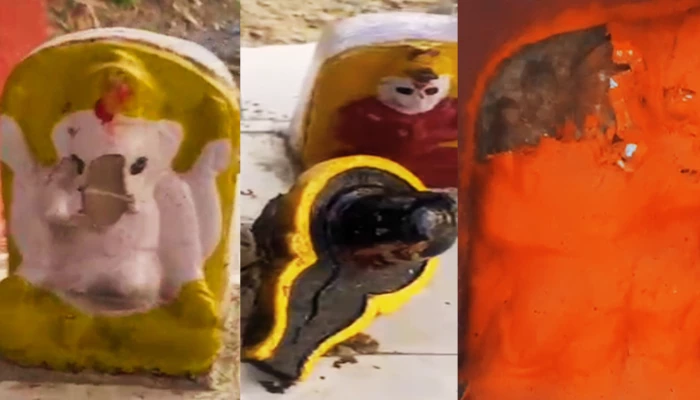
Case Summary
An ancient Hindu temple in Uchad village of Datia district was vandalised during the late hours of Tuesday night, 28 April, 2026. The incident took place within the jurisdiction of Goraghat police station, where unidentified individuals entered an ancient Bhairavnath temple and damaged the idols. During the night, the perpetrators gained access to the temple and damaged multiple idols consecrated in the temple. The idols of Lord Bhairavnath, lord Shiva, lord Ganesha, and lord Hanuman were found broken and defaced inside the temple complex following the intrusion. The damage came to light the following morning when villagers arrived at the temple. Upon witnessing the broken idols, anger spread among the residents. A large number of villagers gathered at the temple premises, expressing outrage over the incident and condemning the act. The residents demanded the immediate identification and arrest of those responsible. After receiving information about the incident, Goraghat police station in-charge Ramesh Shakya arrived at the site along with a police team. The police conducted a detailed inspection of the temple premises and collected evidence from the location and surrounding areas. Based on the initial findings, the police considered the act to be a premeditated mischief. A case was registered against unknown individuals, and efforts were initiated to identify suspects. The police began examining possible CCTV footage installed in and around the village and the temple area, while also gathering information about suspicious persons and activities in the vicinity.
Why it is Hate Crime ?
This case has been added to the tracker under the primary category - Attack on Hindu religious representations. The subcategory selected within this is - Attack on temples. In Hinduism, a temple is the abode of the Deity. The Deity in the Temple is consecrated, thereby making it a real, breathing entity. Hindus believe that not just the Deity but the temple premises itself are sacred to Hindus since Hindus hold the faith that the entire Temple space is an amalgamation of the divine energy of the deity. Given the central significance of Temples in Hindu Dharma, any attack against a Hindu Temple or its peripheral premises is an attack on the faith itself and is born out of animosity towards the faith, of which the Temple is a central tenet. Any manner of attack against a Temple and/or its premises would therefore be considered a religiously motivated hate crime. The other sub-category selected for this case is - Desecration of a Hindu religious symbol. Icons and symbols, or a religious representation of a spiritual ideal, are widely revered in Hinduism. Iconography is of vital significance in the Hindu milieu. It helps connect people’s spiritual beliefs with the real world. Iconography within the Hindu faith takes several shapes and forms. Murtis are of most significance to Hindus, to which daily rituals, prayers and offerings are done. Besides the murtis, there are several other symbols which have deep significance in the Hindu faith – the Om and Swastika, for example. Since these Hindu religious symbols hold paramount importance in Hinduism, any desecration of symbols, icons, murtis, religious representations and manifestations, is driven by animosity towards the faith itself, which manifests itself through these murtis, icons and symbols. Therefore, any desecration of these Hindu religious symbols and representations is considered a religiously motivated hate crime under this category. The incident in Datia was a direct assault on a sacred space that Hindus revere as the living abode of their deities. A temple is not a mere structure; it is a consecrated seat of the divine where the presence of the deity is real and central to daily worship. The perpetrators entered this sanctified space under the cover of night and targeted the very heart of devotion. The destruction was not aimed at property but at the deities themselves, making religion the clear and undeniable focal point of the act. The first and most striking element was the breaking of the idols. The murtis(idols) of lord Bhairavnath, lord Shiva, lord Ganesha, and lord Hanuman are revered as living embodiments of the divine, worshipped through daily rituals, offerings, and prayers. By entering the temple and smashing these murtis, the perpetrators directly attacked what devotees hold as sacred and inviolable. This was a conscious and deliberate act. The selection of multiple deities showed a calculated effort to inflict maximum injury to faith, striking at several pillars of Hindu worship in one go. Such an act cannot be reduced to mere vandalism; it was a targeted desecration of sacred representations. The intent was evident in the manner of execution. The perpetrators chose a temple, entered it deliberately, and focused on destroying consecrated idols central to worship. The assessment that the act appeared premeditated reinforced that this was not random mischief but a calculated act. The focus on sacred objects showed a clear aim to insult, provoke, and wound religious sentiments. This was an act directed at the faith itself, using its most sacred symbols as the point of attack. Equally significant was the violation of the temple itself. The perpetrators chose to enter a consecrated premises at night, indicating planning and intent. A temple functions within a framework of purity, reverence, and discipline, where every part of the space is sacred. By intruding into this environment and carrying out destruction, they defiled the sanctity of the entire premises. This was not a random intrusion but a deliberate breach designed to desecrate a place that Hindus approach with devotion and spiritual discipline. The impact of this act was immediate and deeply wounding. When villagers saw the broken idols the next morning, it triggered anger, grief, and a profound sense of violation. For a devotee, witnessing the destruction of a deity’s murti is not just emotional distress; it is a rupture in spiritual life. The gathering of villagers and their demand for justice reflected collective anguish and a shaken sense of security. Their worship was disrupted, and a sacred space that once offered solace became a reminder of vulnerability. Such acts leave behind a lasting psychological scar on the community. This incident, therefore, stood as a clear example of a deliberate targeting of a religious space and its sacred representations. The destruction of idols within a temple struck at the core of Hindu belief and practice. It reflected hostility that went beyond physical damage, aiming instead to injure the community's spiritual fabric. It is important to mention here that though the last update was that the miscreants were unknown, regardless, the action stemmed out of hatred against Hinduism and resulted in the desecration of the sacred temple and would therefore be considered a religiously motivated hate crime.


Case Status
Complaint filed


Perpetrators Details
Perpetrators
Unknown
Perpetrators Range
Unknown
Perpetrators Gender
unknown
 Sources




