Hindu faith selectively targeted: Bihar police bans Hindu cops from wearing their religious symbols but imposes no similar restrictions on other faiths
 Bihar, India
  7 July, 2025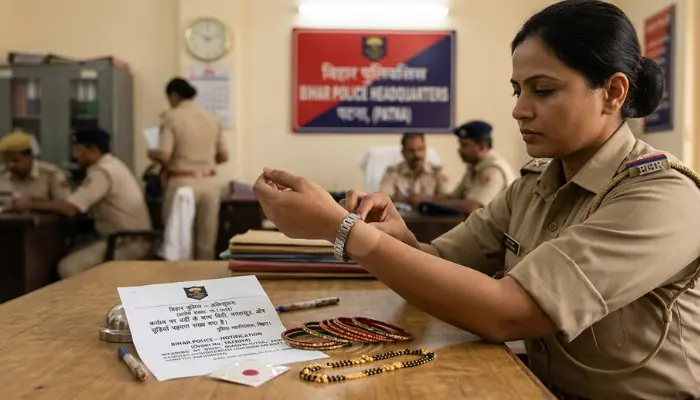
Case Summary
In Bihar, an anti-Hindu administrative decision was made by the Bihar police, barring Hindu cops from wearing their religious symbols under the pretext of "maintaining discipline". However, there were no such restrictions imposed on cops of other religions. According to news reports, the Additional Director General (Law and Order), Pankaj Darad, issued a circular on 8 July 2025 imposing restrictions on Hindu cops from wearing their religious symbols like bindis, churis, kangans, mangalsutras, nose rings, or jhumkas that were visible over their uniforms. The order cited discipline, simplicity, and dignity in the police force's appearance as the reason behind banning the use of Hindu religious symbols for police personnel. However, the police issued no such restrictions on the wearing of other religious symbols like the cross, kada, Muslim-style cap (topi), hijab and burqa. The order not only singled out women officers, but even male officers were also asked to maintain "uniform decorum and avoid improper dressing" while on duty. "The directive will also apply to male officers and personnel, requiring them to wear uniforms properly during duty hours," said Darad. Copies of the order were sent to all Superintendents of Police, Senior Superintendents of Police, Deputy Inspectors General, and Inspectors General for immediate enforcement across their respective jurisdictions. The circular further stated that violation of these guidelines would attract disciplinary action. Police Headquarters warned that violators would be identified and dealt with strictly. If the directive was ignored, senior officers could be asked to explain the lapse in implementation. "In case of non-compliance, the headquarters may seek explanations from officers on why the directive was not implemented," said the Additional Director General.
Why it is Hate Crime ?
The primary category selected in this case is- Restriction/ban on Hindu practices. The subcategory selected is- Restriction on expression of Hindu identity. An example of the state-affected prejudicial and targeted orders against the Hindu community would be a government denying the right of a Hindu or a group of Hindus to hold a religious procession owing to the animosity of non-Hindu groups. Denial of the religious right of the Hindus to assuage the non-Hindu group which harbours animosity to a point where it could lead to violence against Hindus is not only a failure of law and order but is a prejudicial order against Hindus, denying them their fundamental rights to express their religious identity. An example of a hate crime against Hindus by a non-Hindu would be a non-Hindu institution forcing its Hindu employees to abandon religious symbols that a Hindu would wear as an expression of faith owing to inherent prejudice against the faith professed by the victim or a non-Hindu group of people restricting a Hindu group from constructing a place of worship simply because the demography of the area in which the temple is being built is dominated by non-Hindus. Such actions are driven by religious animosity and/or prejudice against Hindus and their faith and would therefore be categorized as a hate crime. The other subcategory selected is- Administration restricts religious practice. In several cases, it is seen that the administration/state disallows a religious practice owing to prejudicial orders and concerns, targeted specifically against the Hindu community. Such restriction/prohibition would be considered documented as a hate crime because the orders are often a result of pressure by groups that harbour animosity towards Hinduism and Hindus. Often, the restriction by the authorities is driven by bias, hostility, or prejudice against the specific community being stopped from holding a religious practice, by pressure groups that harbour animosity towards Hindus, intrinsic to their faith. Since practices are intrinsic to the faith of the Hindus, such prejudicial restriction is considered a curtailing of the fundamental rights of the Hindu community. In several cases, for example, the authorities ban a Hindu religious practice due to pressure from groups opposed to the religion. In other instances the prohibition is selectively enforced against one religious group (Hindus) while others are allowed to proceed. There are still other cases where the authorities preemptively restrict a religious practice by Hindus because those who hold animosity towards Hindus may get “provoked” leading to them being violent, thereby assuaging the sentiments of those who hold animosity towards Hindus by curtailing the religious rights of Hindus. Such acts and orders are prejudiced, indicating discriminatory motives owing to the capitulation to groups that harbour animosity towards Hindus and therefore, would be categorized as a religiously motivated hate crime since the original pressure leading to the order itself is a result of hatred/bias/prejudice/religious hate against Hindus. In this case, the Bihar police department's directive banning Hindu officers from wearing sacred religious symbols like bindis, mangalsutras, churis, and kangans exemplifies a clear case of religiously motivated hate crime rooted in deep-seated animosity towards the Hindu faith and identity. These sacred symbols carry immense spiritual and religious significance for Hindus. Bindi, a mark on the forehead, invokes divine protection and purity, connecting the wearer to ancient Vedic rituals and deities such as Lord Shiva. Mangalsutras signify unbreakable marital bonds blessed by Hindu gods. Churis and kangans complete this sacred adornment, embodying a woman's cultural and religious essence. By forcibly stripping Hindu cops of these religious expressions, the administration assaulted their core religious autonomy. It compelled them to hide their faith identity under the flimsy guise of maintaining discipline. This selective prohibition, absent for other faiths, exposes raw religious prejudice. It turns every day police duty into a battleground where Hindu officers must suppress their religious beliefs to serve. This marks it unequivocally as a crime rooted in religious bias and hatred. The Director General of Police issued a compulsory administrative order applicable to all police officers. It explicitly prohibited Hindu officers from displaying religious symbols such as bindis and mangalsutras while in uniform. This top-down directive created direct pressure on Hindu officers to suppress their religious identity. Non-compliance risked disciplinary action, including suspension. By enforcing the removal of these faith-specific symbols through official policy, the administration compelled Hindu personnel to conceal core elements of their religious expression during duty hours. Such institutional coercion targeting Hindu practices constitutes a religiously motivated hate crime. Such restrictions make Hindu cops feel their faith is inferior. They pressure them to conceal their religious identity just to remain in service. They force a choice between duty and devotion. This coercion stripped them of religious autonomy. It turned workplaces into zones of enforced secularism that only Hindus endured. If they wished to continue working, they had no option but to suppress and hide their faith expressions. This created invisible chains that bound their identity. This coercion, demanding concealment under threat of penalty, underscores the religiously motivated nature of the crime. It weaponised employment against Hindu religiosity alone. Most critically, only Hindu symbols like bindis and mangalsutras faced explicit bans, even though these minute religious symbols neither hamper uniform rules nor break uniformity completely. Outward religious expressions of other faiths worn by cops went unrestricted. Even if uniformity was the true concern, larger symbols like the Muslim cap, hijab, or burqa hamper uniforms far more visibly, yet these were not banned while only Hindu minute symbols were targeted. This showcased the Bihar police administration's blatant bias and prejudice against Hindu identity under flimsy and false pretexts of maintaining discipline. Beards symbolising Sikh piety, skullcaps for Muslim devotion, or crucifixes remained untouched. Yet a simple bindi or mangalsutra became a disciplinary offence. This glaring selectivity proved the directive targeted Hinduism deliberately, not uniformity. It allowed other faiths to flourish visibly while Hindus cowered in hiding. Such discriminatory enforcement revealed institutional contempt for Hindu practices. It framed discipline as a veil for faith-based vendetta. By permitting diverse symbols from other religions but eradicating Hindu ones, the administration broadcast its prejudice. This solidifies it as a textbook religiously motivated hate crime. Given that this case meets every parameter of a hate crime, selective targeting of Hindus, coercion to suppress faith identity, institutional bias, and psychological harm inflicted on victims, it has been added to the hate crime database of the Hinduphobia Tracker. Disclaimer: As per reports, the only accused mentioned is Pankaj Darad, Additional Director General (Law and Order), who issued the circular. Henceforth, the perpetrator count has been recorded as one, referring to Pankaj Darad alone.


Case Status
Unknown


Perpetrators Details
Perpetrators
State and Establishment
Perpetrators Range
One Person
Perpetrators Gender
male
 Sources




