Ancient Hindu temple looted, burnt and demolished by Muslims, reclaimed after 37 years by Hindus in Jammu and Kashmir
 Kupwara, Jammu and Kashmir, India
  28 April, 2026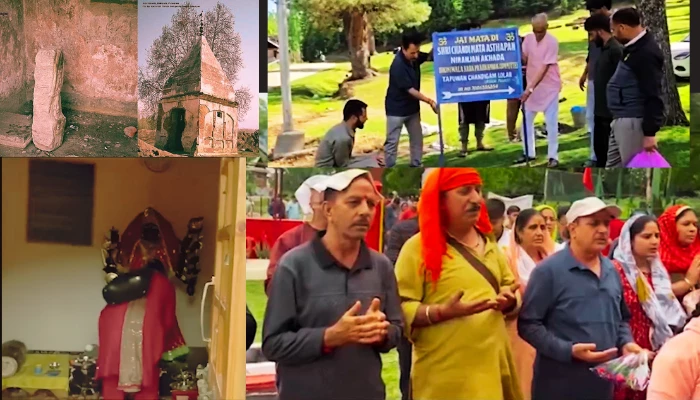
Case Summary
A Hindu temple located in Chandigam, a locality in the Lolab Valley of Jammu and Kashmir, had been looted, desecrated, and demolished by Muslims in the region. It formed part of a wider pattern of destruction during the period of unrest in the Valley. In 1990, several ancestral Hindu religious sites were targeted and destroyed. Approximately 750 temples were demolished during this period. At the same time, members of the Hindu community, particularly Kashmiri Pandits, were forced to flee the Valley due to terrorism and a pervasive sense of insecurity, leading to a mass exodus from their homes and ancestral lands. The temple in Lolab was among those that were destroyed during this phase. It had been set on fire and left in a state of ruin, reflecting the broader erasure of Hindu religious presence in the region during that time. After a gap of nearly 37 years, the temple was reclaimed by the Hindu community and returned to the Kashmiri Pandits. This marked a significant moment in the restoration of their religious and cultural heritage. Following decades of displacement and loss, Kashmiri Pandits reclaimed this site in Chandigam, in the Lolab region of Kupwara district, Jammu and Kashmir. The return carried deep emotional significance for families who had been separated from their ancestral spaces since the 1990s, symbolising not merely the recovery of land or property, but a reconnection with their faith, identity, and historical roots.
Why it is Hate Crime ?
The first primary category selected in this case is- Attack on Hindu religious representations. The selected sub-category is- Attack on Temples. In Hinduism, a temple is the abode of the Deity. The Deity in the Temple is consecrated, thereby, making it a real, breathing entity. Hindus believe that not just the Deity but the temple premises itself are sacred to Hindus since Hindus hold the faith that the entire Temple space is an amalgamation of the divine energy of the deity. Given the central significance of Temples in Hindu Dharma, any attack against a Hindu Temple or its peripheral premises is an attack on the faith itself and is born out of animosity towards the faith, of which, the Temple is a central tenet. Any manner of attack against a Temple and/or its premises would therefore be considered a religiously motivated hate crime. The other subcategory selected is- Desecration of Hindu religious symbol. Icons and symbols or a religious representation of a spiritual ideal are widely revered in Hinduism. Iconography is of vital significance in the Hindu milieu. It helps connect people’s spiritual beliefs with the real world. Iconography within the Hindu faith takes several shapes and forms. Murtis are of most significance to Hindus, to which daily rituals, prayers and offerings are done. Besides the murtis, there are several other symbols which have deep significance in the Hindu faith – the Om and Swastika for example. Since these Hindu religious symbols hold paramount importance in Hinduism, any desecration of symbols, icons, murtis, religious representations and manifestations, is driven by animosity towards the faith itself which manifests itself through these murtis, icons and symbols. Therefore, any desecration of these Hindu religious symbols and representations is considered religiously motivated hate crimes under this category. The incident fell squarely within the scope of a targeted attack on a Hindu place of worship. The temple in Chandigam was not merely a structure of stone and wood; it was regarded as a living sacred space, imbued with the presence of the deity and sustained through generations of faith and ritual. Its looting, desecration, and eventual demolition, followed by being set on fire, was not an incidental act of damage but a direct assault on a site held to be spiritually alive. Moreover, the timing, during the period when Hindus were already facing threats and displacement, further reflected that such acts were part of a broader climate of hostility in which religious spaces became deliberate targets. The nature of destruction also indicated a deeper level of disregard for Hindu religious sentiment. The burning and desecration of the temple inevitably meant the destruction of murtis and sacred representations housed within it. In Hindu practice, these are not symbolic artefacts alone but embodiments through which devotees connect with the divine. Their desecration, therefore, was not simply physical damage but a rupture of a spiritual relationship. Such acts revealed an intent that went beyond vandalism and entered the realm of deliberate religious denigration. The incident also had to be understood in the wider context of the events of 1990, when hundreds of temples were destroyed and the Kashmiri Pandit community was forced to flee. The targeting of religious sites alongside the displacement of the community demonstrated a pattern where faith, identity, and physical presence were attacked together. The destruction of temples in such a climate carried a message that extended beyond the immediate act it signalled erasure, both cultural and religious. The eventual reclamation of the temple after nearly four decades carried deep emotional weight. For the displaced community, it marked not just the recovery of a physical site but a fragile restoration of continuity with their past. However, the passage of time did not dilute the nature of the original act. The destruction remained rooted in hostility towards the faith and its expressions, and as such, met the threshold of a religiously motivated hate crime, where both the sacred space and its spiritual essence had been deliberately violated. Disclaimer: The Hinduphobia Tracker recorded the date when the victims’ ordeal began. Although the temple was reclaimed as per reports on 29 April 2026, the exact date when the temple was desecrated is not known. Therefore, for documentation purposes, the date when it was reclaimed has been selected as the date.


Case Status
Unknown


Perpetrators Details
Perpetrators
Muslim Extremists
Perpetrators Range
From 10 to 100
Perpetrators Gender
unknown
 Sources




