Hindu temple defiled by obscene acts within the premises, priest brutally assaulted upon objecting in Kanpur, Uttar Pradesh
 Kanpur, Uttar Pradesh, India
  26 April, 2026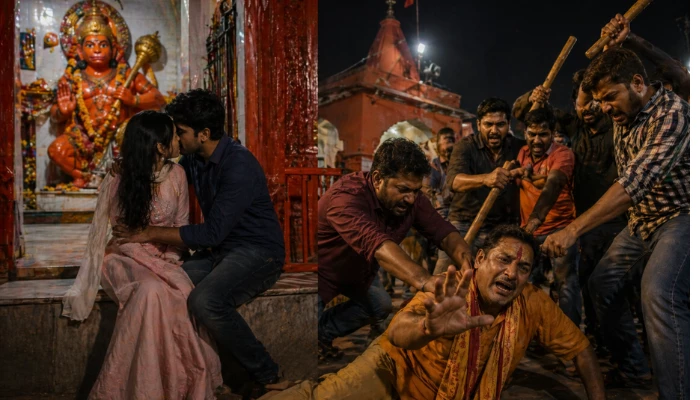
Case Summary
In Kanpur, the sanctity of a Hindu temple was defiled by an unknown couple by performing obscene acts inside the premises. Upon objecting the temple’s mahant was severely beaten and assaulted by more than three dozen men. According to the complaint filed by the victim, Mahant Jayanarayan Das, a resident of Shekhpur, he had been serving as the mahant of the temple for the past three decades. He stated that on the day of the incident, he was unwell and had entrusted the responsibility of the temple to a sevadar. As per the complaint, for about a week prior to the incident, a man and woman from the locality were seen spending extended periods behind the temple premises. This raised suspicion, and upon checking, the sevadar found the man and woman in a semi-nude condition behind the temple. The sevadar objected to their actions and told them not to engage in such activities within the temple premises. Following this, the man left the spot while issuing threats. Later that same night, the accused man returned to the temple premises along with approximately 35–40 individuals armed with sticks. The group entered the temple and brutally assaulted both the mahant and the sevadar. During the attack, Mahant Jayanarayan Das sustained serious injuries, including a fractured finger. The sevadar was also injured in the assault. A complaint was lodged at the Krishna Nagar police outpost. The mahant stated that if no action is taken, he would approach other mahants of the city, the District Magistrate, and the Police Commissioner, and would escalate the matter to the Chief Minister Yogi Adityanath if necessary. Chakeri Station House Officer Ajay Prakash Mishra stated that a case had been registered based on the complaint and that an investigation was underway.
Why it is Hate Crime ?
The primary category for this case is "Attack on Hindu religious representations". The sub-category here is "Breaking rules of place of worship". Sanatan Dharma is not a religion of one book, which is to say that while it has religious scriptures that form the central tenets of the faith, there are several traditions followed through thousands of years, mostly passed from generation to generation orally. One of these oral traditions or written traditions is the rules of specific temples. Certain temples have rules that are traditional, dependent on the worship of the presiding deities. These rules and traditions have been followed for thousands of years, whether they find scriptural mention or not. Such traditions are based on the nature and rules of worship of the presiding deity of that temple. Any non-compliance of these traditions owing to animosity towards the faith or for the sake of activism stems not only from the lack of faith in the presiding deity but also disregard for the faith of the devotees of that deity/temple and implicit bias against the faith, the tradition and the deity itself. Since these specific traditions are central to the faith of the devotees of that specific temple and presiding deity, any non-compliance with these traditional rules would be considered a religiously motivated hate crime. The other sub-category for this case is "Defiling religious customs". Sanatan Dharma is not a religion of one book, which is to say that while it has religious scriptures that form the central tenets of the faith, there are several traditions followed through thousands of years, mostly passed from generation to generation orally. Several such customs and traditions are followed by various Hindus and Hindu sects. Defiling of these traditions and customs is a breach of an individual or group’s religious practices. Such practices can range from dietary restrictions like not eating non-vegetarian food for a certain period of the year, not eating non-vegetarian food at all, not eating beef since the cow is considered holy in Hinduism, the sanctity of religious customs followed in the house (like many ISCKON devotees), etc. Any malicious action leading to the breach of such traditions or defilement of these traditions owing to animosity towards the faith or for the sake of activism stems not only from the lack of faith in the religion itself but also from disregard for the faith of the devotees who follow the customs/traditions and implicit bias against the faith, the tradition itself. Since these specific traditions are central to the faith of the devotees of that specific sect of Hindus, any non-compliance with these traditional rules would be considered a religiously motivated hate crime. Another primary category relevant in this case is- "Attack not resulting in death" Within this, the subcategory selected is In several cases, Hindus are attacked for opposing religiously motivated crimes being committed against a fellow Hindu or simply for voicing an opinion opposing radical elements, who either have in the past or continue to persecute Hindus. In such cases, the initial attack against the victim, against which the Hindu was trying to defend the victim, would also need to be classified as a religiously motivated hate crime. Since the initial crime itself was religiously motivated and the subsequent crime of attempting to save the victim or speaking against the radical elements ends up inviting a violent attack, it would also be classified as a religiously motivated hate crime under this category. This case has been added to the tracker because a Hindu place of worship was desecrated through conduct that violated its sanctity, and those who objected to such conduct were subsequently subjected to organised violence. Firstly, the conduct in question involved a man and a woman engaging in obscene acts within the temple premises. A Hindu temple is a sacred and disciplined space where devotees come to pray, reflect, and connect with the divine. Such spaces are governed by long-standing customs that emphasise purity in both behaviour and surroundings. Obscene or intimate acts are fundamentally incompatible with the spiritual character of a temple and amount to a clear breach of its sanctity. Such behaviour is not merely inappropriate; it reflects disregard for the religious significance of the space and the sentiments of the devotees who revere it. For Hindus, the sanctity of a temple is central to their faith and practice. Any act that defiles this environment disrupts the spiritual order maintained within the premises and diminishes the dignity of the deity worshipped there. In this case, the continued engagement in such conduct within the temple precincts indicated a conscious violation of these norms. This amounted to a defilement of established religious customs, as it intruded upon a space meant exclusively for worship and reverence, not for acts of a personal or intimate nature. Secondly, when the temple authorities objected to this violation and sought to uphold the sanctity of the premises, the response was not dialogue but violence. A large group returned in a coordinated manner and launched a physical assault within the temple itself. This escalation demonstrated that the objection was met with retaliation rather than correction. The attack was not incidental; it was directed at those who had attempted to preserve the religious discipline of the space, thereby turning the temple into a site of intimidation. The assault on the mahant and the sevadar, both custodians of the temple’s sanctity, carried a wider implication. It sent a message that any attempt to enforce or defend religious norms within a Hindu place of worship could invite collective violence. Such acts create an atmosphere of fear among devotees and those responsible for maintaining the temple, weakening their ability to safeguard the sanctity of their own religious spaces. Taken together, the sequence reflected a clear pattern: the violation of a sacred space was followed by a deliberate and disproportionate attack on those who resisted it. The progression from defiling conduct to organised violence indicated hostility not only towards individuals but towards the very idea of maintaining religious discipline in a Hindu temple. Since such actions stem from disregard and animosity towards Hindu religious practices and those upholding them, this case has been added to the tracker. Disclaimer: Media reports stated that the Hindu victim was targeted by a mob of 40 men upon objection to the obscene act; and the initial perpetrators were the man and woman who performed the obscene act, therefore, the total number of perpetrators was recorded as forty-two (42). This is a conservative estimate, for documentation purposes.
Victim Details
Total Victim
2
Deceased
0
Gender
- Male 1
- Female 0
- Third Gender 0
- Unknown 1
Caste
- SC/ST 0
- OBC 0
- General 0
- Unknown 2
Age Group
- Minor 0
- Adult 2
- Senior Citizen 0
- Unknown 0


Case Status
Complaint filed


Perpetrators Details
Perpetrators
Unknown
Perpetrators Range
From 10 to 100
Perpetrators Gender
both
 Sources




