Minor Hindu students targeted for religious conversion, their revered deities ridiculed by teacher during Ambedkar Jayanti celebrations in Begusarai
 Begusarai, Bihar, India
  14 April, 2026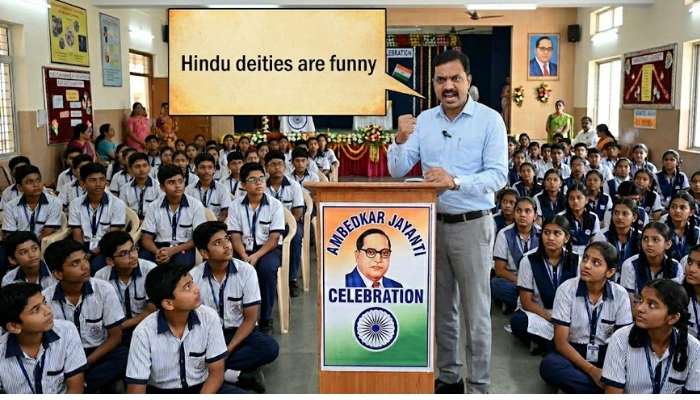
Case Summary
In Bihar’s Begusarai, minor Hindu students were targeted for religious conversion by a teacher named Vishweshwar Kumar. The accused was attempting to convert Hindu students by mocking and denigrating Hindu deities. According to media reports, this incident occurred on 15 April 2026. An Ambedkar Jayanti celebration event took place at a primary school in Singhaul Deeh. During this event, the accused teacher began manipulating and targeting Hindu students for religious conversion. At the same time, he also began mocking and denigrating revered Hindu gods and goddesses. The local villagers were alarmed by this incident and expressed outrage against this act of religious denigration and forced conversion. The villagers, led by the ward councillor, submitted an application to the district officer, accusing the teacher of propagating religious conversion and making fun of Hindu gods and goddesses. Following this complaint, the accused claimed that the programme organised in the school on 15 April was purely for educational and social purposes. On Ambedkar Jayanti, emphasis was placed on spreading social awareness among students and villagers. He further claimed that during the programme, no religious conversion or objectionable comments were made against the Hindu faith.
Why it is Hate Crime ?
The primary category selected in this case is- Predatory Proselytisation. The subcategory selected is- Proselytisation by grooming, brainwashing, manipulation or subtle indoctrination. The tertiary categories selected are- Conversion of minor, Pattern of targeting Hindus. Religious brainwashing essentially means the often subtle and forcible indoctrination to induce someone to give up their religious beliefs to accept contrasting regimented ideas. Religious grooming or brainwashing also involves propaganda and manipulation. It involves the systematic effort, driven by religious malice and indoctrination, to persuade “non-believers’ to accept allegiance, command, or doctrine to and of a contrasting faith. Cases of such grooming or brainwashing are far more nuanced than direct threats, coercion, inducement and violence. In such cases, it is often seen that there is repeated, subtle and continual manipulation of the victim to induce disaffection towards their own faith and acceptance of the contrasting faith of the perpetrator. While subtle indoctrination is widely acknowledged as predatory, an element which is often understated in such conversions or the attempts of such conversion is the role of loyalty and trust which might develop between the perpetrator and the victim. Fiduciary relationships are often abused to affect such religious conversion. For example, an educator transmitting religious doctrine of a competing faith to a Hindu student. The Hindu student is likely to accept what the teacher is transmitting owing to existence of the fiduciary relationship. The exploitation of the fiduciary relationship to religiously indoctrinate victims would also be included in this category. Since the underlying animosity towards the victim’s faith forms the basis of predatory proselytization, such cases are considered religiously motivated hate crimes. The other subcategory selected is- Attempting to convert/converting by denigrating Hinduism. In several cases, Hindus are converted or an attempt is made to convert Hindus by denigrating their faith, Hinduism. In such cases, the Hindus associate with the non-Hindu perpetrators often by choice and then, the attempt to convert them by insulting their faith, showing the faith down etc begins. An example of this would be a non-Hindu gathering where the Hindus are attending the gathering of their own free will. However, once they attend the gathering, there is an explicit attempt to convert them by abusing their faith and hailing the faith of the perpetrator. The denigration of the Hindu faith is often based on misrepresentation of the Hindu faith, its doctrine and scriptures and insult to espoused traditions if not blatant lies about Hindu beliefs and ways. Such conversions or attempts at conversions are driven by animosity towards the Hindu faith and are therefore documented as religiously motivated hate crimes. This case is a clear example of a religiously motivated hate crime, as minor Hindu students were targeted for religious conversion by the teacher Vishweshwar Kumar. Hindu deities were also denigrated in the process, with the accused openly using ridicule and mockery of revered gods and goddesses to carry out the attempted conversion of Hindu children. First, the fact that the victims were minors makes this even more telling, because the element of genuine consent and a free change of conscience is missing ab initio. Minors, due to their young age, are especially vulnerable to manipulation, coercion and conversion efforts; they do not fully understand the long‑term ramifications of converting to another faith. The perpetrator exploited this vulnerability, coercing and manipulating the Hindu students into considering conversion by undermining the value of their Hindu faith through denigration of their deities, which in turn amounts to religiously motivated coercion and forced conversion, making it a religiously motivated hate crime. Pressuring the victims to convert in itself showcases deep‑seated religious animosity. When pressure and manipulation are systematically applied to Hindu children to convert through brainwashing and denigrating techniques, the accused seeks to implant the idea that their Hindu faith is somehow inferior and that they must abandon it for another religion. The religious significance of Hindu gods and goddesses for a Hindu devotee cannot be overstated; they are not mere symbols but living presences in the devotee’s spiritual life, representing protection, moral guidance and identity. The act of mocking and denigrating these deities, especially in front of impressionable Hindu children, is therefore not casual disrespect but a calculated strike at the core of their religious self. When this is done with the explicit aim of converting Hindu children, the nature of the crime is clearly religiously motivated. The conversion is not being offered as a choice of equal faiths, but as a rejection of Hinduism achieved by humiliating the victims for their faith, making their spirits low and positioning them as easy targets for replacement belief. The use of denigration and manipulation in this manner to coerce Hindu victims into accepting another religion constitutes a clear case of a religiously motivated hate crime. In a teacher’s position inside a school, the perpetrator already occupies a more dominant and powerful role. The Hindu victims were his subordinates in the strict hierarchy of the classroom, not only as students but also as children. This power imbalance allowed him to frame his actions as authoritative guidance, making it difficult for the minor students to openly question or resist. The fact that this targeted religious conversion and the denigration of Hindu deities were carried out inside an educational institution adds to the gravity, because a school is meant to be a neutral space for learning, not a site for faith‑based proselytisation and hostility. The accused used his position of authority to force the students to entertain the idea of converting to another faith by systematically denigrating their Hindu identity. This active abuse of a position of trust and power turns the act into something more than mere religious persuasion; it is a predatory use of authority to break down the religious confidence of Hindu children, and therefore a clear case of a religiously motivated hate crime. Such instances of predatory proselytisation are rooted in animosity towards Hinduism. The perpetrator’s behaviour reflects a doctrinal level of hostility, where his own faith is presented not only as superior but as the only acceptable option, and Hinduism is treated as deficient and in need of erasure. This doctrinal animosity is evident in the way he mocked Hindu deities, presented conversion as inevitable and framed resistance as disobedience. The intent is not simply to spread his faith but to diminish Hindu identity, to make Hindu children doubt their own traditions and to push them into accepting another belief system under pressure. When religious conversion is pursued through humiliation, mockery and the exploitation of minors in a place of authority, it goes beyond belief and becomes an act of religious hatred. Given that this case meets the parameters of a religiously motivated offence, it is being added to the Hate Crime database of the Hinduphobia Tracker.


Case Status
Complaint filed


Perpetrators Details
Perpetrators
Others
Perpetrators Range
One Person
Perpetrators Gender
male
 Sources




