Minor Hindu girl befriended, forced to convert, offer namaz, wear burqa, and visit mosques by Muslim man posing as Hindu in Bhilwara
 Bhilwara, Rajasthan, India
  19 January, 2023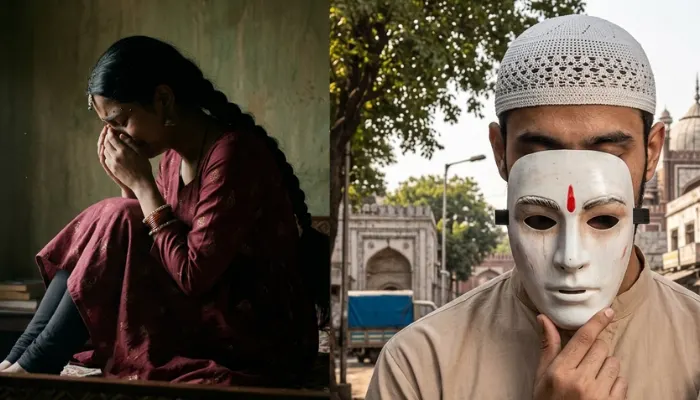
Case Summary
In Rajasthan’s Bhilwara, a minor Hindu girl aged 17 was lured into a friendship by a Muslim man named Sultan Mohammad alias Sultan Ahmed, who was posing as a Hindu. The accused deceived the victim and then raped her. Following this, he also forced her to convert to Islam, marry him, wear a burqa, visit mosques and offer namaz. According to media reports, the victim stated that in January 2023, the accused sent her a request on social media using a fake Hindu name. After this, he called her to meet at Chaska café, where he raped her brutally and made obscene videos of her. After this, he revealed his real name and identity and said that if she revealed this to anyone, he would kill her and her family. The victim stated that after this, the accused blackmailed her with her obscene videos and told her to stay locked in the room and forbade her from going out without a hijab or burqa. The accused also pressured her, saying that if she went out without his permission, he would kill and bury her. The victim stated in the report that the accused pressured her to fight with her family and separate from them. He used to say, “You will have to marry me and change your religion.” The accused man introduced her to an Islamic cleric (maulana) in 2025. The accused took her to a mosque and pressured her to change her religion. The accused also threatened her by saying that if she did not change her religion, he would kill her entire family. The victim also narrated that the accused was brainwashing her to convert to Islam by taking her to multiple Islamic religious places and forcing her to wear hijab or burqa and offer namaz. He also took her to a hotel for sexual exploitation on 20 April 2026. To this, the victim said that he checked into the hotel by using an Aadhaar card of a girl from the Muslim community. Troubled by the constant pressure and harassment by the accused, the victim filed a complaint at the local police station. When Hindu organisations came to know about the incident, they met the Superintendent of Police, Dharmendra Singh, and demanded action. As the case was related to rape and an attempt at religious conversion, the Superintendent of Police handed over the investigation of the case to the Deputy Superintendent of Police, City, Sajjan Singh. The Deputy Superintendent of Police said that after the investigation, the police arrested the main accused on 24 April 2026 and took him on a four‑day remand for questioning. He added, "The search is on for others, including the religious cleric involved in the incident".
Why it is Hate Crime ?
The first primary category selected in this case is- Predatory Proselytisation. The subcategory selected is- Proselytisation by grooming, brainwashing, manipulation or subtle indoctrination. The tertiary categories selected are- Rape and sexual assault/harassment, Conversion of Minor. Religious brainwashing essentially means the often subtle and forcible indoctrination to induce someone to give up their religious beliefs to accept contrasting regimented ideas. Religious grooming or brainwashing also involves propaganda and manipulation. It involves the systematic effort, driven by religious malice and indoctrination, to persuade “non-believers’ to accept allegiance, command, or doctrine to and of a contrasting faith. Cases of such grooming or brainwashing are far more nuanced than direct threats, coercion, inducement and violence. In such cases, it is often seen that there is repeated, subtle and continual manipulation of the victim to induce disaffection towards their own faith and acceptance of the contrasting faith of the perpetrator. While subtle indoctrination is widely acknowledged as predatory, an element which is often understated in such conversions or the attempts of such conversion is the role of loyalty and trust which might develop between the perpetrator and the victim. Fiduciary relationships are often abused to affect such religious conversion. For example, an educator transmitting religious doctrine of a competing faith to a Hindu student. The Hindu student is likely to accept what the teacher is transmitting owing to existence of the fiduciary relationship. The exploitation of the fiduciary relationship to religiously indoctrinate victims would also be included in this category. Since the underlying animosity towards the victim’s faith forms the basis of predatory proselytization, such cases are considered religiously motivated hate crimes. The other subcategory selected in this case is- Harassment, threats, coercion for conversion. Harassment covers a wide range of behaviours of an offensive nature. It is commonly understood as behaviour that demeans, humiliates, and intimidates a person, including threats and coercion. Harassment and threats, in this case, find their root on discriminatory grounds which has the effect of nullifying a person’s rights or infringing upon his freedom to exercise his right specifically owing to the victim’s religious identity. Verbal and physical threats and psychological or physical harassment are often used against Hindu victims because they choose to practice their professed religion. Religious harassment also includes forced and involuntary conversions by harassment, threats or coercion. Coercion includes intimidatory tactics like force-feeding a Hindu victim beef to convert to another religion, forceful circumcision etc. In several cases documented, non-Hindu perpetrators or those who harbour specific animosity towards Hinduism, harass victims simply based on their religious identity. Such cases often also include harassment to ensure the Hindu victim abandons his/her professed religion and adopts the religion of the perpetrator. Such cases where Hindu victims are harassed to convert to the perpetrator’s religion are rooted in animosity towards the victim’s religious identity and are therefore documented as religiously motivated hate crimes. Another primary category selected in this case is- Crimes against women in relationships and other sexual crimes. The subcategory selected is- Man pretends to be Hindu. The tertiary category selected is- Name Changed. When a non-Hindu man pretends to be a Hindu to deceive a Hindu woman into a relationship, the act is seen as triggered by malafide intentions. In some cases, the woman eventually accepts the man’s original religious identity and converts after the man’s identity is revealed. These cases could be argued as cases of religious brainwashing and a result of the pressure a woman feels after getting into a relationship with a man. The woman, it can be argued, also changed her religious identity because of the stigma she believes she might face if she chooses to walk out of a deceptive relationship. However, for the purpose of documenting hate crimes, the cases in this subcategory are limited to those where there is explicit violence aimed at religious conversion against the wishes of the victim (force-feeding beef, blackmailing with intimate videos, rape on refusal to convert, etc), or if the woman herself complains of the man’s religious deception. In such cases, it is established that the deception of the non-Hindu man had a specific aim of religious conversion or targeting of the victim due to her Hindu religious identity, therefore, making it a religiously motivated hate crime. The other subcategory selected is- Brainwashed and/or Groomed. The tertiary categories selected are- Rape and sexual assault/harassment, Conversion of Minor. In our database, we have not added incidents where women have converted to another religion of their free will and no allegations of forced/involuntary conversion have been made. However, there are certain cases of conversion where the consent itself is a result of the brainwashing or grooming of a minor by the non-Hindu perpetrator trying to victimise a woman for her Hindu religious identity. The phenomenon of grooming points to non-Hindu perpetrators identifying their Hindu victims’ vulnerabilities and exploiting them over months and sometimes years, to extract the supposed ‘consent’ in order to convert their religion. In most cases of grooming, the victims are minors or the grooming started when the victim was a minor. In other cases of grooming, the non-Hindu perpetrator brainwashes and grooms a minor victim to extract their trust and then proceeds to rape them repeatedly with the intent of converting them to their faith. It is pertinent to understand here that when the victim is a minor, the ‘consent’ to convert or enter into a romantic relationship with an adult itself is redundant – addressed by POCSO. While every case of conversion of a minor and incidents of establishing a physical relationship with a minor by an adult is a crime, for the purpose of this database, a case would be considered a hate crime only if there is a distinct religious angle to the grooming. For example, in the UK, if a Hindu minor is targeted by Pakistani grooming gangs, it would be considered a hate crime because the victims are specifically targeted owing to their non-Muslim religious identity with the perpetrators being Muslim. In other cases, if a Hindu minor is brainwashed into entering a physical relationship with the non-Hindu adult perpetrator and the family alleges grooming/brainwashing of the minor to convert her religion, it would form a part of this database. If the victim is a Hindu adult, the case would form a part of this database only if the victim herself says that she was brainwashed/groomed to convert her religion. However, if the victim is deceased (murdered or otherwise), the case would form a part of this database if her family/friends provided testimony that the victim was brainwashed/groomed to convert her religion. Since these crimes have a distinct religious angle where the victim is being targeted owing to her Hindu religious identity, these cases are considered a hate crime. The other subcategory selected is- Forced conversion before marriage. The tertiary categories selected are- Forced to follow non-Hindu religious practices, Forced to do nikah, Forced to go to mosque and Forced to wear Hijab. In such cases, a non-Hindu man is in a relationship with a Hindu woman when the pressure to convert her religion begins to manifest. In such cases, typically, two patterns emerge. First, when the relationship is consensual, and the religious identity of the perpetrator is known to the Hindu woman in the relationship, however, at some point during the relationship, the non-Hindu man starts to force the victim to convert her religion and give up her Hindu religious identity. The second is when the woman gets into a marriage with the man pretending to share her faith. Later, when the truth is revealed, the man starts pressuring the woman to convert her religion and give up her religious identity. In both the situations, the methods used to force the victim to convert her religion often revolve around force-feeding beef, forcing her to wear hijab, forcing her to read the Kalma or even pressurizing the victim to do ‘Nikah’, which is marriage under Islamic law, with a prerequisite being conversion to Islam. Cases where a Hindu woman consensually converts to Islam in a relationship will be left out of the hate crime database, even though it could be argued in several cases that the conversion was a result of religious brainwashing. The other subcategory selected is- Assault or threat upon refusal to convert. When Hindu women are in a relationship with non-Hindu men, there are cases where the woman faces threats or assault after she refuses to convert and change her religious identity owing to pressure/force by the non-Hindu man. Such relationships may be consensual with the religious identity of the non-Hindu man known to the victim. Somewhere along the relationship, the non-Hindu man starts pressurizing the Hindu woman to convert to Islam and upon her refusal, assaults or threatens the victim. Such cases are driven by specific religious motivations and against the religious identity of the victim and are therefore qualified as hate crimes. Cases where the Hindu woman converts to Islam and does not file a complaint about the force or threat, are not considered a part of the hate tracker, even though, it may be argued that the woman was brainwashed or threatened to convert to Islam. The other subcategory selected is- Blackmailed to convert. When Hindu women are in a relationship with non-Hindu men, there are cases where the woman is blackmailed to convert her religion, owing to her religious identity of being a Hindu. Such relationships may be consensual with the religious identity of the non-Hindu man known to the victim, however, there could be cases where the relationship is not consensual and the non-Hindu man starts blackmailing a Hindu woman to convert her religion. In these cases, it is often seen that the Hindu woman is blackmailed with intimate photos and/or videos, threats of harm to her or her family, threats of violence etc. Such cases are driven by specific religious motivations and against the religious identity of the victim and are therefore qualified as hate crimes. This case stands as a clear example of a religiously motivated hate crime in which a minor Hindu girl was lured into a friendship, raped, and systematically pressured into religious conversion. The perpetrator befriended the Hindu girl under false pretences, exploited her sexually, recorded obscene videos of her and then used those videos to forcibly coerce her to convert to Islam, wear a burqa, offer namaz, visit mosques and marry the Muslim man who had been posing as a Hindu. All of these steps, luring her, exploiting her, shooting videos, cutting her off from family, imposing Islamic dress and rituals, and threatening her and her family, combine into a coordinated campaign aimed not only at individual sexual gratification but at the erasure of her Hindu identity. This pattern points unmistakably to a crime motivated by religious animosity and anti‑Hindu bigotry, and thus qualifies as a religiously motivated hate crime. It is first important to state that the victim is a minor, which means the element of consent and genuine change of conscience is missing ab initio. Minors, due to their young age, are most vulnerable to manipulation and coercion and do not fully understand the long‑term ramifications of converting to another religion. The perpetrator in this case deliberately exploited this vulnerability of the victim, using deception, sexual exploitation, blackmail and threats to coerce her into conversion, subsequently enforce Islamic rules upon her and then insist on marriage. This systematic targeting of a minor girl, designed to strip her of her Hindu faith identity and replace it with an imposed Islamic identity, showcases the predatory, malicious and hate‑driven nature of the crime, making it a clear case of a religiously motivated hate crime. Firstly, the perpetrator’s act of deception by posing as a Hindu itself demonstrates a clear bias and malicious intent towards the victim’s religion. By hiding his true identity, the Muslim man manipulated the minor Hindu girl’s trust and targeted her under false pretences, indicating a premeditated effort to exploit her precisely because of her Hindu background. This constituted a direct violation of her right to informed consent regarding whom she chooses to associate with, as well as an infringement upon her religious beliefs. The deliberate decision to conceal his religious identity strongly underscores the religious motive behind the crime. In such instances, identity concealment is not merely a personal lie; it is a calculated strategy rooted in religious profiling and targeted exploitation. The accused was aware that the victim, being Hindu, would likely refuse his advances if she had known his real identity, and he circumvented this by lying. This deception reflects a larger pattern in which Hindu girls are singled out through false identities by Muslim men, with the end goal of coercion, control and forced conversion. Such targeted victimisation based on religion does not just show opportunism; it reveals a fundamental disregard for Hinduism and a deeper animosity towards Hindus and their beliefs. The victim was first befriended and then lured to a café where she was forcibly raped by the accused. The act of raping her came after he had already religiously profiled her through a deceptive friendship and used that trust to isolate her and dominate her. The rape was not simply an act of sexual gratification; it was a tool to assert power over a Hindu girl precisely because of her religious identity. By violating her body after grooming her emotionally and psychologically, the perpetrator also sought to humiliate not only the victim as an individual but the Hindu community she belongs to. The obscene videos he recorded served as both proof of domination and as leverage for future blackmail. This combination of sexual assault, deceit, and the recording of private acts transforms the rape into a clear case of religiously motivated sexual violence, one aimed at diminishing the victim’s dignity and using her faith as a backdrop for humiliation. The crime was not random or neutral; it was directed at a Hindu minor, making it a hate crime rooted in religious animosity. The videos of the victim were recorded so that she could be blackmailed and coerced into total compliance with the perpetrator’s demands, exactly as he wanted. This shows a predatory mindset from the outset: the relationship was never genuine, and the friendship was only a vehicle to gain control. The very act of filming intimate moments turns the victim into a tool of pressure, stripping her of agency and turning her body into a weapon against herself. The videos were used to lock her in fear, to threaten exposure, and to bind her to the perpetrator’s will. This calculated use of recorded material to manipulate and coerce the Hindu victim confirms that the attack was not merely a personal crime but a systematically planned act founded on religiously targeted exploitation. Following the rape and the blackmail with videos, the perpetrator began pressuring the minor Hindu girl to convert to Islam, marry him and adopt an Islamic lifestyle. Conversion in this context is not the result of voluntary conviction or a free choice; it is the outcome of rape, coercion, blackmail and the threat of further violence. The perpetrator used his sexual control over the victim, the obscene videos, the isolation and the threats to strip her of religious autonomy and the fundamental right to practice Hinduism freely. Pressuring her to change her religion after violating her body and holding her videos over her head amounts to forced religious conversion, which is itself a grave form of religiously motivated violence. The conversion was engineered through fear, pressure and exploitation, rather than any free or informed choice, further confirming that this is a religiously motivated hate crime rooted in anti‑Hindu animosity. The victim was also pressured to offer namaz, wear a burqa and hijab, and to adopt Islamic practices as part of daily life. Forcing her to offer namaz, dress in Islamic clothing and perform Islamic rituals was not an act of religious encouragement but a tool of alienation. The perpetrator’s strategy was to slowly and deliberately distance her from Hindu practices and slowly embed her in an Islamic lifestyle, so that converting her to Islam would appear to be a “natural” step. Over time, the imposed Islamic routines, daily prayers, veiling, and mosque visits were designed to make her drift away from Hinduism and to make her more vulnerable to Islamic conversion. The burqa and hijab were used symbolically as well as practically to sever her visual and social ties with her Hindu identity, turning her outward appearance into a marker of Islamic dominance. This imposition of an entirely foreign religious and cultural framework on a Hindu minor girl shows that the crime was not incidental but religiously motivated, with the goal of replacing her Hindu identity with an imposed Islamic one. The victim was also forced to visit mosques and meet a maulvi, who was used to apply brainwashing and coercive conversion techniques. The maulvi played a role in legitimising the perpetrator’s narrative, framing the conversion as religiously justified and essential, while the perpetrator reinforced this with threats and blackmail. The involvement of Islamic places like mosques and religious leaders such as the maulvi shows that this was not a one‑off incident but a well‑calculated and premeditated act aimed at stripping the victim of her religious identity. The fact that a maulvi was brought in, and that she was taken repeatedly to mosques to offer namaz and undergo religious instruction, indicates a coordinated effort in which religious authority was actively enlisted to support the perpetrator’s goals. The combination of religious authority, familial disconnection and psychological pressure was used to indoctrinate the victim into Islam, rather than allowing her to make a free choice. This shows that the perpetrator’s motive was not simply sexual exploitation; it was also religiously fanatical and conversion‑driven. The use of religious leaders and religious spaces to facilitate and normalise the victim’s enforced conversion underlines the deeply religiously motivated nature of the crime and fits the pattern of such hate‑driven exploitation of a Hindu girl, making it a clear case of a religiously motivated hate crime. The victim was also deliberately isolated from her family; the accused forced her to stay locked in a room, forbidden from going out without hijab or burqa, and made her cut emotional ties with her parents. This isolation was a deliberate step in the perpetrator’s plan: he sought to strip the girl of her support network, so that she would be emotionally and socially dependent on him alone. By keeping her away from her Hindu family and her Hindu environment, he turned her into a captive “host” for ongoing sexual exploitation and religious conversion. Such prolonged isolation and control amount to a clear case of harassment, in which the harassment and coercion are specifically designed to dismantle the victim’s Hindu faith and identity. The methodical nature of the attack, removing her from her community, imposing new religious practices and cutting her off from help, fits the pattern of a religiously motivated hate crime aimed at the systematic erasure of her Hindu self. The victim was also pressured to remain confined at home and not go out without the perpetrator’s permission, which further deepened her loneliness and dependence. The perpetrator slowly cut her off from the outside world, so that she had no social or emotional support apart from him. This growing isolation made her an easier target for domination and religious conversion, because without contact with family, community or religious peers, she had no counter‑narrative to his manipulation. The calculated creation of this emotional vacuum highlights the predatory and malicious nature of the perpetrator. By reducing her to a state of extreme vulnerability, he made her more susceptible to his religious and sexual demands. This pattern of control confirms that the crime was designed to exploit both her youth and her religious identity, making it a hate crime grounded in religious animosity. The victim was also subjected to severe threats of violence against herself and her family if she refused to convert. The perpetrator told her that he would kill her and her family, and that he would bury her, if she disclosed anything or resisted his demands. These threats were used alongside the blackmail of the obscene videos to break her spirit and arm‑twist her into accepting every aspect of his conversion agenda. The use of such violent threats and blackmailing tactics reveals that the perpetrator was prepared to cross any limits to strip her of her Hindu faith and community. The combination of blackmail, rape, isolation and lethal threats is not a mere criminal act; it is a systematic campaign to erase her Hindu identity through fear, force and religious subjugation. This pattern of multi‑pronged pressure leaves no doubt that the crime was motivated by religious hatred and qualifies as a religiously motivated hate crime. Given that this case meets several parameters of a religiously motivated crime, it is being added to the hate crime database of the Hinduphobia Tracker. Disclaimer: The Hinduphobia Tracker records the dates of incidents based on when the victim’s ordeal begins, rather than when the incident is reported by the media. In this case, media reports have not stated the exact date when the victim’s ordeal began; they only indicate that her ordeal started in January 2023. The other specific date mentioned is 20 April 2026, when she was taken to a hotel by the perpetrator. Based on this information, an indicative date of 20 January 2023 has been selected as the indicative incident date. This date is recorded for documentation purposes only. In this case, along with the Muslim perpetrator, a maulvi has also been identified as playing an active role in the coercion and attempted conversion of the victim. Therefore, the perpetrator count has been recorded as "2", reflecting both the primary accused and the religious figure involved. This is a conservative estimate, as ongoing police investigations revealed that multiple other individuals could also be involved in facilitating the crime.
Victim Details
Total Victim
1
Deceased
0
Gender
- Male 0
- Female 1
- Third Gender 0
- Unknown 0
Caste
- SC/ST 0
- OBC 0
- General 0
- Unknown 1
Age Group
- Minor 1
- Adult 0
- Senior Citizen 0
- Unknown 0


Case Status
Case sub-judice


Perpetrators Details
Perpetrators
Muslim Extremists
Perpetrators Range
From 2 To 5
Perpetrators Gender
male
 Sources




